Skip to content
GreenhouseSetup
Menu

Humidifier versus misting system

The short answer

A misting system is the right tool for propagation, because rooting cuttings need water on the leaf surface and high humidity in a small zone, delivered intermittently on a timer. A humidifier is the right tool for raising humidity across a whole propagation area or a room, which suits germination and tropical crops. Do not use either to fix a whole greenhouse in summer: that is a shading and ventilation problem, not a moisture one.

Misting is for
Cuttings and leaf surfaces
Humidifier is for
Raising humidity in a volume
Pressure
True misting needs a pump
Risk with both
Botrytis in still air

Researched from published specifications and verified owner reviews · Updated 2026-08-16

Both add water to the air and they are not interchangeable. Propagation from cuttings is the case where misting genuinely cannot be replaced: a cutting with no roots loses water through its leaves faster than it can take it up, and a film of water on the leaf plus saturated air around it is what keeps it alive long enough to root.

Raising general humidity for germination or for a tropical crop is a different requirement, and a humidifier does it more efficiently and without soaking the bench.

The comparison

Figure 1. Humidifier against misting system · 7 rows
Figure 1. Humidifier against misting system
MeasureHumidifierMisting system
Wets the leaf surface No Yes
Raises humidity in a volume Yes Locally
Suits unrooted cuttings Not on its own Yes, this is its job
Water supply Fill a tank Plumbed, with a pump
Droplet size Fine fog Fine, if pressure is adequate
Hard water problems Scale and white dust Nozzle blockage
Control Humidistat Timer, short frequent cycles
Researched general information rather than professional advice.

Pressure decides whether a mister mists

Hose pressure through plastic nozzles produces droplets, not mist, and droplets soak the media and rot the base of the cutting. A pump-driven system such as a MistKing Starter Misting System, 5th Generation ($199.99) atomises properly, which is why it is the standard in propagation and orchid work. If you are running from hose pressure, Adjustable Brass High-Pressure Misting Nozzles ($12.99) at least survive hard water far better than the plastic nozzles bundled with cheap kits.

Run misting in short frequent bursts on a timer rather than long soakings. A few seconds every several minutes during daylight keeps a film on the leaf without waterlogging the media underneath.

Humidifiers, and the output question

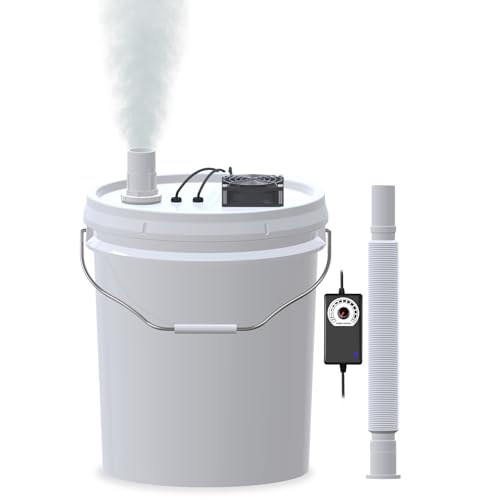
Consumer humidifiers are sized for bedrooms and are quickly overwhelmed by a greenhouse. A Yokekon 30 L Large Humidifier, 10 Atomizers ($209.99) with multiple atomisers is in a different output class and can hold humidity across a propagation area. A 19 L DIY Fogger Humidifier Kit, Dual Mist ($39.99) built for plant and mushroom propagation gives more output per pound again, at the cost of assembling it yourself.

Whatever you use, run it from a humidistat rather than a timer, so it responds to the actual condition. An Inkbird IHC-200 Humidity Controller ($42.99) does that job for either appliance.

Adding humidity without air movement invites botrytis

The same conditions that root a cutting also suit grey mould, and a propagation bench that is warm, wet and still will lose a batch. Keep gentle air movement across the bench, remove any leaf that has collapsed, and step humidity down as roots form rather than keeping the bench saturated until potting on.

What not to use either for

Neither is a summer cooling strategy for a whole greenhouse. Evaporative cooling can work at scale in a dry climate, but a consumer humidifier in a hot house in humid weather adds moisture without cooling and pushes the crop towards disease. Overheating is answered by shading and ventilation, in that order, and those are covered in cooling a greenhouse in summer.

The decision, summarised

  • Rooting cuttings: a pump-driven misting system on a short-cycle timer.
  • Germination and tropical crops needing ambient humidity: a high-output humidifier on a humidistat.
  • Hard water: brass nozzles, filtered water, and a cleaning schedule whichever you choose.
  • A hot greenhouse in summer: neither, shade and vent it.
  • Either one: gentle air movement across the bench, or you will lose the batch to botrytis.

Adding humidity, two ways

Propagation misting, ambient humidity, and the control both should run from.

Related on this site

Common questions

4 answers

+ How often should a propagation mister run?

Short bursts, frequently, during daylight hours, with the interval tuned so a film of water is maintained on the leaf without the media becoming waterlogged. A few seconds every several minutes is a common starting point, extended in bright warm conditions and reduced as cuttings root. Watch the cuttings and the media rather than fixing a schedule and leaving it.

+ Will a humidifier stop my greenhouse overheating?

Not meaningfully. Evaporative cooling does work in dry climates at scale, using a purpose-built cooler drawing air through a wet pad, but a room humidifier adds moisture without the airflow that makes evaporative cooling effective. In humid weather it makes conditions worse by raising disease pressure. Shade and ventilation are the answers to heat.

+ What about hard water and misting nozzles?

Hard water blocks fine nozzles and leaves white deposits on foliage, and it is the main maintenance burden of any misting system. Options are a filter, collected rainwater, or brass nozzles that tolerate deposits better and can be cleaned. Whatever you choose, build a periodic nozzle clean into the routine rather than waiting for a blocked line to kill a batch of cuttings.

+ Is high humidity bad for greenhouse crops?

It depends entirely on the crop and the stage. Cuttings and germinating seed want it high. Ripening fruit and most winter crops do not, because persistent high humidity with still air produces botrytis and mildew. The measure worth tracking is vapour pressure deficit rather than relative humidity alone, since the same relative humidity means different things at different temperatures.

Working out the figures for your own house and season? The Greenhouse Build & Growing Planner is the paid version of these pages: 8 printable worksheets you fill in with your own numbers, plus the full PDF, $29.