Calculator
Exhaust fan airflow required
The method this uses
This follows the sizing method published by the National Greenhouse Manufacturers Association, which is the standard reference for greenhouse ventilation: CFM equals floor area multiplied by 8, then multiplied by four correction factors.
The 8 is the multiplier for a house with an average internal height near 8 feet, and it is what produces the familiar rule of one complete air change per minute. The corrections adjust it for the conditions that make a house harder or easier to cool.
House length factor. Short houses need proportionally more airflow per square foot, because the two end walls are a larger share of the envelope and the air travels a shorter distance before exiting, giving it less time to pick up heat. The standard correction is the square root of 100 divided by the house length, applied to houses shorter than 100 feet, which every hobby greenhouse is.
Elevation factor. Air at altitude is less dense and carries less heat per cubic foot, so more of it must be moved to remove the same energy. The correction becomes worth applying above roughly 1,000 feet and is substantial by 5,000.
Light factor. The heat load is driven by the solar energy entering the house. A shaded house, a north-facing one or a house at a high latitude takes less, so it needs less airflow. Fitting shade cloth is the cheapest way to reduce this term, which is why shade belongs before fan capacity in any cooling budget.
Temperature rise factor. Four divided by the rise you will accept between the intake end and the fan end. The standard design figure is 4 degrees F, giving a factor of 1. Accepting a 7 degree rise reduces the required airflow considerably, and in a hobby house growing tolerant crops that is a reasonable trade.
Intake, which decides whether the fan works at all
The most common ventilation failure in hobby greenhouses is not fan size. It is a correctly sized fan fitted in one gable with no intake opening, pulling against a sealed structure.
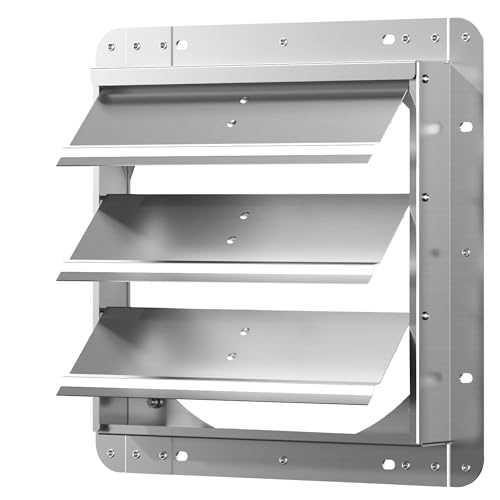
A fan cannot exhaust air that is not being replaced. The working rule is that intake area should be at least 1.25 times the fan face area, and more is better. A 12 inch fan has a face area of roughly 0.79 square feet, so it wants around 1 square foot of intake minimum. A louvered shutter vent is the standard solution, and louvers rather than an open hole so the intake seals when the fan is off.
Position matters as much as area. Intake low, exhaust high, at opposite ends of the house. Cool air enters at floor level, warms, rises and leaves at the ridge, which works with the stack effect rather than against it. Intake and exhaust at the same end short-circuits: the fan draws back the air it just expelled and the far end never ventilates.
Insect mesh over an intake is a large restriction and is frequently added without any allowance. Where mesh is fitted, the intake area needs increasing substantially, often by half again or more depending on the mesh. This is one of the most common reasons a system that was calculated correctly underperforms.
Passive ventilation, and why most kits fall short
Before powered extraction, a greenhouse should be able to ventilate itself passively for most of the year, and standard horticultural practice sets the target at roughly one fifth of floor area in total vent opening.
A 36 square foot house therefore wants around 7 square feet of opening. Essentially no hobby kit ships with that; a typical single roof vent is closer to 2 square feet. This is not a defect so much as a market reality, and it is why the builds on this site budget for a second vent or a low-level louvered intake as a matter of course.
The vent area should be split between high and low openings rather than concentrated in the roof. The stack effect requires both: warm air leaving at the ridge has to be replaced by cool air entering at low level, and a house with roof vents only is trying to breathe through a closed mouth. Adding a low louvre to a house that already has a roof vent frequently improves passive performance more than adding a second roof vent would.
Wax cylinder vent openers make passive venting automatic with no power at all, which handles the majority of days in most climates. The fan then covers the days passive flow cannot manage. The two are complements rather than alternatives, as set out in vent opener versus exhaust fan.
Cooling in cost order
Ventilation is one of four cooling stages and it is the third. Buying fan capacity before addressing the earlier stages is the common and expensive error.
Shade first. Shade cloth fitted outside the glazing removes solar energy before it enters, which no fan can do. It reduces the light factor in this calculation directly, and for fruiting crops 40 to 50 percent costs almost nothing in yield because photosynthesis saturates well below full summer sun. It has no running cost and no moving parts.
Passive venting second. Automatic openers plus a low-level intake use no power at all and handle most days.
Forced extraction third, which is what this calculator sizes.
Evaporative cooling fourth, and only where the climate is dry enough for it to work. In humid regions it adds moisture to a house where humidity is already the main disease driver and achieves very little cooling. The full sequence is in cooling a greenhouse in summer.
The other fan, which this calculator does not size
Exhaust ventilation exchanges air with the outside. A greenhouse also needs air moved inside it, and that is a different job requiring different equipment.
Every leaf sits inside a thin boundary layer of still, near-saturated air, and fungal spores germinate in that layer rather than in the room. A greenhouse can read a comfortable 70 percent relative humidity and still lose plants, because humidity at the leaf surface is far higher. Only air movement strips that layer away.
An internal circulation fan running continuously whenever the house is closed is the cheapest fungal disease control available. The target is gentle continuous leaf movement everywhere, roughly 0.5 to 1 mile per hour at canopy level, not a strong draught anywhere. It runs when the exhaust fan is off, which is most of the year. Covered in best circulation fans.
Building the ventilation system the number implies
-

-

Above about 500 CFM
iLIVING 14 in Wall-Mounted Shutter Exhaust Fan with Temperature and Humidity Controls
$115.99
-
-
