Skip to content
GreenhouseSetup
Menu

A heater built-in thermostat versus an external controller

The short answer

An external controller with a remote probe placed at plant height is worth buying even if your heater already has a thermostat. A built-in dial reads the air immediately around the appliance, which is warmer than the crop, so it switches off early and lets the far end of the house drop. An external controller with a tight differential also short-cycles less, and one unit can run both a heater and a fan on separate setpoints.

Where a built-in probe sits
Inside the appliance
Where the probe belongs
At plant height, mid house
Dual-output controllers
Heat and cool from one unit
Capacity check
Match the relay rating to the load

Researched from published specifications and verified owner reviews · Updated 2026-08-16

Every heated greenhouse has a control problem before it has a heating problem. The heat is being supplied to a long thin space with cold surfaces at both ends, and the temperature at the appliance bears very little relation to the temperature at the far bench.

A built-in thermostat is inside the appliance, which is the warmest point in the house whenever the heater is running. It therefore satisfies early.

The comparison

Figure 1. Built-in thermostat against an external controller · 7 rows
Figure 1. Built-in thermostat against an external controller
MeasureBuilt-in thermostatExternal controller
Probe location Inside the appliance Wherever you place it
Measures the crop temperature No Yes, if sited at plant height
Setpoint precision A dial, often unnumbered Digital, to a degree
Differential control Fixed and usually wide Adjustable
Runs a fan as well No Dual-output models do
Extra cost None Modest
Works with any heater Not applicable Yes, within the relay rating
Researched general information rather than professional advice. Match the controller rating to the connected load.

Where to put the probe

At plant height, in the body of the house, out of direct sun and away from the heater outlet. A probe in the sun reads the sun rather than the air; a probe next to the heater reads the heater. A probe hanging above the crop in the middle of the house reads roughly what the crop experiences, which is the point.

An Inkbird ITC-308 Digital Temperature Controller ($36.00) has two relay outlets, one for heating and one for cooling, so a single box can run the heater on the low setpoint and the extract fan on the high one. That means the heater is not fighting the fan, which is a genuinely common and expensive mistake when both have their own separate thermostats.

Rating, and the mistake worth avoiding

Controllers are rated for a maximum load, and a 1500 W heater draws about 12.5 amps. A bayite BTC211 Temperature Controller, 1650 W ($39.99) rated 1650 W has almost no headroom above that, which is fine for exactly one 1500 W heater and nothing else on the same outlet. Check the rating against the connected load rather than assuming, and never run two heaters through one controller outlet.

If you would rather not assemble a controller and a heater separately, a bundled unit such as a Greenhouse Heater with Digital Thermostat Control Kit ($89.99) at least cycles on a setpoint rather than running flat out, which is better than an uncontrolled heater even if the probe placement is still not ideal.

Note

A tight differential is not always the goal

A very narrow differential makes the heater switch on and off frequently, which is hard on relays and on the appliance. A degree or two of differential is usually a sensible compromise between temperature stability and short cycling. Set the minimum you actually need rather than the one that feels safe, because every degree above the real requirement costs money on every cold night.

Humidity deserves its own controller

Temperature is only half the winter problem. Running an extract fan on a humidistat such as an Inkbird IHC-200 Humidity Controller ($42.99) vents the house when moisture rises rather than on a timer, which is the difference between controlling botrytis and merely losing heat on a schedule. That is covered in humidity and disease control.

The decision, summarised

  • Any heated greenhouse: an external controller, probe at plant height.
  • A heater and a fan both running: a dual-output controller so they share one setpoint scheme.
  • One 1500 W heater and nothing else: a single-output controller is sufficient, check the rating.
  • Winter disease problems rather than cold: add a humidistat on the extract fan.
  • Before buying either: confirm what the house actually needs to hold, because the setpoint costs more than the hardware.

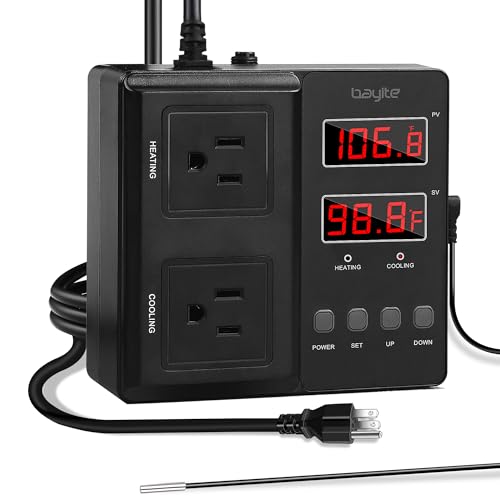
Controllers by job

Dual output, single output, humidity, and the bundled option for anyone who wants one box.

Related on this site

Common questions

4 answers

+ Where exactly should the temperature probe go?

At the height of the plants, roughly in the middle of the house, out of direct sunlight and away from the heater outlet and from cold glazing. Shielding it from direct sun matters, because a probe in a sunbeam reads far higher than the surrounding air and will hold the heater off while the crop is cold. Secure it so it cannot fall onto a bench or into a tray.

+ Can one controller run a heater and an extract fan?

A dual-output controller can, with the heating outlet set to a low temperature and the cooling outlet to a higher one, and that arrangement stops the two appliances fighting each other. Keep a sensible gap between the setpoints, because a narrow gap has the heater and the fan cycling against one another and wastes a great deal of energy.

+ What minimum temperature should a greenhouse be held at?

It depends on what is growing. Frost free, around 40 degrees Fahrenheit, is enough to overwinter many hardy plants and costs far less than holding 50 degrees for active winter growing. Every degree above what the crop needs is paid for on every cold night, so set the minimum by the crop and check it against the tolerance chart rather than choosing a comfortable round number.

+ Do I need a controller if the heater already has a digital thermostat?

A digital thermostat is better than a dial, but the probe is still inside the appliance and still reads air the heater has just warmed. An external probe at plant height is measuring the thing you care about. If the heater has a remote probe input, use it. If not, an external controller is a modest cost against a winter of heating.

Working out the figures for your own house and season? The Greenhouse Build & Growing Planner is the paid version of these pages: 8 printable worksheets you fill in with your own numbers, plus the full PDF, $29.