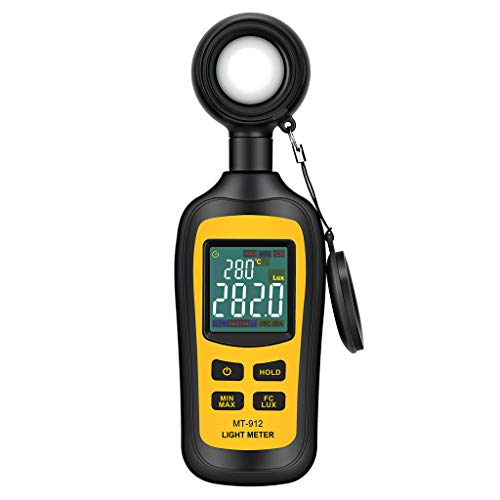
A quantum PAR meter reads PPFD in micromoles per square metre per second, which is the unit crop light requirements are written in, so it answers the question directly. A lux meter measures illuminance weighted to human vision, which peaks in the green that plants use least, so its readings must be converted with a factor specific to the light source and are meaningless across mixed sources. For a single known fixture a lux meter is genuinely useful. For comparing daylight against LEDs it is not.
PAR meter unit
PPFD, micromoles per m2 per second
Lux meter unit
Lux, weighted to human vision
Conversion factor
Different for every light source
Seedling target
Roughly 200 to 400 PPFD
Researched from published specifications and verified owner reviews · Updated 2026-08-16
Both instruments measure light. They weight it differently, and that weighting is the entire difference.
A lux meter is built to match the human eye, which is most sensitive to green light around 555 nanometres. Plants are least efficient in exactly that band and do most of their photosynthesis in blue and red. So a lux meter systematically overreads sources rich in green and underreads sources rich in red, which is precisely the difference between daylight and a red-heavy LED fixture.
The comparison
Figure 1. Quantum PAR meter against lux meter·7 rows
Figure 1. Quantum PAR meter against lux meter
Measure
PAR meter
Lux meter
What it weights for
Photosynthetically active radiation
Human eye response
Output unit
PPFD in micromoles per m2 per second
Lux
Directly comparable to crop targets
Yes
Only after conversion
Valid across different light sources
Yes
No, factor changes per source
Compares daylight with LED honestly
Yes
No
Useful for tracking one fixture over time
Yes
Yes
Typical cost
Several times higher
Low
Researched general information rather than professional advice.
Where a lux meter is genuinely useful
Within one light source, a lux meter is a perfectly good relative instrument. A URCERI Digital Lux Light Meter ($29.98) will tell you that the corner of your bench receives a third of what the middle does, that a fixture has dimmed over two seasons, and that the shade cloth is cutting more than you expected. Those are useful answers and none of them need an absolute unit.
What it cannot honestly do is tell you whether your LED fixture is delivering the PPFD a crop needs, or let you compare a bright winter day against your lamps. The conversion factor between lux and PPFD is specific to the spectrum of the source, and using a single number across different sources produces confidently wrong answers.
What a PAR meter buys
A quantum sensor such as a DANOPLUS Quantum PAR Meter, PPFD Tester ($79.99) reads in the unit the horticultural literature uses, so a reading maps straight onto published requirements. Take readings at leaf height across the tray, note the lowest one, and feed the intensity and your run hours into the DLI and PPFD calculator to get the daily light integral. Compare that against the DLI targets by crop.
The most common thing a PAR meter reveals is that a fixture is fine and hung too far away. The second is that the edges of a tray receive half what the centre does, which explains why the outer rows always stretch.
Note
Neither instrument is a substitute for looking at the plants
Stretching between the leaves means not enough light. Bleached or bronzed leaf tips directly under a fixture mean too much or too close. Both signals appear before any meter would prompt you to check, and both are free to read. A meter tells you by how much, which is what makes it worth owning once you already know something is wrong.
The decision, summarised
Checking whether an LED fixture meets a crop target: PAR meter, nothing else answers it.
Comparing daylight, shade cloth and lamps on one scale: PAR meter.
Mapping bright and dim spots under one fixture: a lux meter is fine and costs a third as much.
Tracking whether a fixture has faded over seasons: either, provided you always use the same one.
Growing on a windowsill with no supplementary light: neither, spend it on lights.
Measuring light, at two prices
The instrument that answers the question, and the cheaper one that answers a narrower version of it.
Only with a conversion factor specific to the exact light source, because the ratio between what the eye sees and what a plant uses changes with spectrum. Factors published for daylight, for white LEDs and for red-heavy fixtures all differ. Applying one factor across different sources produces answers that look precise and are not, which is the main reason the cheap meter gets misused.
+- Is a phone light meter app any use?
For very rough relative comparisons in one place under one source, sometimes. Phone sensors are not calibrated for this, they sit behind a cover glass with its own transmission curve, and readings vary between handsets. Treat an app as a way of noticing that one end of a bench is darker, not as a measurement.
+- What PPFD do seedlings need?
Broadly in the region of 200 to 400 micromoles per square metre per second over a 14 to 16 hour day for most vegetable and flower seedlings, with fruiting crops wanting considerably more once they are growing on. The more useful target is the daily light integral, since intensity and hours trade off against each other, and the crop chart gives figures for the common greenhouse crops.
+- Where should I take the reading?
At the top of the canopy, not at the bench surface, and at several points across the tray rather than one. The number that matters is the lowest reading any plant receives, because that is the plant that will stretch. Repeat the exercise after every change of hanging height and after adding shade cloth.
Working out the figures for your own house and season? The Greenhouse Build & Growing Planner is the
paid version of these pages: 8 printable worksheets you fill in with your own
numbers, plus the full PDF, $29.