The two products look similar in the bag and behave very differently in a tray. A seed-starting mix is milled fine so that a small seed sits in contact with the media on all sides, it drains freely so the surface can dry, and it contains very little nutrient. A potting mix is coarser, holds more water, and carries a fertiliser charge intended to feed a plant for several weeks.
Almost every problem caused by mixing them up runs in one direction: sowing into a fed potting mix.
The comparison
| Measure | Seed-starting mix | Potting mix |
|---|---|---|
| Particle size | Fine, sieved | Coarse, with bark or perlite |
| Nutrient charge | Very low or none | Weeks of feed included |
| Water holding | Moderate, drains fast | High |
| Risk under small seed | Low | Salt stress, poor germination |
| Surface crusting | Low | Higher |
| Use for potting on | No, too lean | Yes |
| Use for grow bags and beds | No | Yes, or a container mix |
| Typical cost per litre | Lower | Higher |
What goes wrong when you sow into potting mix
Three things, in order of how often they happen. Fertiliser salts around a germinating seed can inhibit germination and burn the first root. The coarser texture leaves air pockets against small seed, so germination is patchy. And the higher nutrient level produces fast soft growth that goes leggy under insufficient light, which is exactly the failure most people blame on their lamps.
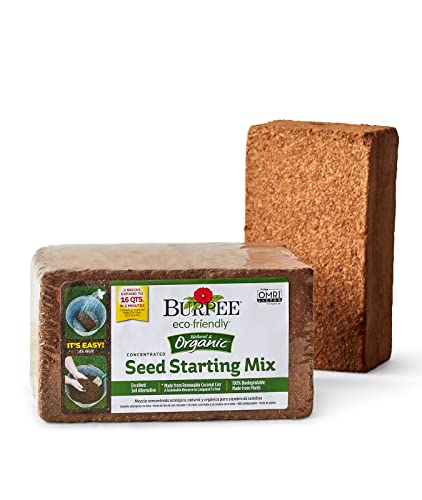
A fine, lean mix such as a Burpee Organic Coconut Coir Seed Starting Mix, 16 qt Expanded ($10.39) avoids all three. It expands from a compressed brick, which is also considerably less bulky to store than bagged compost.
When to switch
The seed leaves, the cotyledons, run on the seed's own reserve. Once the first true leaves open the plant is photosynthesising and needs feeding, and a lean mix stops being an advantage. That is the point to pot on into a fed mix such as a Burpee Premium Organic Potting Mix, 9 qt ($14.95), or to begin a dilute liquid feed if the plant is staying in its cell for another week or two.
Seedlings held in a lean mix past that point go pale from the oldest leaves inwards and simply stop. That is a hunger signal, not a disease, and it is easy to misread.
Containers and beds are a third category
Neither mix suits a plant that will spend its whole life in a container. A tomato in a grow bag needs a heavily amended, well aerated container mix such as FoxFarm Ocean Forest Potting Soil, 1.5 cu ft ($35.63), with far more nutrient and structure than a potting mix intended for a few weeks in a 9 cm pot. Garden soil in a container is a different mistake again: it compacts, drains badly and brings weed seed and pathogens in with it.
The decision, summarised
- Sowing anything: a fine, lean seed-starting mix, every time.
- Potting on a seedling with true leaves: a fed potting mix, or start a dilute liquid feed.
- Grow bags and long-term containers: a heavily amended container mix, not a potting mix.
- Filling a greenhouse bed: a soil-based blend, calculated by volume, not bagged potting compost.
- Seedlings going pale from the oldest leaves: they are hungry rather than sick, feed or pot on.