Growing media is the part of greenhouse practice most often treated as interchangeable, and it is where a surprising share of failures start. Seed sown into coarse potting soil germinates unevenly. Established plants in fine seed mix suffocate. A bed filled with bagged container mix slumps and drains badly by the second season. Three different jobs, three different products.
Under cover the stakes are higher than outdoors, because the medium is doing more of the work. There is no rain to leach it, no worm traffic to reopen it, and often a fraction of the root volume an outdoor plant would have.
The property that actually matters
Roots need water and they need oxygen, and a medium has to hold both at once. The measure of that balance is air-filled porosity: the proportion of the volume that is air once the medium has been saturated and allowed to drain freely.
Somewhere between 15 and 25 percent is the working target for most container growing. Below about 10 percent, roots are effectively in standing water and root rot becomes a matter of time. Above about 30 percent the medium dries too fast to be practical outside a misted propagation bench.
Two counter-intuitive consequences follow, and both explain problems people blame on other things. First, a shallow container of the same medium is wetter at the bottom than a deep one, because the height of the water column determines how much drains out. This is why a 2 inch plug tray goes anaerobic in a mix that behaves perfectly in a 6 inch pot. Second, adding a layer of gravel to the bottom of a pot makes drainage worse rather than better, because water does not cross the boundary between two different materials until the finer one above is saturated.
The three media
| Job | Texture | Nutrients | Typical composition |
|---|---|---|---|
| Seed starting | Fine and uniform, no lumps | Very low | Peat or coir with fine perlite or vermiculite, sterile |
| Potting on and containers | Medium, some structure | Charged with a starter feed | Peat or coir, bark or compost, perlite for air |
| Long-term containers and grow bags | Coarser, holds structure for a season | Slow release, often with amendments | Compost, bark, coir, grit or perlite |
| Greenhouse bed fill | Coarsest, soil based | Moderate, topped with compost annually | Roughly half loam, a third compost, the rest grit or bark |
| Rooting cuttings | Very open and free draining | None at all | Perlite, sharp sand or a coir and perlite blend |
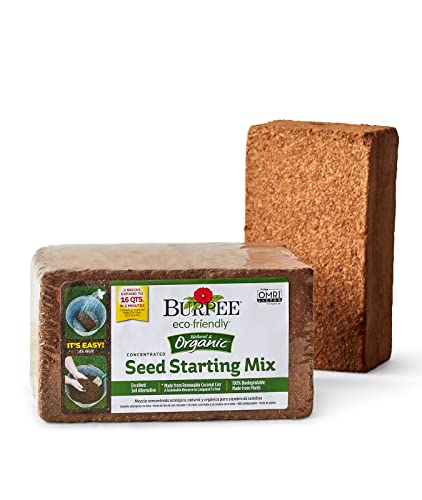
Seed starting mix is fine, uniform, sterile and deliberately low in nutrients. Seed carries its own reserves and does not need feeding until the first true leaves. A Burpee Organic Coconut Coir Seed Starting Mix, 16 qt Expanded ($10.39) is a straightforward coir-based example, and the fineness matters as much as the sterility: a lump in a plug cell means a seed that never makes contact with moist medium.
Potting mix is coarser, holds structure longer and carries a starter charge of nutrients. A Burpee Premium Organic Potting Mix, 9 qt ($14.95) suits potting on seedlings and general container work, and a richer mix such as FoxFarm Ocean Forest Potting Soil, 1.5 cu ft ($35.63) suits hungry crops in larger containers where the plant will stay for a whole season.
Bed fill is soil-based, because a large volume of pure container mix is both expensive and structurally poor at depth. The proportions and the reasoning are in raised beds inside a greenhouse, and the quantity is worked out with the soil volume calculator.
The components, and what each one does
- Peat. Holds a great deal of water, is naturally low in nutrients and slightly acidic, and has excellent structure for germination. It is also a slowly renewing resource and increasingly restricted in some markets, which is why coir has grown so quickly.
- Coir. Coconut husk fibre, which behaves similarly to peat with slightly better rewetting once dry. Sold compressed, and it expands to roughly five to six times its dry volume, which makes Gro-Med Organic Coco Coir Seed Starter Pellets, 35 mm, 50-Pack ($10.99) and compressed blocks very efficient to store and ship. It can carry salts from processing, so a product described as washed or low-EC is worth the small premium.
- Perlite. Expanded volcanic glass. It holds no water internally and exists purely to create air space. This is the component to add when a mix is too wet, and it is the main constituent of a rooting medium.
- Vermiculite. Expanded mica, which holds water and nutrients rather than air. Useful as a fine covering over sown seed, where it keeps the surface moist without crusting.
- Compost. Supplies nutrients, biology and structure, and it is the annual top-up for a bed. Quality varies enormously, and immature compost can lock up nitrogen as it finishes breaking down.
- Grit and coarse sand. Adds weight and drainage. Weight matters for tall plants in small pots, which otherwise blow over in a ventilated house.
- Bark. Slow to break down, so it holds structure for a long time in a container that will not be repotted for a season or more.
pH, and why it matters more under cover
pH does not feed a plant. It decides which nutrients are chemically available to be taken up, and the band where most are simultaneously available is roughly 6.0 to 6.8 for vegetables in soil, and slightly lower, around 5.5 to 6.5, for peat and coir based container media.
Outside that band, nutrient availability rather than nutrient supply becomes the limit, which is why feeding a plant in the wrong pH often does nothing. Iron and manganese lock up as pH rises, phosphorus becomes less available at both extremes, and the classic symptom is interveinal yellowing on new growth in a plant that is being fed perfectly well.
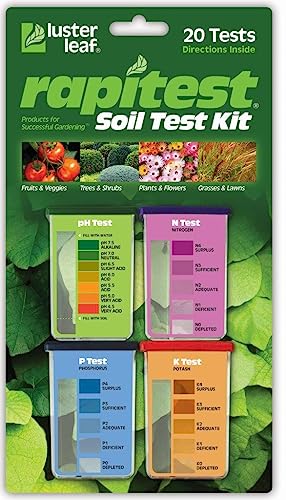
Under cover this drifts faster than outdoors, because hard tap water is mildly alkaline and there is no rain to counteract it. A simple SONKIR MS02 3-in-1 Soil Moisture, Light and pH Meter ($9.99) gives an indication, and a chemical Luster Leaf Rapitest Soil Test Kit ($15.99) gives a more reliable reading along with a rough nutrient picture. Test a permanent bed annually rather than never.
Reusing medium, and when not to
Fresh medium every time is the safest practice and the most expensive one. The honest middle ground depends on what the medium was doing.
- Seed trays: never reuse. The economics are trivial, the damping off risk is real, and a tray of collapsed seedlings costs a season rather than a few dollars.
- Container mix from a healthy plant: reuse once, refreshed. Break it up, mix roughly a third fresh material and some compost into it, and use it for something less demanding than what it grew before.
- Anything that grew a diseased plant: discard. Root rot organisms and soilborne wilts persist in medium, and reusing it moves the problem to the next crop.
- Bed soil: top up rather than replace. An annual inch or two of compost worked into the surface maintains a bed indefinitely, with the caveats about salt and pathogen accumulation covered in the raised beds guide.
- Spent medium is good soil improver. Even medium too tired for containers is useful worked into open ground outside, where rain and biology will finish it off.
Media and testing


Media choice interacts with watering more than with anything else: an open mix forgives overwatering and punishes neglect, and a dense one does the reverse. Set the two together using watering in a greenhouse.