Growing under cover concentrates pests rather than introducing new ones. The species are the same ones present outside; what changes is everything holding them in check. There is no rain to knock aphids off leaves. There is no wind. There is a much smaller predator population, because predators arrive later than prey and a closed structure slows their arrival further. And there is no winter, so a population that would be reset by frost outdoors simply continues.
The practical consequence is that greenhouse pest management is a monitoring discipline rather than a treatment discipline. Populations that are trivial to control when small are extremely difficult to control when large, and the difference between those two states is often two weeks of not looking.
The main pests and what each one tells you
| Pest | What you see | Conditions it likes | What works |
|---|---|---|---|
| Aphids | Clusters on new growth, sticky honeydew, distorted tips | Soft lush growth, high nitrogen, warm still air | Squash by hand early, insecticidal soap, ladybirds and parasitic wasps, and less nitrogen |
| Greenhouse whitefly | Tiny white insects rising in clouds when disturbed | Warm conditions and a continuous host, which a greenhouse provides year round | Yellow sticky traps for monitoring, biological control with parasitic wasps, and a break in host continuity |
| Two-spotted spider mite | Fine stippling, bronzed leaves, webbing in bad cases | Hot dry air, above 80 degF and below 50 percent humidity | Raise humidity, damp down, predatory mites introduced early, and remove badly infested leaves |
| Thrips | Silvery streaks on leaves, distorted flowers, black specks | Warm dry conditions, and they arrive on bought-in plants | Blue sticky traps, predatory mites, and quarantining new plants |
| Fungus gnats | Small dark flies over the medium surface | Constantly wet medium surface, especially in propagation | Let the surface dry between waterings, yellow sticky traps, and bottom watering |
| Slugs and snails | Irregular holes, silvery trails, seedlings gone overnight | Damp floor, hiding places under trays, pots and benches | Remove damp hiding places, hand collect after dark, keep trays off the floor |
| Vine weevil | Notched leaf edges, sudden collapse of a potted plant | Container plants left undisturbed for a season or more | Check root balls when repotting, biological nematode drenches |
| Caterpillars | Large holes and visible frass | A moth got in through an open vent | Insect mesh on vents, hand removal, targeted biological products |
Two rows repay a second look. Spider mite is a hot dry air problem, which means the same summer conditions that stress the crop also favour the pest, and damping down the floor addresses both at once. And fungus gnats are a watering problem wearing an insect costume: a medium surface that dries between waterings does not support them.
Monitoring, which is most of the job
Sticky traps are not a control. They catch a trivial fraction of a population and will never clear an infestation. What they do is tell you a pest has arrived while the number is still small, which is when everything else works.
Hang Yellow Sticky Traps, 36-Pack ($12.99) just above the canopy from the start of the season, one per few square yards, and move them up as the crop grows. Yellow attracts whitefly, aphids and fungus gnats. Check them weekly and write down the count, because the trend matters far more than the number: five whitefly this week and forty next week is an emerging problem, while a steady five is background.
Add a weekly inspection of leaf undersides on a few plants, since that is where mite and whitefly live and the traps will not show mite at all. A hand lens makes spider mite obvious two weeks before the stippling does.
Biological control, which suits greenhouses specifically
Biological control works better under cover than outdoors, for the same reason pests do: the enclosed environment keeps the introduced organism where you put it. A predator released outdoors disperses; one released in a greenhouse stays.
The requirements are strict, though. Introduce early, on a small population, because predators need prey to establish and a large outbreak overwhelms them. Introduce at the right temperature, since most predatory species have a working range. And do not use a broad-spectrum insecticide before or after, because it kills the control as effectively as the pest.
- Ladybirds such as Live Ladybugs, 3,000 Count ($15.00) for aphids. Release at dusk onto damp foliage so they settle rather than dispersing, and only where there is already an aphid population for them to work on.
- Predatory mites for spider mite and thrips. These are the most reliable greenhouse biological control there is, and they need introducing at the first sign rather than at the first damage.
- Parasitic wasps for whitefly. Slow to show an effect and very effective once established, which is why they are a season-long strategy rather than a response.
- Nematode drenches for vine weevil larvae and fungus gnat larvae, applied to the medium at the temperatures the product specifies.
When something has to be applied
Where a population has got away, the least disruptive products come first.
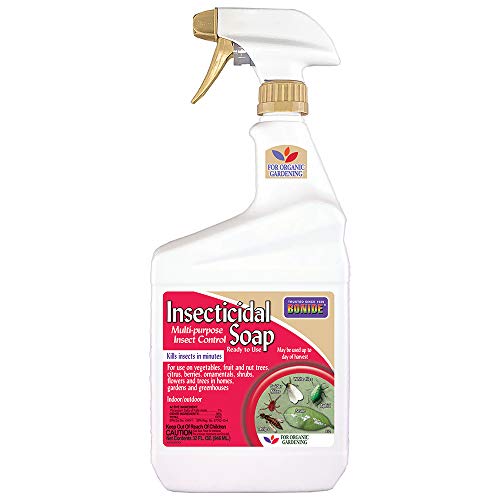
Bonide Insecticidal Soap, 32 oz Ready-to-Use works by physical contact and has no residual activity, which means it must actually hit the pest, particularly on leaf undersides, and it does relatively little damage to a biological control programme afterwards. It is the standard first response for aphids and a useful knockdown for whitefly.
Bonide Captain Jack's Neem Max Concentrate, 16 oz acts as a growth regulator and antifeedant rather than a contact killer, so it is slower and works on the population rather than the individual. Both are labelled for use on edible crops, and both should be applied exactly as the label directs, including the interval before harvest.
Two cautions specific to growing under cover. Applying anything in a closed structure concentrates it in the air you are breathing, so ventilate and follow the personal protection the label states. And anything applied to a flowering crop reaches pollinators in an enclosed space, which matters if bumblebees are doing the pollination described in pollination in a greenhouse. This is researched general information rather than professional pest control advice; follow the label, which is the legally binding instruction.
The structural measures that prevent most of it
- Screen the vents rather than the doors. Fine Ultra-Fine Garden Mesh Insect Netting, 10 x 50 ft ($27.99) over roof and side vents keeps most flying pests out while leaving the door as a working entrance. Screening everything also excludes pollinators, which is a poor trade in a house full of fruiting crops.
- Clear plant debris continuously. Dead leaves under a bench are both a disease reservoir and a slug hotel. This is the highest-value five minutes anyone spends in a greenhouse.
- Break host continuity. Whitefly and aphids persist year round because there is always something green. A few weeks with the house empty of susceptible crops interrupts several life cycles at once.
- Keep weeds out. A weed in a greenhouse grows all year and hosts pests while it does so, which is why weed fabric under the floor is a pest measure as much as a tidiness one.
- Keep trays off the floor. Staging removes the permanently damp gap where slugs live, and it makes leaf undersides visible without kneeling.
- Manage nitrogen. Soft, lush, over-fed growth is what aphids are looking for. Feeding less in a bed that never leaches produces tougher growth and fewer aphids.
Monitoring and control



Pests and disease share the same underlying cause, which is a closed environment with no weather in it. The disease half is in humidity and disease control, and the end-of-season measure that resets both is in cleaning and the season reset.