Calculator
Heat units accumulated and days to maturity
Why heat units beat calendar days
Plant development is driven by accumulated temperature rather than by elapsed time. A tomato does not know what date it is; it responds to how much warmth it has experienced. This is why the same variety, sown on the same date, matures weeks apart in a cool season and a warm one.
Growing degree days quantify that. Each day contributes the amount by which the average temperature exceeded a crop-specific base below which development effectively stops. Accumulate those daily contributions and you have a measure of how much developmental progress the crop has actually made.
The practical value is prediction. If a variety is known to mature at around 1,200 GDD, tracking accumulation tells you roughly when it will be ready regardless of how the season is running, which a calendar cannot. It also explains failures retrospectively: a crop that did not ripen was frequently short of heat units rather than short of anything you could have added.
In a greenhouse this becomes a genuine planning tool rather than a curiosity, because a heated house accumulates GDD faster than the outdoors and lets you quantify exactly how much earlier a crop will finish.
The calculation and its base temperatures
The standard averaging method takes the daily maximum and minimum, averages them, and subtracts the base temperature. If the result is negative, the day contributes zero rather than a negative value, because cold does not undo development.
Two refinements are applied in the version here. An upper cutoff, conventionally 86 degrees F for most vegetables, caps the maximum used in the average, because development does not continue to accelerate above that and in many crops it actively slows. A lower bound holds the minimum at the base temperature rather than letting a cold night pull the average below it.
Base temperature by crop group. Warm-season crops, including tomatoes, peppers, eggplant, cucumbers, squash, melons and beans, use a base of 50 degrees F. Cool-season crops including brassicas, lettuce, spinach, peas and root vegetables use 40. Sweet corn conventionally uses 50. These bases are the temperature below which measurable development stops for that crop group, and using the wrong one produces a number that does not correspond to anything.
Because different crops use different bases, GDD figures are only comparable within a base. A statement that a crop needs 1,200 GDD is meaningless without knowing which base it was calculated at.
Using GDD in a greenhouse
A greenhouse changes the temperature the crop experiences, which changes the rate of accumulation directly. Three practical applications follow.
Quantifying what protection buys. A house running 10 degrees F above ambient overnight and warmer during the day accumulates GDD substantially faster than the outdoors. Tracking both, using a max-min thermometer inside and published outdoor data, shows exactly how many days of season the structure is worth in your climate, which is a far better answer than a general rule.
Deciding whether a late crop will finish. If a variety needs 1,000 GDD and your house accumulates roughly 12 per day in fall, that crop needs about 83 days, and if there are only 60 left before light becomes limiting, it will not finish. This is the calculation that prevents a whole bed being committed to something that cannot mature.
Setting the heating target rationally. Raising a greenhouse minimum increases GDD accumulation, and that increase can be weighed against the heating cost. Frequently the answer is that a few extra degrees overnight buys very little developmental progress relative to what it costs, because the daily average moves less than the minimum does, and this is a genuine argument for holding a house frost-free rather than warm.
Where GDD is genuinely useful, and where it is not
GDD is a good model of development, and like every model it has boundaries.
It works well for predicting maturity in crops whose development is primarily heat driven, for comparing seasons, for timing successions, and for anticipating pest life cycles. That last use is underappreciated: many insect pests develop on heat units too, and extension services publish GDD thresholds for pest emergence that let you time monitoring rather than react to damage.
It works poorly where something other than heat is the limiting factor. In a midwinter greenhouse, light is limiting, and accumulating heat units against a crop that has no light to photosynthesize with predicts nothing useful. It also does not capture water stress, nutrient deficiency, day length responses such as bolting, or vernalization requirements in biennials.
The honest framing is that GDD tells you how much developmental opportunity the crop has had. Whether the crop used that opportunity depends on everything else being adequate, which is the grower's job rather than the model's.
Tracking it in practice
Accumulating GDD requires a daily maximum and minimum, which is exactly what a max-min thermometer records and what most growers already have.
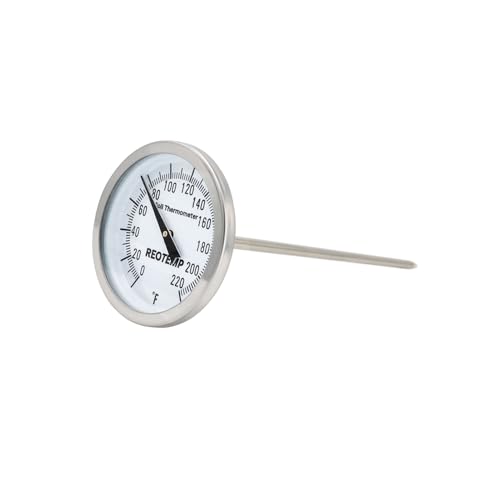
A mechanical max-min thermometer reset each morning gives both figures with no power and no dependency. A logging hygrometer gives the same figures automatically along with a full temperature history, which makes retrospective analysis possible rather than requiring daily discipline.
For outdoor comparison, your nearest weather station data serves. Many state extension services publish accumulated GDD for their region directly, which saves the arithmetic and provides a regional benchmark to compare your own structure against.
Recording it alongside sowing dates and varieties on plant labels and in a notebook turns one season of observation into a planning tool for every season afterwards, which is the actual payoff. A grower who knows their own greenhouse accumulates a given number of GDD in a typical season can plan varieties against that figure with confidence.