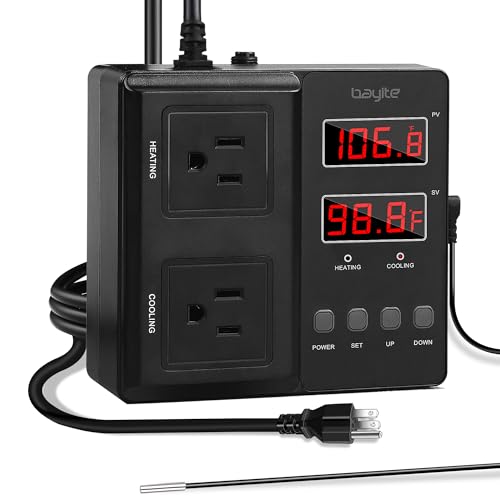
The best greenhouse controller for almost every hobby setup is the Inkbird ITC-308 at roughly $35: it has separate heating and cooling outlets, a remote probe you place at canopy height, a settable differential that stops short-cycling, and it will drive a heater and an exhaust fan from one unit. Add an Inkbird IHC-200 if humidity control matters, and use two ITC-308 units to stage a small and a large heater.
Controllers compared
4
Typical price
$25 to $40
Right differential
2 to 3 F
Probe placement
Canopy height, shaded
Researched from published specifications and verified owner reviews · Updated 2026-08-16
A thirty dollar controller changes a greenhouse more than a three hundred dollar heater does. The heater sets a ceiling on what is possible; the controller determines whether the house actually spends its nights at the temperature you intended rather than swinging ten degrees either side of it.
For almost every hobby setup the answer is the Inkbird ITC-308 at around $35, because it has separate heating and cooling outlets and a probe you place where the plants are rather than inside an appliance.
Two independent switched outlets, one for heating and one for cooling, a remote temperature probe on a lead so it sits at canopy height rather than inside a heater casing, and a settable differential so the heater is not cycling every ninety seconds. That combination means one unit runs both the heater at a low setpoint and the exhaust fan at a high one, which is the entire climate control system of a hobby greenhouse in a single box. It is also the component you can buy twice to build genuine two-stage heating.
Inkbird IHC-200 Humidity Controller ($42.99). The humidity equivalent, with the same two-outlet arrangement, for driving a circulation fan or extraction when relative humidity climbs past the level where disease becomes likely.
Why the built-in thermostat is not enough
Nearly every greenhouse heater has a thermostat, and nearly every one has the same three problems.
The sensor is in the wrong place. It sits inside the heater casing, in the airflow of its own element. That is the least representative point in the building. The heater warms its own sensor, satisfies itself and shuts off while the far end of the house is still cold, then cools, restarts, and repeats. The result is a house that is warm near the heater and cold everywhere else, with the thermostat reporting success.
There is no number. Built-in thermostats are usually bimetallic dials marked with a series of dots or a range from one to five. You cannot set 42 degrees F. You can set "somewhere around the third dot", discover what that means empirically over a fortnight, and hope it does not drift.
The differential is fixed and usually wrong. Differential is the gap between the temperature at which the device switches on and the temperature at which it switches off. Too narrow and the heater short-cycles, wearing the relay and the element and swinging the house. Too wide and the temperature roams. On a built-in thermostat it is whatever the manufacturer chose.
An external controller fixes all three for around thirty dollars, which is why it appears in every build on this site including the one with no greenhouse in it.
The three tiers
Controllers in three tiers
3 tiers · priced at the time of writing
Beginner
A single heater or a single mat, where you want a real setpoint and nothing more.
A dual-outlet digital temperature controller with a probe, which covers the fundamental job: put the sensor where the plants are and set an actual number. For a small house running one heater, or a propagation bench running mats, this does everything that matters at the lowest price in the category.
The trade-off:
Fewer configuration options and a less refined interface than the Inkbird units. If you expect to add a second stage or want fine control over the differential and compressor delay, you will replace it rather than extend it.
Separate heating and cooling outlets mean one unit holds a floor with the heater and a ceiling with the exhaust fan, with a dead band between them so the two never fight. The remote probe, the settable differential and a compressor delay to protect equipment are all present. At this price it is the default rather than an upgrade, and two of them build a staged system.
The trade-off:
It is a plug-in box that must live somewhere dry in a wet building, so it needs a sheltered position or an enclosure. It also switches line voltage through its outlets, so the total load on each outlet has to respect its rating.
Humidity, not temperature, is what usually decides whether a winter greenhouse loses crops to botrytis and mildew. This controls to a relative humidity setpoint with the same two-outlet arrangement, so it can run a circulation fan or an extraction fan whenever humidity climbs past the threshold where spore germination becomes likely. Paired with a temperature controller it is a genuine climate system.
The trade-off:
It addresses the second problem rather than the first, so it belongs alongside a temperature controller rather than instead of one. Humidity control in a leaky structure also fights the outdoors to some degree, so expect it to manage the problem rather than eliminate it.
Four settings decide whether a controller helps or merely reports.
Probe placement. At canopy height, in the middle of the growing area, shaded from direct sun and away from the heater outlet. A probe in direct sun reads the sun rather than the air and will shut the heater off on a cold sunny afternoon while the far corner is freezing. Shielding it inside a small white tube or under a bench edge is enough.
Differential. Two to three degrees F is right for a greenhouse. Narrower than that and the heater short-cycles constantly, which wears the relay and achieves nothing, because the thermal mass in the house smooths the swing far more than the number suggests. Wider than about five degrees and you get a genuine roam.
Dead band between heating and cooling. If the heater is set to hold 40 F and the fan to start at 42, they will fight on any mild afternoon. Leave a wide gap: heat at 40, cool at 80. The house is supposed to swing between those two figures, and a swing is not a fault.
Compressor or restart delay. Set a few minutes. This exists to protect equipment from rapid restart cycling, and while it matters most for refrigeration it is worth having on any motor load such as an exhaust fan.
Field tip
Two cheap controllers beat one expensive one
Genuine two-stage heating is available from two ITC-308 units for under seventy dollars. Set the first to hold your target and drive a smaller heater. Set the second one or two degrees lower and drive a larger heater, so the big unit only engages when the small one has already failed to keep up. You get finer control at mild temperatures, much less short-cycling, and redundancy on the one night of the year a single point of failure would cost you the crop. This is what the expert build does.
What a controller cannot fix
A controller switches equipment on and off. It cannot create capacity that is not there, and three problems get misdiagnosed as control problems.
An undersized heater. If the heater cannot deliver the BTU the envelope loses, the controller will simply leave it on continuously while the temperature falls. The symptom is a heater that never cycles off on cold nights. That is a sizing problem, and it is solved in the heater BTU calculator rather than in the controller menu.
Poor air distribution. A house with a ten degree difference between one end and the other does not have a control problem, it has a circulation problem. The fix is a small internal fan running continuously, not a different thermostat. This is also why probe placement matters so much: the controller can only manage the temperature at the probe.
A leaky envelope. Air infiltration through door gaps, vent seals and panel joints commonly adds 10 to 25 percent to the real heat loss of a hobby structure. No controller addresses that. Sealing does, and cheaply. See insulating a greenhouse.
Timers, which are a different tool
Timers control on a schedule rather than a measurement, and the distinction matters. Temperature and humidity need controllers because the required state varies with the weather. Photoperiod needs a timer, because the required state is a schedule and does not vary with anything.
A mechanical timer is the right tool for a seed-starting light rack: it costs very little, has no firmware, and does not forget its programme after a power cut, which cheap digital timers routinely do. For a fixed 16 hour photoperiod it is entirely sufficient.
A 7 day digital timer earns its place where day length is being used as a growing signal rather than only as an energy input. Photoperiod controls flowering in many ornamentals and bolting in several vegetables, and the ability to set different schedules on different days makes that manageable. It is also the right choice for irrigation valves where a weekly rather than daily pattern is wanted.
How we chose
We did not bench-test these controllers for calibration accuracy, and any site claiming laboratory verification of four thermostats is telling you a story. We compared published specification, outlet configuration and ratings, probe type and lead length, the availability of a settable differential and restart delay, and verified owner reviews weighted toward long-term reliability rather than initial impressions.
Two failure modes drove the selection. The first is relay failure, which is the dominant long-term complaint in this category and which correlates strongly with running loads near the stated outlet rating and with short-cycling from a narrow differential. The second is probe failure at the cable entry, which is a wet-environment problem specific to greenhouses and is why probe construction was weighted heavily.
We also treated calibration claims sceptically across the board. Inexpensive controllers commonly read a degree or two off, and the practical answer is not to buy a more expensive one but to check the probe against a known-good thermometer at greenhouse temperatures and set the offset accordingly, which most units in this class support.
What to pair with a controller
The rest of the control system
A controller is a switch with a brain. These four are what it switches, measures against and depends on, and the GFCI is not optional in a wet outdoor structure.
GFCI protection on the supply feeding the controller and its loads. A greenhouse is a wet outdoor environment and this is a basic requirement rather than an upgrade.
A controller reports what it sees at its probe. A separate logger elsewhere in the house tells you whether the probe is representative, which is how distribution problems get found.
Photoperiod and irrigation are schedules rather than measurements, and belong on a timer rather than a controller. A weekly programme allows day length to be used as a growing signal.
+- What differential should I set on a greenhouse thermostat?
Two to three degrees F. Narrower than that and the heater short-cycles constantly, which wears the relay and the element without improving stability, because the thermal mass in the house already smooths the swing more than the setting suggests. Wider than about five degrees and the temperature genuinely roams. Leave a much larger gap between the heating setpoint and the cooling setpoint so the two never fight.
+- Where should the temperature probe go in a greenhouse?
At canopy height in the middle of the growing area, shaded from direct sun and away from the heater outlet. A probe in direct sun reads the sun rather than the air and will switch the heater off on a cold sunny afternoon. Shielding it inside a small white tube or under a bench edge is sufficient. The controller can only manage the temperature where the probe is.
+- Can one controller run a heater and a fan?
Yes, if it has separate heating and cooling outlets, which is the main reason to choose that type. Set the heater to hold a floor, set the fan to start at a much higher ceiling, and leave a wide dead band between them. The house is meant to swing between those two figures across a day, and a swing between 40 and 80 degrees F is normal rather than a control fault.
+- How do you set up two-stage heating in a greenhouse?
Use two controllers and two heaters. Set the first controller to your target temperature driving the smaller heater. Set the second a degree or two lower driving the larger heater, so the big unit only engages when the small one has already failed to hold. This gives finer control at mild temperatures, much less short-cycling, and redundancy against a single failure on the coldest night.
+- Do I need a humidity controller in a greenhouse?
It matters most in winter, when humidity rather than cold is usually what loses crops. A closed, heated house with wet soil and no air movement spends long periods above 85 percent relative humidity, which is where botrytis and mildew establish. A humidity controller driving a circulation or extraction fan addresses that directly. In summer, ventilation for temperature generally handles humidity as a side effect.
+- Why does my greenhouse heater cycle on and off constantly?
Usually a differential set too narrow, or a probe placed in the heater airflow so it warms rapidly and satisfies immediately. Widen the differential to two or three degrees F and move the probe to canopy height away from the outlet. If the heater instead never cycles off at all on cold nights, that is the opposite problem and indicates the heater is undersized for the envelope.
Working out the figures for your own house and season? The Greenhouse Build & Growing Planner is the
paid version of these pages: 8 printable worksheets you fill in with your own
numbers, plus the full PDF, $29.