Skip to content
GreenhouseSetup
Menu

The best greenhouse thermometers and hygrometers

The short answer

Three numbers run a greenhouse: the overnight minimum, the afternoon maximum, and the hours spent above 85 percent relative humidity. A mechanical max-min thermometer at roughly $30 captures the first two with no power at all. A logging hygrometer such as the Govee H5179 at around $22 captures all three and shows the pattern, which a spot reading never can.

Numbers that matter
Min, max, RH hours
Disease threshold
Above 85 percent RH
Instruments compared
7
Probe placement
Canopy height, shaded

Researched from published specifications and verified owner reviews · Updated 2026-08-16

A greenhouse is managed from three numbers, and none of them can be obtained by standing in it. The overnight minimum happens while you are asleep. The afternoon maximum happens while you are at work. And the hours spent above 85 percent relative humidity, which is the figure that actually predicts disease, is invisible to any instrument that only shows the present moment.

The starting instrument is a mechanical max-min thermometer at around $29.99, which records the first two figures with no power, no firmware and no batteries.

The first instrument to buy

Brannan Digital Max-Min Greenhouse Thermometer

Brannan

Brannan Digital Max-Min Greenhouse Thermometer

A mechanical max-min thermometer records the two figures that drive every heating and venting decision, and it does so with no power, no firmware and nothing to fail. That reliability is the point rather than a nostalgic preference: it keeps recording through a power cut, which is exactly the event that produces the overnight minimum you most needed to know about. Reset it daily and it gives a continuous record of what the house is actually doing while nobody is watching.

Check price on Amazon $13.95 at the time of writing

If that is unavailable

Govee H5179 WiFi Thermometer and Hygrometer ($33.99). A logging hygrometer that adds humidity and, critically, the history rather than the moment, so you can see how many hours the house spent in the range where disease establishes.

The three numbers

The overnight minimum tells you whether the heating is adequate and whether the setpoint is right. It is the number that decides whether a crop survives, and it occurs a couple of hours before dawn, which is why nobody observes it directly. A heater that appears to be working can still be failing to hold the house on the coldest nights, and only the recorded minimum reveals it.

The afternoon maximum tells you whether the ventilation is adequate and whether the vent opener is set correctly. Crops are lost to cooking far more often than to cold in spring, and always on the pleasant day when the grower went out. A recorded maximum of 105 degrees F on a day you thought was mild is the information that changes the vent setting.

Hours above 85 percent relative humidity is the number that predicts fungal disease, and it is the one almost nobody measures. Botrytis and mildew establish during sustained high humidity, particularly overnight in a closed house. A greenhouse can show a comfortable 70 percent when you visit at midday and spend nine hours a night above 90. Only a logger shows this.

Figure 1. What each instrument tells you, and what it does not · 7 rows
Figure 1. What each instrument tells you, and what it does not
InstrumentCapturesMissesBest used for
Dial thermometer Present temperature Everything overnight and while away A quick glance on entering
Max-min thermometer Overnight low, daily high Humidity, timing, duration Heating and venting decisions
Digital hygrometer Present temperature and humidity History and duration A spot check at canopy level
Logging hygrometer Full history of both Soil conditions Disease risk and pattern analysis
Soil thermometer Root zone temperature Air conditions Deciding when to sow or transplant
PAR meter Usable light at the canopy Everything else Shade and supplemental light decisions
Soil pH and nutrient kit Growing medium chemistry Everything else Diagnosing persistent poor growth
The pattern worth noting is that instruments showing only the present moment answer very few useful questions, because the conditions that determine outcomes in a greenhouse occur at times when nobody is present to read a display.

The three tiers

Greenhouse measurement in three tiers

3 tiers · priced at the time of writing

Beginner

A first instrument, for someone who currently has none.

TempPro TP50 Digital Thermometer and Hygrometer

TempPro

TempPro TP50 Digital Thermometer and Hygrometer

$10.49

A digital thermometer and hygrometer at canopy height immediately answers questions that were previously guesses, particularly about humidity, which almost nobody estimates correctly by feel. Several of these placed around a house also reveal temperature stratification and dead zones, which is genuinely useful diagnostic information for a few dollars each.

The trade-off: It shows the present moment only, so it misses the overnight minimum, the afternoon maximum and the duration of high humidity, which are the three numbers that actually drive decisions. It is a starting point rather than a solution.

Check price

Buy once

Anyone running a heated house or trying to understand a recurring disease problem.

Govee H5179 WiFi Thermometer and Hygrometer

Govee

Govee H5179 WiFi Thermometer and Hygrometer

$33.99

Logging changes the nature of the information from a reading to a pattern. Seeing that the house sits above 90 percent relative humidity from midnight to nine each morning explains a botrytis problem that no spot reading ever would, and it also shows whether an intervention worked. Remote reading means checking the overnight minimum without going out in the cold.

The trade-off: It depends on a network connection and an app, which is a dependency a mechanical instrument does not have. Battery life in cold conditions is also shorter than the specification suggests, so it needs checking before winter rather than during it.

Check price

Expert

A grower managing several zones, or one who wants data reliable enough to act on confidently.

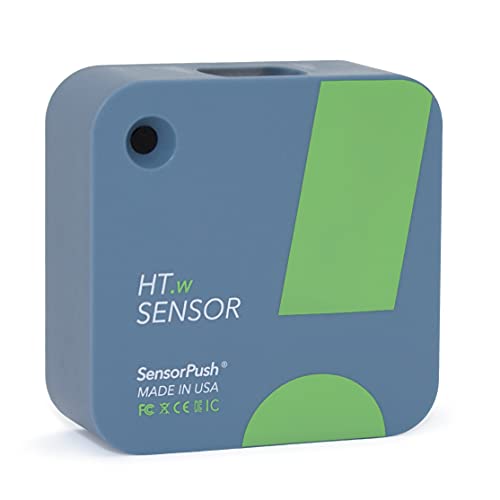
SensorPush HT.w Water-Resistant Temperature and Humidity Sensor

SensorPush

SensorPush HT.w Water-Resistant Temperature and Humidity Sensor

$69.99

Better sensor accuracy and a more robust logging arrangement, which matters when decisions are being made on small differences. Multiple units in different zones reveal how much a house varies internally, which is frequently more than growers expect: ten degrees between floor and ridge in a closed house is common, and the implications for probe placement and circulation are significant.

The trade-off: Considerably more expensive per sensor, and the additional accuracy is more than most hobby decisions require. The value is in multi-zone coverage rather than in precision at any one point.

Check price

Placement, which determines whether readings mean anything

An instrument in the wrong place produces confidently wrong numbers, and three placement errors are close to universal.

In direct sun. A sensor in sunlight reads its own solar heating, not air temperature, and can read twenty degrees high on a bright day. Every sensor needs shading. A simple white tube or a position under a bench edge is sufficient; the requirement is only that direct beam radiation does not strike it while air can still move around it.

At the wrong height. A closed greenhouse stratifies substantially, commonly five to ten degrees between floor and ridge. A sensor at head height reports conditions no plant experiences. Canopy height, where the plants actually are, is the correct position, and it changes as the crop grows.

Near equipment. A sensor in the heater airflow reads the heater. One near a vent reads the outside. One against a glazing panel reads the panel, which at night is the coldest surface in the building. Mid-house, mid-canopy, shaded, away from anything that moves or produces air is the answer.

Field tip

Two sensors tell you far more than one

A single sensor tells you the temperature at one point. Two, at opposite ends of the house, tell you whether the house is uniform, which is a far more actionable piece of information. A ten degree difference between one end and the other is not a heating problem, it is a circulation problem, and it is solved with a small fan rather than a larger heater. Growers frequently spend money on heating capacity to fix what is actually an air distribution issue, and the second sensor is what distinguishes the two.

Soil temperature, the number that decides sowing

Air temperature is what greenhouse equipment controls. Soil temperature is what seeds and roots actually respond to, and the two diverge substantially, particularly in late winter when a sunny house can feel warm while the soil in a raised bed is still close to 45 degrees F.

A soil thermometer pushed to seed depth answers the only question that matters when deciding whether to direct sow: is the medium at the temperature this crop germinates in. Carrots at 50 degrees F soil may take three weeks and rot before they emerge; at 65 they take ten days. The full table is in the germination soil temperature chart.

It is also the instrument that verifies a heat mat thermostat. A probe placement error on a propagation controller can hold the medium ten degrees from the setpoint, and an independent soil thermometer in a different cell is how that gets caught.

Compost thermometers with a long stem serve a related purpose for growers making their own medium, where the temperature of an active heap determines whether it is composting properly and whether weed seed and pathogens are being killed. A shorter compost thermometer covers smaller heaps.

Light measurement

Light is the input growers estimate worst, because human vision compresses an enormous range of brightness. A greenhouse that feels bright in midwinter can be delivering a daily light integral below what lettuce needs to grow.

A PAR meter measures photosynthetically active radiation directly, in the units that horticultural targets are expressed in. Its two most valuable uses are checking what a grow light actually delivers at canopy distance, which is invariably less than the marketing figure, and measuring natural light inside the greenhouse in midwinter to decide whether supplemental lighting is needed at all.

A lux meter is a cheaper alternative that measures light weighted for human vision rather than plant response. It can be converted to approximate PPFD with a factor that depends on the light source, and for comparing one position with another under the same light it is perfectly adequate. For absolute values under mixed daylight and LED it is less reliable.

The conversion and the crop targets are handled in the DLI and PPFD calculator.

Growing medium chemistry

Two problems in a greenhouse look like nutrition problems and are actually chemistry problems, and both are diagnosed with inexpensive tools.

pH out of range. Outside roughly 6.0 to 7.0 for most vegetables, nutrients present in the medium become chemically unavailable to roots. A plant showing deficiency symptoms in a well-fed medium is usually a pH problem rather than a supply problem, and adding more fertilizer makes it worse. A soil pH meter identifies this in seconds.

Salt accumulation. This is specific to growing under cover and is worth understanding because it builds slowly and is easy to miss. Outdoors, rainfall leaches excess salts through the soil profile continuously. Under cover, nothing ever leaches, so dissolved salts from irrigation water and fertilizer accumulate season after season, particularly in a hard water area. The symptoms are a white crust on the medium surface, poor growth in a well-fed bed, and marginal leaf scorch. A soil test kit covers the nutrient side, and periodic heavy leaching with rainwater is the correction.

This accumulation is one of the strongest practical arguments for rainwater capture in a greenhouse, since rainwater is soft and near neutral where municipal supply is frequently hard and alkaline.

How we chose

We did not calibrate these instruments against reference standards, and any site claiming metrological verification of seven sensors is telling you a story. We compared published accuracy specifications and the conditions they apply at, sensor type, logging capability and history depth, battery life in cold conditions, and verified owner reviews weighted toward long-term stability rather than initial impressions.

The failure mode that shaped the selection is sensor drift in a humid environment, which is specific to greenhouse use and is not captured by indoor reviews. Inexpensive capacitive humidity sensors are prone to drift after prolonged exposure to near-saturated conditions, and once drifted they continue reporting confidently. Units with a stated operating humidity range covering the high end scored higher.

We also weighted the presence of logging heavily, because the argument of this entire page is that the informative numbers occur when nobody is present. An accurate instrument that only shows the present moment answers fewer useful questions than a less accurate one that records overnight.

What to measure with what

The instruments worth owning

A complete measurement setup is inexpensive and it is what turns greenhouse management from guesswork into decisions. These four cover the four different physical quantities that matter.

  • La Crosse 8 in Round Analog Dial Thermometer

    The glance

    La Crosse 8 in Round Analog Dial Thermometer

    $9.99

    A large dial visible from the door means the present temperature is checked every time you enter, which is how anomalies get noticed early.

  • TempPro TP49 Digital Hygrometer

    The second point

    TempPro TP49 Digital Hygrometer

    $9.99

    A second cheap sensor at the far end of the house reveals stratification and dead zones, which is a circulation diagnosis rather than a heating one.

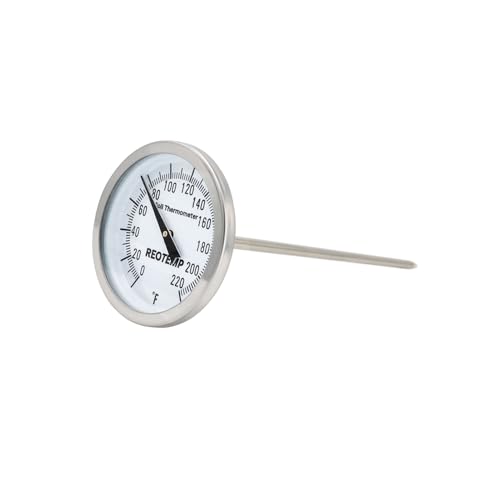
  • REOTEMP K82 Soil Thermometer, 5 in Stem

    The root zone

    REOTEMP K82 Soil Thermometer, 5 in Stem

    $12.99

    Soil temperature decides germination and it diverges substantially from air temperature in late winter. It also verifies heat mat controller placement.

  • DANOPLUS Quantum PAR Meter, PPFD Tester

    The light

    DANOPLUS Quantum PAR Meter, PPFD Tester

    $79.99

    Human vision is a poor judge of plant-usable light. One measurement at the canopy settles shade and supplemental lighting questions that no specification comparison can.

Related on this site

Common questions

6 answers

+ What should I measure in a greenhouse?

Three numbers drive nearly every decision: the overnight minimum, which tells you whether heating is adequate; the afternoon maximum, which tells you whether ventilation is; and the hours spent above 85 percent relative humidity, which predicts fungal disease. None of the three can be obtained by standing in the greenhouse, because all three occur when nobody is present, which is why recording instruments matter more than displays.

+ Where should a greenhouse thermometer be placed?

At canopy height in the middle of the house, shaded from direct sun, away from the heater outlet, vents and glazing panels. A sensor in sunlight reads its own solar heating and can be twenty degrees high. A closed greenhouse also stratifies by five to ten degrees between floor and ridge, so a sensor at head height reports conditions no plant experiences.

+ What humidity should a greenhouse be?

Broadly 50 to 70 percent relative humidity suits most vegetable and flower crops, but the figure that matters more is time spent above 85 percent, which is where botrytis and mildew establish. A house can read a comfortable 70 percent at midday and spend nine hours a night above 90, and only a logging instrument reveals that. Vapour pressure deficit is a more precise framing because it accounts for temperature.

+ Do I need a soil thermometer?

It answers the only question that matters when deciding whether to sow: is the medium at the temperature this crop germinates in. Air and soil temperature diverge substantially in late winter, when a sunny house feels warm while a raised bed is still near 45 degrees F. It also independently verifies a heat mat thermostat, where a probe placement error can hold the medium ten degrees from its setpoint.

+ Is a wifi greenhouse thermometer worth it?

The value is the logging rather than the remote reading. Seeing that the house sits above 90 percent relative humidity from midnight to nine each morning explains a recurring disease problem that no spot reading would, and it shows whether an intervention actually worked. The dependency on a network and an app is a real drawback, which is why a mechanical max-min thermometer is worth keeping as a backstop.

+ Why do my greenhouse plants show deficiency symptoms despite feeding?

Usually pH out of range, or salt accumulation, both of which look like nutrition problems. Outside roughly pH 6.0 to 7.0 nutrients present in the medium become chemically unavailable, so adding more fertilizer makes it worse. Salt build-up is specific to growing under cover, because no rainfall ever leaches through, so salts from irrigation and feed accumulate season after season. A white crust on the surface is the visible sign.

Working out the figures for your own house and season? The Greenhouse Build & Growing Planner is the paid version of these pages: 8 printable worksheets you fill in with your own numbers, plus the full PDF, $29.