The single most efficient decision in greenhouse heating is not to heat the greenhouse. Germination and rooting respond to the temperature of the medium, not the air around the plant, and heating a tray of medium to 78 degrees Fahrenheit costs a small fraction of heating the volume of a house to the same figure.
A 10 by 20 inch seedling mat draws somewhere between 17 and 25 watts. Getting the same result from air heat in even a small greenhouse means 1500 watts running for hours. That ratio is why bottom heat appears in every build on this site, including the one with no greenhouse at all.
The comparison
| Measure | Seedling heat mat | Heated bench |
|---|---|---|
| Scale | One or two standard 1020 trays | A whole propagation bench |
| Typical draw | 17 to 25 W per mat | Depends on area, but low per square foot |
| Cost to start | Very low | Moderate, and usually built rather than bought |
| Temperature control | Needs a separate thermostat to be precise | Same, and the thermostat matters even more at scale |
| Evenness | Good under the mat, poor at tray edges | Better, because a sand or matting layer spreads heat |
| Flexibility | Move it wherever the trays are | Fixed to the bench it was built into |
| Suits | A few trays, a windowsill, a shelf unit | A dedicated propagation area running a full season |
| Failure impact | One tray | The whole bench |
The thermostat is the important half
An unregulated heat mat does not hold a temperature. It adds a roughly fixed amount of heat, so the medium sits somewhere around 10 to 20 degrees Fahrenheit above ambient depending on conditions. In a cold room that might land at 65 degrees, which is too cold for peppers. In a warm room it might reach the mid eighties, which is fine for peppers and ruinous for lettuce.
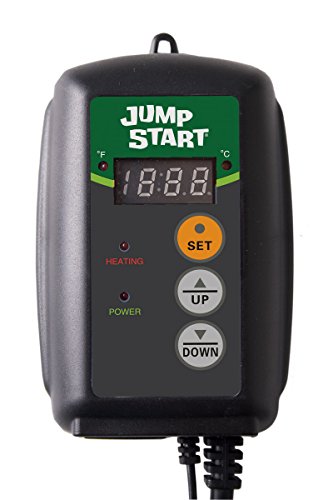
A thermostat converts that into a setpoint. A VIVOSUN 10 x 20.75 in Seedling Heat Mat and Digital Thermostat Set ($24.78) bundles mat and controller, and a Hydrofarm Jump Start MTPRTC Digital Heat Mat Thermostat ($30.69) adds control to a mat you already own, such as a plain VIVOSUN 10 x 20.75 in Waterproof Seedling Heat Mat ($14.99).
Probe placement decides whether the reading means anything. The probe belongs in the medium, at seed depth, in a cell in the middle of the tray. A probe lying on the mat surface reads the mat rather than the medium, and a probe at the tray edge reads several degrees cool. This is a two-minute detail that determines whether the whole system works.
Building a heated bench
A heated bench is not usually a bought product at hobby scale. It is a bench with a heat source under a distributing layer.
- A solid bench top, insulated underneath. Rigid foam board under the heat source stops most of the heat going into the space below the bench, and it is the difference between an efficient bench and a warm floor.
- The heat source laid out evenly across the top: heating cable in a serpentine pattern at even spacing, or several mats laid side by side.
- A distributing layer above it. An inch or two of damp sand, or a layer of Kapmat Capillary Matting, 72 in x 5 yd ($148.78), spreads the heat laterally so there are no hot lines directly over the cable and cold gaps between.
- A thermostat with its probe in the distributing layer at tray-base height rather than in the air above it.
- A cover if wanted. Low hoops with fleece or film over the bench trap a small warm volume, which raises air temperature around the seedlings without heating the house.
Capillary matting has a second benefit worth noting: it can be kept damp and will water trays from below by capillary action, which keeps the medium surface drier and reduces both damping off and fungus gnats.
How much either one is worth
The germination table makes the case. Peppers want 80 to 85 degrees Fahrenheit in the medium and germinate slowly and patchily below 70. Tomatoes want 75 to 85 and emerge in about six days at the optimum against two or three weeks at 60. Cucurbits want 75 to 85. Meanwhile lettuce germinates best at 60 to 68 and fails above about 80, which is why one bench temperature does not suit a whole spring sowing programme.
The full crop table is in the germination soil temperature chart. The practical conclusion is that a controller is what lets you run peppers at 82 and lettuce at 65 on the same bench in different weeks, and that is worth considerably more than the difference between any two mats.
The other value is speed. Faster, more even emergence means a tighter crop, fewer gaps, and less time occupying bench space. On a bench that turns over several times in a spring, that compounds.
The all-in-one option
For a first setup, a Jump Start Germination Station with Heat Mat, 72-Cell ($32.35) bundles a 72-cell tray, a dome and a mat, which removes the compatibility questions entirely. It is not thermostatically controlled, so it inherits the ambient-plus-fixed-offset behaviour, and adding a separate controller later is straightforward.
At the other end, a AC Infinity Heavy-Duty Humidity Dome Germination Kit, 5 x 8 ($89.99) is a heavy-duty germination kit built around the same standard tray footprint, and it is the format everything else in propagation is sized around. Whatever route you take, staying with standard 1020 tray dimensions is what keeps mats, domes, trays and benches interchangeable.
Bottom heat equipment



Bottom heat handles germination. Light handles what happens next, and the two are frequently confused. That is covered in LED versus fluorescent for seed starting.