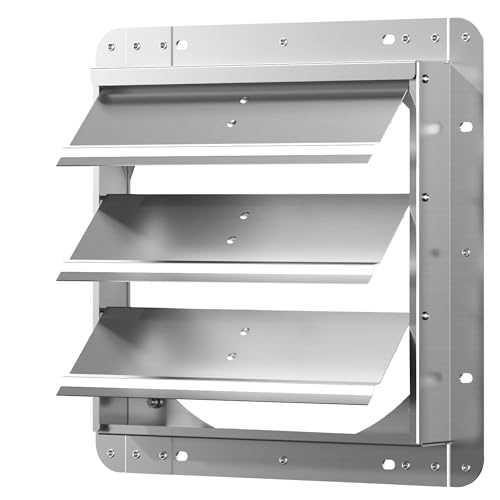
A shuttered wall fan is the right choice for whole-house extraction, because it moves the airflow a greenhouse volume needs and its gravity shutters close when it stops, sealing the opening against heat loss. An inline duct fan moves far less air but can be ducted to a specific bench or used to draw fresh air in at one end. Size whichever you buy from the greenhouse volume rather than from the price.
Target air changes
Roughly one per minute in summer
12 in shutter fan
Suits smaller houses
14 in shutter fan
Past roughly 120 sq ft
Inline 6 in fan
About 345 CFM, targeted use
Researched from published specifications and verified owner reviews · Updated 2026-08-16
Greenhouse ventilation is sized by volume, not by floor area or by feel. The usual rule of thumb for summer cooling is roughly one complete air change per minute, which for a modest house is a bigger number than most people expect and immediately rules out anything small.
Run your own dimensions through the ventilation CFM calculator before choosing anything, because it converts the argument into a number.
The comparison
Figure 1. Shuttered wall fan against inline duct fan·7 rows
Figure 1. Shuttered wall fan against inline duct fan
Measure
Shutter fan
Inline duct fan
Typical airflow
High, sized for the volume
Lower, a few hundred CFM
Seals when off
Yes, gravity shutters
No, needs a damper
Mounting
Cut into a wall or gable
In a duct run
Targeted airflow
No, whole volume
Yes, ducted where needed
Speed control
Model dependent
Usually included
Winter heat loss when idle
Low, shutters close
Real without a damper
Noise
Higher
Lower
Researched general information rather than professional advice.
Whatever the fan, it needs somewhere for the replacement air to come from. A fan extracting from a sealed house simply pulls against the structure. A louvre or an open vent at the opposite end, sized at least as large as the fan opening, is not optional, and a 12 in Galvanized Gravity Shutter Louver Vent ($38.99) is the standard answer.
Where an inline fan earns its place
A VIVOSUN P6 6 in Inline Duct Fan, 345 CFM ($31.27) is not a whole-house extractor and should not be bought as one. It is useful for ducting fresh cool air to a specific propagation bench, for pulling air through a filter, or for a small closed growing space inside a larger structure. Speed control makes it easy to tune, and it is far quieter than a wall fan.
Note
Extraction and circulation are different jobs
Extracting hot air out of the house and moving air around inside it are separate requirements, and one fan rarely does both. An extract fan runs when the house is too hot. A circulation fan runs most of the time, at low speed, to stop still damp air sitting on leaf surfaces. Budget for both rather than expecting the extract fan to handle the second job.
Control
Fans with integral thermostats are convenient and the sensor sits in the fan housing, on a wall, usually high up where the air is hottest. That is not the worst place for a cooling sensor, but a dual-output controller running both heater and fan from one probe at plant height gives a more coherent result and avoids the two appliances fighting.
The decision, summarised
Whole-house summer cooling: a shuttered wall fan, sized from the volume.
House above roughly 120 sq ft: the 14 inch class, not the 12 inch.
Cool air to one specific bench: an inline duct fan.
Any powered extraction: an intake louvre at the far end, at least as large as the fan.
Still damp air and botrytis rather than heat: circulation fans, which is a different purchase.
Extraction, intake and targeted airflow
Two sizes of wall fan, the intake that makes either work, and the duct fan for a specific job.
A common design target for summer cooling is around one complete air change per minute, so the CFM figure is roughly the internal volume of the greenhouse in cubic feet. Shading, climate and crop change that, and hot dry regions often need more. Calculate from your own dimensions rather than following a fan size recommendation, because the same fan is correct in one house and hopelessly small in another.
+- Does an extract fan need an air intake?
Yes, and this is the most common installation mistake. A fan can only move air that can be replaced, so a sealed house means the fan works against negative pressure and moves a fraction of its rated airflow. Fit a louvre or leave a vent open at the opposite end of the house, with an opening area at least as large as the fan.
+- Should the fan be high or low on the wall?
Extract high, because hot air collects at the ridge, and bring replacement air in low at the opposite end so cool air crosses the crop on its way through. That arrangement moves the hottest air out and gives the plants the benefit of the incoming air. A fan mounted low simply recirculates the coolest air in the house.
+- Is a fan better than roof vents?
It is more certain. Passive vents rely on temperature difference and wind, and on a still hot afternoon they can be inadequate exactly when they are needed most. Roof vents cost nothing to run and never fail, which is the argument the other way. Many houses do best with both, with automatic vent openers handling ordinary days and a thermostatically controlled fan for the extremes.
Working out the figures for your own house and season? The Greenhouse Build & Growing Planner is the
paid version of these pages: 8 printable worksheets you fill in with your own
numbers, plus the full PDF, $29.