Ventilation is the system a hobby greenhouse most often lacks and most urgently needs. A sealed greenhouse in full sun gains heat faster than almost any other structure of its size, and the temperature inside rises until something lets it out. If nothing does, it keeps rising, and the numbers get dangerous quickly: an unvented small greenhouse on a clear day can reach 40 degrees Fahrenheit above outside temperature within an hour or two.
Ventilation is also doing three other jobs that are easy to overlook. It replaces the carbon dioxide the crop consumes, which in a sealed house on a bright morning can fall to the point where photosynthesis slows. It removes moisture, which is what stops a house saturating and going down to fungal disease. And it moves air across leaf surfaces, which keeps them dry and strengthens stems.
The two mechanisms
Passive ventilation is driven by two forces working together. The stack effect: warm air rises, leaves through a ridge vent, and pulls cooler air in through a low side vent to replace it. And wind pressure: air moving across the outside of the house creates a pressure difference that pushes through any opening.
The stack effect requires height between the intake and the exhaust, which is why a ridge vent paired with a low side vent works and two vents at the same height do not. It also requires a temperature difference to drive it, which means it works best exactly when you need it most.
Mechanical ventilation replaces the pressure difference with a fan. It is more reliable, is not dependent on wind, and can be sized precisely. It costs electricity and it needs an intake as large as the fan or the fan simply strains against a sealed box.
How much passive vent area you actually need
Standard horticultural practice puts total vent opening at roughly one fifth of floor area, split roughly evenly between ridge vents and side vents.
| House size | Floor area | Total vent area needed | Ridge vents | Side or door area |
|---|---|---|---|---|
| 6 x 4 ft | 24 sq ft | About 4.8 sq ft | About 2.4 sq ft | About 2.4 sq ft |
| 6 x 6 ft | 36 sq ft | About 7.2 sq ft | About 3.6 sq ft | About 3.6 sq ft |
| 6 x 8 ft | 48 sq ft | About 9.6 sq ft | About 4.8 sq ft | About 4.8 sq ft |
| 8 x 12 ft | 96 sq ft | About 19.2 sq ft | About 9.6 sq ft | About 9.6 sq ft |
| 10 x 18 ft | 180 sq ft | About 36 sq ft | About 18 sq ft | About 18 sq ft |
Now compare that with what a kit actually ships. A typical 6 by 8 foot polycarbonate house has one hinged roof vent of roughly 2 to 3 square feet and a door. That is somewhere around a third of the vent area the rule calls for, and it is the single most common specification shortfall in hobby greenhouses.
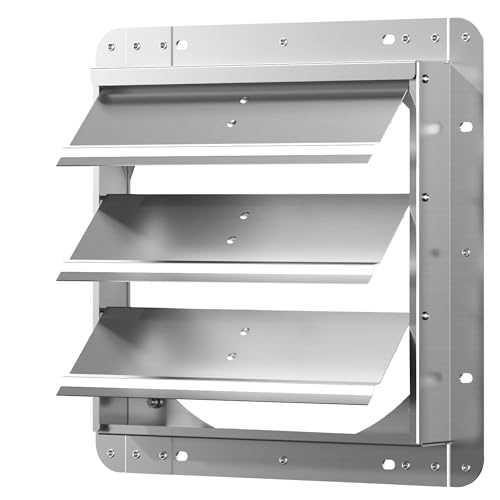
Three fixes, in ascending order of effort: leave the door open, which is what everyone does and which only works when someone is present; add a second roof vent, which many kits offer as an accessory; or fit a 12 in Galvanized Gravity Shutter Louver Vent ($38.99) low in a gable end, which gives a proper low intake and pairs with the existing roof vent to make the stack effect work.
Automatic vent openers, which are not optional
A greenhouse needs venting on a schedule set by the sun, not by the person. It has to open by mid-morning on a clear day in early spring and close before the temperature falls in the evening, and it has to do that on days when nobody is home. A hand-operated vent gets opened when convenient, which is how houses cook.
A wax-cylinder opener such as the GDHSWJ Solar Automatic Greenhouse Vent Opener ($26.99) needs no power at all. The cylinder contains a wax that expands as it warms, pushing a piston that lifts the vent, and contracts as it cools, closing it again. Most models start opening somewhere around 60 to 75 degrees Fahrenheit and are fully open by roughly 25 degrees above that, and the setpoint is adjustable by turning the cylinder in its housing.
They lift a limited weight, typically 15 to 30 pounds depending on the model, which is why a heavier vent wants a dual-spring unit such as the Yziixi Heavy-Duty Dual-Spring Automatic Vent Opener ($29.99) or a heavier-duty opener like the Bayliss XL Autovent Automatic Window Opener ($80.69). Fitting one that is undersized for the vent produces a vent that opens partway and stalls.
When you need a fan, and how big
Passive venting reaches its limit when the house is large relative to its openable area, when the site has no wind, when the climate is hot, or when the vents cannot be made big enough without rebuilding the structure. At that point a fan is the answer.
The standard sizing method, published by the National Greenhouse Manufacturers Association, is floor area multiplied by 8, then corrected. The 8 is the multiplier for a house with an average height near 8 feet and is what produces the familiar rule of one complete air change per minute.
Four corrections matter. A house shorter than 100 feet needs proportionally more airflow per square foot because it has more end-wall leakage, and the correction is the square root of 100 divided by the length. Air at altitude is thinner and carries less heat per cubic foot. A shaded or lightly loaded house needs less. And the temperature rise you are prepared to accept between the intake and the fan scales the whole thing, with 4 degrees Fahrenheit as the standard target. The ventilation CFM calculator applies all four.
Two rules about installation matter as much as the sizing. The intake must be at least as large as the fan outlet, and preferably larger, or the fan is working against a partial vacuum and moves far less air than its rating. And the intake goes at the opposite end of the house from the fan, low down, so the air sweeps the length of the growing space rather than short-circuiting across a corner.
Circulation is a separate job from ventilation
Exhaust ventilation exchanges air with outside. Circulation moves air around inside. They are different problems and they need different equipment, and conflating them is why so many greenhouses have a big extractor and still have stagnant, disease-prone corners.
Still air in a greenhouse forms a boundary layer over every leaf, a thin film of saturated air that does not exchange with the bulk of the room. That film is where fungal spores germinate. Gentle continuous air movement, on the order of half a mile per hour, breaks it up, keeps leaf surfaces drying, and produces noticeably sturdier stems because plants respond to mechanical stress by thickening.
Small clip fans such as a Roodike 5 in Clip-On Circulation Fans, 2-Pack ($35.99) run continuously at very low wattage and are the standard answer for a hobby house. In a larger structure an oscillating wall fan such as the Fanspex 16 in Wall-Mounted Oscillating Fan ($61.39) covers more ground. The important part is that they run all the time, including at night and including in winter, because the dawn condensation period is exactly when leaf surfaces are wettest.
Ventilation equipment



Ventilation is stage two of four in summer temperature control. The whole sequence, from shade through venting to evaporative cooling, is in cooling a greenhouse in summer, and the disease side of the same system is in humidity and disease control.