The purchase that stops a greenhouse cooking, and the hole in the wall it needs.
iPower 14 in Wall-Mounted Shutter Exhaust Fan with Temperature Controller
~$89
A 14 inch shuttered wall fan rated 1,000 CFM at 1600 RPM, with corrosion-resistant aluminum louvers and blades, a steel frame and an 8-level temperature controller.
Check price on AmazonSpecifications
| Fan size | 14 in |
|---|---|
| Airflow | 1,000 CFM |
| Speed | 1600 RPM |
| Power | 120 V, 60 Hz, 70 W |
| Construction | Aluminum louvers and blades, steel frame |
| Controller | 115 to 120 V, 13 A, 1200 W, 8 levels, adjustable 50 F to 120 F |
| Shutters | Gravity closing when the fan stops |
Specifications above come from iPower's published specifications for this model. Treat pricing as approximate, since Amazon pricing moves.
What it does well
- 1,000 CFM at 70 W is a lot of air for very little electricity. Ventilation is the cheapest cooling in a greenhouse precisely because you are moving air rather than conditioning it.
- The temperature controller is included and adjustable from 50 F to 120 F, so the fan runs on the days you are not there. An extractor without a thermostat is a fan you have to remember.
- Gravity shutters that close when the fan stops keep wind, insects and heat loss out overnight, which is the whole reason to choose a shuttered fan over a bare axial one in a wall.
- Aluminum louvers and blades rather than steel is the correct choice for a permanently humid space where a painted steel blade would corrode at the edges within a couple of seasons.
- At 70 W it is cheap enough to run continuously through a hot afternoon without thinking about the meter, which is not true of any active cooling.
Where it falls short
- It needs a hole in the wall, sized, framed and weathered. On a polycarbonate kit that means cutting a panel and building a mount, which is the real cost of this purchase and it is not in the price.
- An extractor is only as good as its inlet. Pulling 1,000 CFM out of a sealed greenhouse just creates a vacuum, so you need an opening of comparable area at the far end, ideally low and shaded.
- The published CFM is free air, which every fan manufacturer quotes. Through a shutter, against a partly blocked inlet and with any duct, real delivered airflow is lower.
- It is single speed with an 8-level controller that switches at temperature rather than modulating, so on a marginal day it will cycle rather than run gently.
- 1600 RPM on a 14 inch blade is not quiet. In a small garden it is audible, and if the greenhouse sits near a neighbour's boundary that is worth thinking about before you cut the hole.
What owners report
Greenhouse growers who have run both consistently report the same order of value: shade first, passive vents and an automatic opener second, powered extraction third. That order exists because each step is cheaper than the next and removes heat closer to the source. A fan is the tool for the days when the first two are already doing their job and the house is still too hot, and it is a poor substitute for either. Our vent opener versus exhaust fan comparison and the circulation fan versus exhaust fan comparison set out where each belongs.
The recurring practical complaint is inlet area rather than the fan. Growers fit an extractor, leave the house otherwise sealed and find the airflow disappointing. A fan can only remove what an inlet lets in, so plan a low intake at the opposite end with at least as much free area as the fan opening, and shade it so the incoming air is the coolest available. That single detail changes the result more than moving up a fan size.
Sizing is the other place people get it wrong in both directions. Greenhouse ventilation is usually specified as air changes per hour, and a summer target of turning the volume over roughly once a minute is the common rule of thumb. Put your own dimensions into the ventilation CFM calculator and check the result against the greenhouse fan CFM chart rather than buying the biggest fan on the shelf. If the calculator says you need less than this, our exhaust fans roundup covers the smaller 12 inch options.
Who it suits
- Owners of greenhouses past roughly 100 sq ft where passive vents are losing the argument on clear days.
- Growers with mains power at the greenhouse and a wall they are willing to cut.
- Anyone growing fruiting crops through a hot summer, where still humid air causes as much loss as the heat itself.
Who should skip it
- Anyone who has not yet fitted shade cloth and an automatic vent opener, which come first and cost less.
- Growers with no way to provide a matching low-level air inlet.
- Owners of small houses under roughly 60 sq ft, where 1,000 CFM is far more fan than the volume needs.
Alternatives worth considering
 Smaller House Pick
 iLIVING 12 in Wall-Mounted Shutter Exhaust Fan with Thermostat
~$69
The same idea one size down with a thermostat included, for a house where 1,000 CFM would be overkill. A fan matched to the volume cycles less and holds a steadier temperature than an oversized one.
Check price on Amazon Do This First
 Bayliss Autovents XL Autovent Automatic Greenhouse Window Opener
~$81
A wax-cylinder opener with over 6 kg of lift and a 30 cm opening range, needing no power at all. On many houses an automatic roof vent plus shade removes the need for a fan entirely, and it works in a power cut.
Check price on Amazon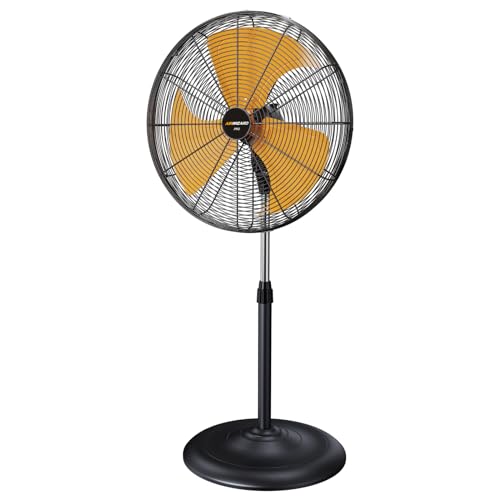 For Air Movement, Not Extraction
 AIRWIZARD Pro Series 18 in High-Velocity Pedestal Fan, 5,400 CFM
~$120
If the problem is still air around the crop rather than trapped heat, a circulation fan is the correct tool and needs no hole in the wall. The two do different jobs and many greenhouses want both.
Check price on AmazonKeep reading
- Shutter fan vs inline fan
- Vent opener vs exhaust fan
- Circulation fan vs exhaust fan
- Ventilation CFM calculator
- Greenhouse fan CFM chart
- Hessaire DC18 evaporative cooler review
- 90 percent shade cloth review
- Best greenhouse exhaust fans
This review draws on published specifications, manufacturer figures and the consensus of verified owner reviews. We have not tested this product ourselves, and we say so rather than implying otherwise. As an Amazon Associate we earn from qualifying purchases.