Almost every greenhouse problem that cannot be fixed later is a siting problem. A heater can be upgraded, glazing can be replaced, a bench can be rebuilt in an afternoon. A greenhouse standing in the shadow of a garage from noon onward in winter is a greenhouse that will never do the one job it was bought for, and the only fix is moving it.
The order of priority is worth stating plainly, because it is not the order most advice uses. Winter light first, drainage second, access to water and power third, shelter from wind fourth, and ridge orientation a distant fifth. Ridge orientation is the thing people ask about and the thing that matters least.
Winter light is the constraint, not summer light
A greenhouse in the growing season has more light than it can use. That is why shade cloth exists. What limits what a greenhouse can actually do is the light available in the shortest weeks of the year, when the sun is at its lowest and the day is at its shortest, and that is the condition the site has to be chosen for.
The practical test is the mid-winter sun path. At 40 degrees north, the sun at the winter solstice reaches an altitude of about 26 degrees at solar noon and considerably less either side of it. A six foot fence casts a shadow roughly twelve feet long at that altitude. A twenty foot tree casts one about forty feet long. The usual rule of thumb, and it is a good one, is that an obstruction on the southern side should be no closer than about two and a half times its own height.
Obstructions to the north matter hardly at all, and a solid one can be an asset: a wall or fence on the north side reflects light back into the house and blocks the coldest wind. This is the entire logic of a lean-to house such as the Ohuhu Lean-To Wall-Mounted Greenhouse ($66.49), which uses a house wall as its north side and gains both shelter and stored heat from it.
The window to protect is roughly 9 a.m. to 3 p.m. in the depths of winter. Early morning and late afternoon light at that time of year arrives at such a low angle that most of it reflects off the glazing rather than entering it, so shade at 8 a.m. costs much less than shade at noon. If you can only have unobstructed sun for part of the day, take the middle of it.
Drainage, and what a greenhouse does to the ground around it
A greenhouse concentrates water. Every drop that lands on the roof runs off the edge of the footprint rather than soaking in across it, so a 10 by 18 foot house sheds about 95 gallons for every inch of rain onto a strip of ground a few feet wide. On level clay, that produces a permanent bog along both eaves within a season.
Two fixes, and doing both is better than either. Give the site a slight fall, around one inch in ten feet, running away from the door. And fit gutters, which turns the problem into a resource: a 32 mm Greenhouse Gutter and Water Butt Collection Kit ($23.39) feeding a 50 gallon barrel both removes the runoff and gives you the soft water that container growing under cover really wants. Work out what your own roof yields with the rain barrel capacity calculator.
Avoid the bottom of a slope even when it is otherwise the sunniest spot on the property. Cold air is denser than warm air and flows downhill, pooling in hollows and against solid barriers, which is why frost pockets exist. A greenhouse in a frost pocket sees overnight minima several degrees below the rest of the garden, which directly raises what you pay to heat it.
Water and power decide what the greenhouse can become
Both of these are far cheaper to run before the structure goes up than after, and both determine the ceiling on what the house can ever do.
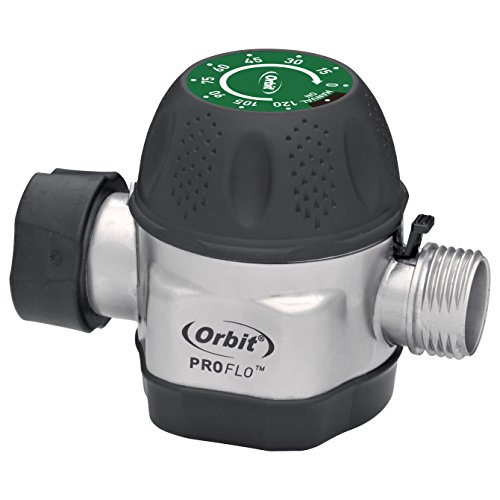
Water first, because it is the cheaper of the two and the one that gets skipped. A greenhouse without a tap within hose reach gets watered with a can, and a greenhouse watered with a can gets watered when someone is available rather than when the crop needs it. That inconsistency is behind blossom end rot, fruit splitting and most bolting. A hose to the site plus an Orbit 62041 Single-Zone Hose Timer ($19.99) costs very little and removes the failure entirely.
Power is the harder constraint. A 120 volt 15 amp circuit supplies 1,800 watts at full load, and a continuous load such as a heater should not exceed 80 percent of that, which is about 1,440 watts. A 1500 watt greenhouse heater is at or slightly over that limit on its own. In practical terms one 15 amp circuit heats a house of roughly 36 to 50 square feet in a cold climate, and nothing larger. Past that you need a 240 volt supply, which means a trench, conduit, conductor sizing and a disconnect, and which is dramatically cheaper dug once at the start.
This is code-governed work and a qualified electrician job. There is orientation rather than instruction in the greenhouse electrical and safety guide, and the practical implications for heater choice are worked through in the heater BTU calculator.
Wind, and the mistake of building a wind tunnel
A greenhouse is a large, light, sealed box, which makes it an excellent sail. Wind damage is the most common way a hobby greenhouse is destroyed, and it usually happens in one of two ways: the whole structure lifts and moves, or the wind gets inside through an open door or vent and lifts the roof from underneath.
Shelter helps, but the wrong shelter makes things worse. A solid fence upwind creates a zone of turbulence and accelerated flow on its lee side that can be more damaging than open exposure. A permeable windbreak such as a hedge, a slatted fence or a mesh screen that passes roughly half the air slows wind over a distance of about ten times its height without producing that turbulence. If you have a choice, put the greenhouse eight to ten fence heights downwind of a permeable barrier rather than tight against a solid one.
Then anchor it properly regardless. A Ciyivak 18 in Screw-In Ground Anchor Kit with Straps ($32.99) is the minimum for a film tunnel and is not sufficient on its own for a rigid house on an exposed site. The full detail, including the load figures, is in anchoring a greenhouse against wind.
Ridge orientation, and why it matters less than you have been told
The classic advice is that a greenhouse ridge should run east to west so that one long roof plane faces south. For commercial houses over about 25 feet long this is correct and the gain is measurable. For a hobby house it is a small effect that gets quoted as though it were a large one.
| Orientation | Winter light | Summer light | Best for |
|---|---|---|---|
| East to west ridge | Roughly 5 to 10 percent more, concentrated on the south side | More uneven, with a hot south bench and a cool north bench | Winter growing, overwintering, a house used mostly in the cold months |
| North to south ridge | Slightly less total, but distributed evenly across both sides | Even across the house, both sides get direct sun at some point | Spring propagation and summer cropping, benches on both sides |
| Whatever the site allows | Depends entirely on shading | Depends entirely on shading | Almost everyone, because an hour of lost sun beats any orientation gain |
The reason the effect is small on a short house is that the gable ends are a large fraction of the total glazed area. On a 6 by 8 foot house the two ends are around a third of the envelope, and they face in whichever directions the ridge does not. As the house gets longer, the ends become proportionally less important and the roof planes dominate, which is when orientation starts to matter.
So orient east to west if the site allows it and you care mostly about winter. Otherwise put the door where you can get a wheelbarrow to it, run the ridge along the axis that fits the plot, and spend the attention you saved on shading and drainage instead.
Working out the footprint before you commit to a spot
A common sequence is to choose the house, then look for somewhere to put it. Reversing that produces better results, because the site usually imposes a maximum width and the width is what determines whether the internal layout works at all.
A house with benches down both sides and a path between them needs at least two bench depths plus a path width. At a 30 inch bench and a 24 inch path, that is 7 feet minimum, and 6 feet is the width at which you get one bench and a path, not two benches. This single dimension explains why so many 6 foot wide kit houses end up with everything on one side and a pile of bags on the other. The greenhouse size calculator works the whole layout backwards from what you actually want growing.
Leave working space outside as well. You need roughly 2 feet clear all the way round to fit and later replace glazing panels, and considerably more at the door end for a wheelbarrow. A house tight against a fence on its north side will have panels that cannot be replaced without dismantling something.
What a well-sited greenhouse still needs on day one


Once the site is settled, the next two decisions are what the house is glazed with and how it is held down. Both are covered in detail in the glazing guide and in anchoring against wind, and both are considerably easier to get right before the structure is standing.