Glazing is the only part of a greenhouse that has to do two contradictory jobs at once. It has to let light in, and it has to keep heat from going out. Every material available is a compromise between those two, and the compromise is not linear: insulation varies by a factor of three across the common materials while light transmission varies by well under a half. That asymmetry is the single most useful thing to understand before choosing.
It also has a third job nobody quotes, which is surviving. A glazing that is theoretically ideal and cracks in the first hailstorm, clouds in three summers or blows out of its channel in a gale has failed regardless of its R-value. Service life and how the panel is retained matter as much as the published figures.
The materials, with the numbers side by side
These are the values published by glazing manufacturers and extension services for new material. Every one of them degrades with age: film loses transmission steadily and is a consumable, polycarbonate yellows from the outside in if the UV-protected face is fitted the wrong way round, and glass is essentially permanent.
| Material | R-value | U-factor | PAR transmission | Service life |
|---|---|---|---|---|
| Single polyethylene film, 6 mil | 0.87 | 1.15 | 88 percent | 3 to 4 years |
| Double polyethylene film, inflated | 1.70 | 0.59 | 78 percent | 4 to 5 years |
| Single horticultural glass, 3 mm | 0.95 | 1.05 | 90 percent | 25 years and up |
| Double insulated glass unit | 2.00 | 0.50 | 78 percent | 20 years and up |
| Corrugated single-wall polycarbonate | 0.83 | 1.20 | 88 percent | 10 years |
| Twin-wall polycarbonate, 4 mm | 1.54 | 0.65 | 80 percent | 10 years |
| Twin-wall polycarbonate, 6 mm | 1.72 | 0.58 | 78 percent | 10 to 12 years |
| Twin-wall polycarbonate, 8 mm | 1.89 | 0.53 | 76 percent | 10 to 15 years |
| Triple-wall polycarbonate, 8 mm | 2.10 | 0.48 | 74 percent | 10 to 15 years |
| Five-wall polycarbonate, 16 mm | 2.50 | 0.40 | 62 percent | 15 years |
| Double-wall acrylic, 16 mm | 2.00 | 0.50 | 83 percent | 20 years and up |
| Fiberglass reinforced panel | 0.83 | 1.20 | 85 percent | 7 to 15 years |
Read that table with the heat loss equation in mind. Heat loss is area multiplied by U-factor multiplied by the temperature difference, so halving the U-factor halves the heating bill for the same house and the same target. Going from 6 mil film at U-1.15 to 6 mm twin-wall at U-0.58 halves it. Going from 6 mm twin-wall to 16 mm five-wall cuts it by a further 31 percent, but costs 16 percentage points of light, which in a short winter day is a great deal to give away.
Put your own numbers through the glazing heat loss calculator before spending. The absolute saving depends on how big the house is and how cold it gets, and on a small house in a mild climate the difference between good glazing and excellent glazing is often a few dollars a season.
Where each material actually belongs
Polyethylene film is the cheapest covered square foot available and the only sensible way to cover a large area on a small budget. A roll of Tapix 6 mil UV-Resistant Poly Sheeting, 10 x 25 ft ($19.90) covers a hoop tunnel for less than the price of two rigid panels. It is a consumable: UV degrades it, and even UV-stabilised film is a three to four year part. Use it on tunnels, on temporary structures, and as a second layer inside a rigid house in winter.
Twin-wall polycarbonate is the hobby default for good reasons. EVERECO Twin-Wall Polycarbonate Panels, 4 x 2 ft, 6-Pack and similar 4 by 2 foot sheets cut with a utility knife, weigh almost nothing, survive hail that would destroy glass, and hold roughly twice the insulation of film. The diffused light they produce is arguably better for plants than direct light because it penetrates deeper into a canopy rather than lighting only the top leaves.
Glass is the highest transmission and the longest life, and it is why old greenhouses are still standing. It is also heavy, needs a frame built for it, breaks, and is dangerous to work above. Single glass insulates about as poorly as single-wall polycarbonate, which surprises people. Choose it for looks, permanence and light, not for warmth.
Triple-wall and five-wall polycarbonate belong in genuinely cold climates on houses that are heated all winter, where the heating saving is large enough to outweigh the light loss. On an unheated house they are usually the wrong trade, because an unheated house in winter is short of light rather than short of insulation.
Fitting twin-wall polycarbonate without ruining it
Twin-wall is forgiving to cut and unforgiving to fit badly. Five rules cover nearly every failure.
- Flutes run vertically, always. The channels inside the sheet must run up and down the slope so that any condensation that forms inside them drains out of the bottom. Fitted horizontally, the flutes fill with water, then with algae, and the panel goes green and opaque within a season. This is the single most common fitting mistake and it is not repairable.
- The UV face goes outward. Twin-wall carries UV protection on one side only, marked with a printed film. Fitted inside out, the sheet yellows and turns brittle in two to three years instead of ten. Peel the protective film only after the sheet is in place, and check the print before you cut.
- Seal the top, vent the bottom. The top edge of each sheet gets solid aluminium tape, the bottom edge gets vented tape or perforated tape. Sealing both ends traps moisture inside the flutes permanently. Leaving both open lets insects and dust in from the top, which is just as bad and looks worse.
- Drill oversized holes. Polycarbonate expands and contracts considerably with temperature, roughly an eighth of an inch over a 6 foot length across a normal seasonal swing. Fixing holes should be about 3 mm larger than the screw shank, with a washered screw that clamps the sheet without pinching it. A panel screwed tight through a snug hole buckles in summer and cracks at the fixing in winter.
- Cut with a sharp blade, supported. A utility knife scored several times through the top skin, then snapped over a straight edge, gives a cleaner cut than any saw. If you must saw, use a fine-tooth blade and support both sides of the cut so the sheet cannot flex.
Film, and the difference between covering and skinning
Film goes on differently. It is not fastened at points, it is tensioned across the whole structure, and the tension is what keeps it from flapping. Flapping is what destroys film covers: a loose sheet works against every hoop and fastening until it tears at a stress point, usually in the first serious wind.
Cover on a warm, still day. Film goes on slightly loose in the cold and pulls drum-tight when the sun warms it, so a cover fitted tight at 40 degrees Fahrenheit is under enormous stress at 90. Fit it in the morning warmth, pull the tension by hand rather than with a machine, and secure the long edges by rolling them around a batten and screwing the batten to the frame rather than by punching grommets through the film.
Bury or weight the skirt. On a tunnel, the standard method is a trench along each side into which the film edge is folded and backfilled, which seals the structure at ground level and removes the edge as a place for wind to get underneath. Where you cannot dig, landscape staples through a folded hem into firm ground, or sandbags along the skirt, do the same job less elegantly.
A double film layer with an air gap between roughly doubles the R-value, from 0.87 to about 1.70, for the price of a second sheet. Commercial houses hold the gap with a small blower. At hobby scale, a second layer of 6 mil film clipped to the inside of the hoops with a two-inch gap achieves most of the same effect for a winter, and comes down in spring when the light matters more than the insulation.
Insulating an existing house without replacing the glazing
Replacing glazing is expensive. Adding a temporary internal layer for the cold months is not, and it produces a comparable improvement in the season when it matters.
FONUNO Reflective Bubble Insulation Roll, 23.6 in x 10 ft taped to the inside of the north-facing panels adds roughly R-1 to that surface for a few dollars. Applied to the north wall only, it costs almost nothing in light, because the north side of a greenhouse receives essentially no direct sun in winter anyway, and it removes a large area of the coldest glazing from the heat loss equation. Applied across the whole house it is a meaningful insulation gain and a meaningful light loss, which is a trade worth making only for overwintering rather than growing.
Doors and vents leak more than glazing does. The infiltration multiplier in greenhouse heat loss calculations runs from 1.0 for a tight new structure to about 1.25 for an older film house with loose doors, and a 25 percent penalty is larger than the difference between two adjacent glazing grades. A Shed and Greenhouse Door Hardware Kit with T-Handle Lock ($39.99) that lets a door close and latch properly against a seal is one of the cheapest heating upgrades available.
Glazing and sealing materials
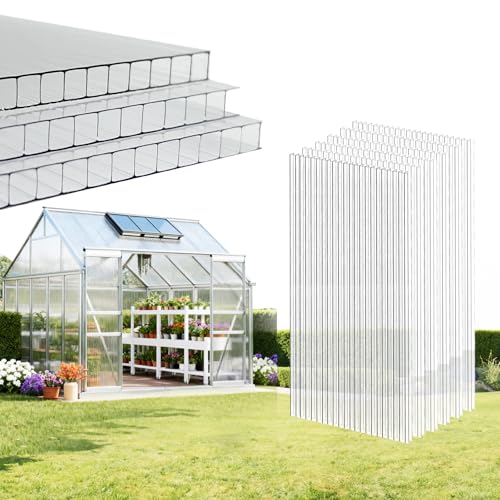


Glazing choice sets the heating bill for the life of the structure, so it is worth a calculator session rather than a guess. Work the specific trade for your own house in twin-wall versus triple-wall and poly film versus polycarbonate, then size the heater against the answer.