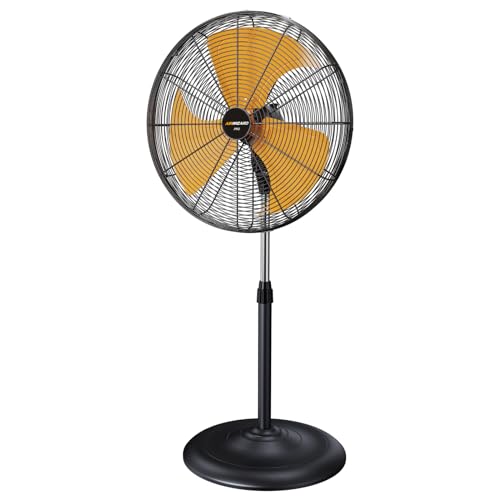
A circulation fan moves air inside a closed greenhouse rather than exchanging it with outside, and it is the cheapest fungal disease control available. The AC Infinity CloudRay S6 at roughly $40 is the pick for most hobby houses: quiet, oscillating, variable speed and safe to run continuously. Aim for gentle leaf movement everywhere in the house rather than a strong draught anywhere.
Target airflow
Gentle leaf movement
Run schedule
Whenever the house is closed
Fans compared
4
Typical draw
5 to 30 W
Researched from published specifications and verified owner reviews · Updated 2026-08-16
The most misunderstood fan in a greenhouse is the one that does not ventilate. A circulation fan exchanges no air with the outside at all. It stirs the air already inside, and it does that for one reason: to break up the still boundary layer at the leaf surface where fungal spores germinate.
For most hobby houses the pick is the AC Infinity CloudRay S6 at around $40, because it oscillates, runs quietly at low speed, and draws little enough power to leave on continuously.
A 6 inch oscillating clip fan with genuinely variable speed and low power draw, which is the specification that matters for this job. The requirement is continuous gentle movement across every leaf in the house, not a strong draught in one place, and a fan that can be turned down far enough to run all day without drying foliage or stressing seedlings is doing the job correctly. Oscillation matters because a fixed fan creates one moving column and leaves still zones either side of it.
Roodike 5 in Clip-On Circulation Fans, 2-Pack ($35.99). Two smaller clip fans for the price of one larger unit, which is frequently the better arrangement: two modest fans at opposite corners produce more even movement than one strong fan in the middle.
What circulation actually does
Every leaf sits inside a thin layer of still, humid air called the boundary layer. It forms because air in contact with a surface does not move, and it is where the plant's own transpiration accumulates. In that layer, relative humidity at the leaf surface can be far higher than the bulk humidity in the greenhouse, frequently close to saturation even when the house reads 70 percent.
Fungal spores need free water or near-saturated air to germinate. Botrytis, powdery mildew and downy mildew all establish in that boundary layer rather than in the room. This is why a greenhouse can show a comfortable humidity reading and still lose plants to disease, and why growers who respond by buying a dehumidifier frequently see very little improvement.
Moving air strips the boundary layer away, replacing saturated air at the leaf with bulk air from the room. The energy required is small because the layer is thin. Gentle continuous movement is far more effective than intermittent strong airflow, and this is the single cheapest disease intervention available in a greenhouse.
There are two secondary benefits worth knowing. Air movement evens out temperature stratification, which in a closed house can be five to ten degrees between floor and ridge. And modest mechanical stress produces shorter, stockier stems with better structural tissue, which is why seedlings raised under a fan transplant better than sheltered ones.
The three tiers
Circulation fans in three tiers
3 tiers · priced at the time of writing
Beginner
A small house or a propagation bench, where two modest fans beat one strong one.
Two clip fans placed at opposite corners produce more even movement across a small house than a single larger fan does, because the requirement is coverage rather than velocity. Clip mounting means they attach to a bench edge, a frame member or a shelf upright without brackets, and they can be repositioned as the planting changes through the year.
The trade-off:
Limited reach, so in anything above roughly 60 square feet they will leave still zones. Basic bearings and no speed control on most units at this price, which means they run at one speed and that speed may be more than a tray of seedlings wants.
Variable speed is the specification that matters, because the correct setting is gentle leaf movement and a fan that only runs at full speed will desiccate seedlings and stress transplants. Oscillation covers the width of a house rather than a single column. Low power draw and quiet operation are what make continuous running practical, and continuous running is what actually controls disease.
The trade-off:
Considerably more than a basic clip fan for a job that a basic clip fan partly does. The value is in being able to run it all day at a low setting, so if the fan will only be switched on occasionally the cheaper option is adequate.
In a house above roughly 120 square feet, small clip fans simply do not have the throw to move air the length of the structure, and still zones form regardless of how many you add. A pedestal fan at low speed, positioned to push air down the length of the house and let it return along the other side, sets up a slow circulation pattern across the whole volume.
The trade-off:
Much higher power draw, and a floor-standing unit takes floor space and is in the way. At full speed it is far too strong for propagation areas, so it needs positioning to avoid blasting a bench of seedlings.
There is no CFM figure to hit here, and the useful test is visual: leaves should move gently and continuously everywhere in the house. Not fluttering, not still. If a leaf at the far end of the bench is completely motionless, that spot is where disease will start.
Commercial horticultural practice targets an air speed in the region of 0.5 to 1 mile per hour at canopy level, which is genuinely slight, roughly the movement you notice on the back of your hand but would not call a breeze. Most hobby growers who fit a circulation fan run it far too strong, which dries foliage, increases water demand and stresses seedlings without improving the disease outcome.
Coverage beats velocity every time. Two small fans at opposite corners of a house produce a slow rotating pattern that reaches everywhere, where one strong fan in the middle produces a fast column and two still zones. If you have one fan and still areas, the answer is a second fan rather than a faster one.
Field tip
Run it when the house is closed, which is when it matters
The instinct is to run a circulation fan on hot days, but that is exactly when it is least needed, because the vents are open and the house is exchanging air anyway. The critical period is a closed house: cold nights, wet winter days, and the humid still hours after watering. That is when the boundary layer forms and when spores germinate. A circulation fan on continuously through winter, at a low speed, is doing its most valuable work on the days nothing appears to be happening.
Placement
Three arrangements work, in rising order of house size.
Two corners, opposed. In a small house, clip a fan high in one corner pointing down the length, and a second in the diagonally opposite corner pointing back. This sets up a slow horizontal rotation that reaches the whole volume. It is the most effective arrangement per dollar in hobby houses.
Above the canopy, angled down. On a propagation bench, a fan above the trays angled slightly downward moves air across the seedling canopy without blowing directly into it. Direct airflow onto a tray of germinating seed dries the surface unevenly and produces patchy emergence.
Down one side, back the other. In a house above roughly 120 square feet, place a larger fan at one end pushing air along one side. The air travels the length, turns at the far end and returns along the opposite side. This is what commercial growers do with horizontal airflow fans and it scales far better than adding more small fans.
In all three cases, aim above the canopy rather than into it. Air moving over the top of a planting mixes down into it; air fired directly at foliage creates a dry channel and leaves the surrounding area untouched.
What a circulation fan does not do
It does not cool. It exchanges no air with outside, so on a hot afternoon it moves hot air around a hot house. Growers sometimes report a circulation fan making no difference in summer, and that is correct: cooling is an exhaust fan and shade cloth problem, covered in best greenhouse exhaust fans and cooling a greenhouse in summer.
It does not reduce absolute humidity. The water in the air stays in the air. What it does is stop that water accumulating in a saturated layer against leaf surfaces, which is the part that matters biologically. Reducing absolute humidity requires exchanging air with drier outside air, or heating, which lowers relative humidity by raising the air's capacity.
It does not substitute for spacing. A canopy planted too densely under cover cannot be ventilated into health by a fan, because air cannot reach the interior of the planting. Greenhouse spacing is consistently wider than outdoor spacing for exactly this reason, and the figures are in the plant spacing chart.
How we chose
We did not measure air speed from these fans, and any site claiming anemometer verification across four fans in a greenhouse is telling you a story. We compared published airflow and power figures, speed control range, oscillation, mounting options, bearing and motor type, noise where published, and verified owner reviews weighted toward continuous-duty reliability.
Continuous duty is the property that decided this category. A fan that runs a few hours a day in a living room faces nothing like the duty cycle of a greenhouse circulation fan, which may run thousands of hours a season in a humid environment. Sleeve bearings that are adequate for intermittent domestic use fail relatively quickly under that load, and the failure mode is usually noise first and seizure later.
We weighted variable speed heavily, more heavily than raw airflow, because the correct operating point for this job is far below full speed on almost every fan in the category. A fan that cannot be turned down is a fan that will either be run too strong or be switched off, and both outcomes lose the benefit.
What goes with it
The rest of the air management system
Circulation is one of four air jobs in a greenhouse. These are the other three, plus the measurement that tells you whether any of them is working.
Circulation moves air inside; extraction replaces it. Cooling and genuine humidity reduction both require exchanging air with the outside, which a circulation fan never does.
A humidity controller can run a circulation or extraction fan whenever relative humidity climbs past the threshold where spore germination becomes likely, rather than on a schedule.
The figure that predicts disease is hours spent above 85 percent relative humidity, and that is invisible without logging. It is also how you tell whether the fan changed anything.
It is the cheapest fungal disease control available and it does a job no other equipment does. Every leaf sits inside a thin boundary layer of still, near-saturated air where botrytis and mildew spores germinate, and only air movement strips that layer away. A greenhouse can read a comfortable 70 percent humidity and still lose plants, because the humidity at the leaf surface is far higher than the room reading.
+- How strong should a greenhouse circulation fan be?
Much gentler than most growers set it. The target is continuous slight movement of leaves everywhere in the house, roughly 0.5 to 1 mile per hour at canopy level, which is barely a breeze. Too strong dries foliage, raises water demand and stresses seedlings without improving disease control. If there are still zones, add a second fan rather than increasing the speed of the first.
+- When should a greenhouse circulation fan run?
Whenever the house is closed, which is the opposite of most people instinct. On hot days the vents are open and air is exchanging anyway. The critical periods are cold nights, damp winter days and the still humid hours after watering, when the boundary layer forms and spores germinate. A low-speed fan running continuously through winter is doing its most valuable work.
+- Is a circulation fan the same as an exhaust fan?
No, and conflating them leaves one job undone. An exhaust fan exchanges air with the outside, which is what cools the house and reduces absolute humidity. A circulation fan exchanges no air at all; it stirs the air already inside to break up the still layer at leaf surfaces. A greenhouse needs both, and neither substitutes for the other.
+- Where should a circulation fan be placed in a greenhouse?
In a small house, two fans clipped high in diagonally opposite corners pointing along the length, which sets up a slow rotation reaching the whole volume. Over a propagation bench, above the trays angled slightly downward rather than blowing directly into them. In a large house, one fan pushing air down one side so it returns along the other. Always aim above the canopy rather than into it.
+- Will a fan reduce humidity in my greenhouse?
A circulation fan does not reduce absolute humidity, since the water stays in the air. What it does is prevent that moisture accumulating in a saturated layer against leaves, which is the part that causes disease. Genuinely lowering humidity requires exchanging air with drier outside air, or heating, which lowers relative humidity by raising the air capacity to hold moisture.
Working out the figures for your own house and season? The Greenhouse Build & Growing Planner is the
paid version of these pages: 8 printable worksheets you fill in with your own
numbers, plus the full PDF, $29.