Size a greenhouse exhaust fan for roughly one complete air change per minute in summer, which for a 6 by 8 house at 7 ft average height is about 340 CFM and for a 10 by 18 house about 1,260 CFM. The iLIVING 12 inch shutter fan at roughly $110 covers houses up to about 60 square feet; the iPower 14 inch handles larger. Intake area at low level matters as much as the fan.
Sizing rule
1 air change per minute
6x8 house needs
About 340 CFM
10x18 house needs
About 1,260 CFM
Intake area
1.25x fan area minimum
Researched from published specifications and verified owner reviews · Updated 2026-08-16
Ventilation is the largest cooling lever a greenhouse has, and it is sized wrong more often than any other component. The standard is not a guess: roughly one complete air change per minute in summer, corrected for the things that make a house harder to cool. That single figure determines the fan, the intake area and whether the house is usable in July.
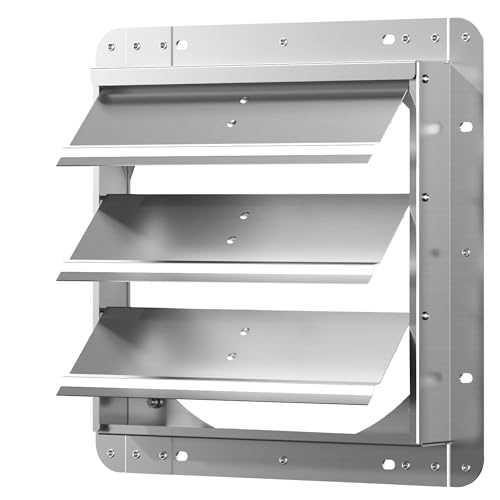
For houses up to about 60 square feet the pick is the iLIVING 12 inch shutter fan at around $110, which combines the fan and its weatherproof shutter in one unit.
A 12 inch shutter exhaust fan with gravity louvers built into the same assembly, which is the right form factor for a greenhouse gable end. The integrated shutter is the point: it opens on airflow and closes when the fan stops, which seals the opening against heat loss in winter and against wind and insects year round. A bare fan in a hole does none of that and turns into a cold draught the moment it is off. Sized for houses up to roughly 60 square feet at one air change per minute.
Sizing: one air change per minute, then corrections
Calculate the internal volume, then aim to move that volume in one minute. Volume is floor area multiplied by average height, and average height rather than ridge height is the input people get wrong: a house with a 5 ft eave and an 8 ft ridge averages closer to 6.5 ft than 8.
A 6 by 8 house at 7 ft average height is 336 cubic feet, so the base figure is about 340 CFM. A 10 by 18 house at 7 ft is 1,260 cubic feet and needs about 1,260 CFM. That is the starting point rather than the answer, because three conditions raise the requirement.
Figure 1. Exhaust fan CFM by house size·7 rows
Figure 1. Exhaust fan CFM by house size
House size
Approx volume
Base CFM
With shade cloth
At 3,000 ft elevation
4 x 6 ft
168 cu ft
170 CFM
145 CFM
190 CFM
6 x 6 ft
252 cu ft
250 CFM
215 CFM
280 CFM
6 x 8 ft
336 cu ft
340 CFM
290 CFM
380 CFM
6 x 10 ft
420 cu ft
420 CFM
360 CFM
470 CFM
8 x 12 ft
672 cu ft
670 CFM
570 CFM
750 CFM
10 x 12 ft
840 cu ft
840 CFM
715 CFM
940 CFM
10 x 18 ft
1,260 cu ft
1,260 CFM
1,070 CFM
1,410 CFM
Base figures assume one complete air change per minute at an average internal height of 7 ft, which is the standard hobby greenhouse rule. Shade cloth at 50 percent reduces the cooling load meaningfully. Elevation raises the requirement because thinner air carries less heat per cubic foot. Fan CFM ratings are free-air figures and real delivery through a shutter and against intake restriction is lower, so choose a fan with margin.
Elevation raises the requirement, because thinner air carries less heat per cubic foot. Above roughly 1,000 feet the correction becomes worth applying and by 5,000 feet it is substantial. Light intensity raises it in high-sun regions. Shade cloth lowers it, sometimes dramatically, which is why shade is the cheapest cooling in the system and belongs before fan capacity. The ventilation CFM calculator applies all three, and the fan CFM chart tabulates the result.
The three tiers
Exhaust fans in three tiers
3 tiers · priced at the time of writing
Beginner
A small house or a tunnel where a permanent installation is not wanted.
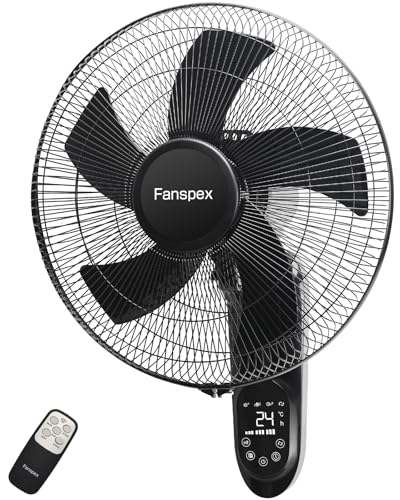
A wall-mounted fan moves useful air without cutting a hole in the structure, which matters on a rented site, a film house or a kit you may reconfigure. For a small house that mainly needs help on the hottest afternoons rather than continuous extraction, it covers the requirement at the lowest cost and can be repositioned.
The trade-off:
It circulates and pushes air rather than sealing an exhaust opening, so it is far less effective at genuine heat removal than a shutter fan in a gable. It also has no shutter, so it offers nothing in winter.
Fan and gravity shutter in one assembly, which is the correct arrangement for a greenhouse. The shutter opens on airflow and closes when the fan stops, sealing against heat loss, wind and insects. Sized properly it delivers one air change per minute for houses in the most common hobby range, and on a thermostat cooling outlet it runs entirely unattended.
The trade-off:
It requires cutting and framing an opening in the gable, which is irreversible and needs doing carefully on a polycarbonate panel. At 12 inches it runs out of capacity above roughly 60 to 80 square feet of floor.
At 14 inches the fan reaches the CFM a larger house actually requires. Undersizing at this scale is the most common error in hobby greenhouse ventilation, because the volume rises faster than people estimate and a fan chosen by eye is invariably too small. This is the size that lets a 10 by 18 house stay usable through summer rather than merely survivable.
The trade-off:
A larger fan needs a proportionally larger intake, and the intake is what limits most installations. Fitting this without opening at least 1.25 times its face area at low level will simply produce a noisy fan pulling against a partial vacuum.
Intake area, which is what most installations get wrong
A fan cannot exhaust air that is not being replaced. This sounds obvious and is the single most common ventilation error in hobby greenhouses: a correctly sized fan fitted in one gable with no intake opening at the other end, pulling against a sealed structure.
The working rule is that intake area should be at least 1.25 times the fan's face area, and more is better. For a 12 inch fan, face area is roughly 0.79 square feet, so intake wants to be around 1 square foot minimum. A louvered shutter vent at low level in the opposite gable is the standard solution, and louvers are used rather than an open hole so the intake seals when the fan stops.
Position matters as much as area. Intake low, exhaust high, at opposite ends. Air enters cool at floor level, warms, rises, and leaves at the ridge, which works with the stack effect rather than against it. Intake and exhaust on the same end short-circuits: the fan pulls the air it just expelled straight back in and the far end of the house never ventilates at all.
Watch out
Rated CFM is a free-air figure
Fan ratings are measured with nothing in front of or behind the fan. In a real installation the shutter, the intake restriction and any insect mesh all reduce delivery, commonly by 20 to 30 percent in a typical hobby setup. Insect mesh in particular is a large restriction and is frequently added after the fact without any allowance. Choose a fan with margin over the calculated figure rather than one that exactly meets it on paper.
Shutter, inline or circulation
Three fan types appear in greenhouse contexts and they do different jobs. Buying the wrong type is more common than buying the wrong size.
Shutter fans mount in a wall opening with integral gravity louvers. This is the correct type for greenhouse exhaust: high volume at low pressure, which is exactly the requirement when moving air through a large opening, and self-sealing when off.
Inline duct fans such as the VIVOSUN P6 are built for pressure rather than volume, which suits moving air through ducting and filters. In a greenhouse they make sense for a specific extraction run, such as venting a propagation enclosure, but they are the wrong tool for whole-house cooling because the CFM per dollar is far worse when no ducting is involved. The AC Infinity filtration kit belongs in the same category: useful for a controlled sub-space, not for a house.
Circulation fans such as the CloudRay S6 or clip fans do not ventilate at all. They move air inside the house, which is a completely different and equally necessary job, covered in best greenhouse circulation fans. A house needs both, and conflating them leaves one job undone.
Controlling the fan
An exhaust fan on a manual switch gets used on the days you are home and thinking about it, which is not the same set of days on which the house overheats.
The standard arrangement is a thermostat with a cooling outlet, such as the ITC-308, set to start the fan at the top of the acceptable range. Leave a wide dead band between the heating setpoint and the cooling setpoint, because a house that heats at 40 F and cools at 80 F is behaving correctly and one that heats at 40 and cools at 45 is fighting itself.
A useful refinement is running the fan on a brief cycle in winter even when cooling is not needed, to control humidity. A few minutes of extraction on a mild winter afternoon dumps the moist air and costs relatively little heat because the outside air is at its warmest. This is one of the more effective disease interventions available and it is covered in humidity and disease control.
How we chose
We did not measure airflow on these fans, and any site claiming its own CFM verification of three shutter fans is telling you a story. We compared published CFM ratings and the conditions they were measured at, motor type and enclosure rating, shutter construction, blade material, noise figures where published, and verified owner reviews weighted toward multi-season outdoor reliability.
Two things drove the ranking. The first is the shutter, which is the component that fails first in this category. Aluminum louvers on a proper pivot outlast thin steel ones that corrode at the hinge and then either stick open, which loses heat all winter, or stick closed, which stalls the fan. The second is motor sealing: a greenhouse gable is a wet, dusty position and open-frame motors intended for indoor use fail early there.
We treated published CFM figures as comparative rather than absolute throughout, because they are free-air measurements and real delivery in a greenhouse installation is materially lower. The sizing guidance on this page already builds in margin for that.
The rest of the ventilation system
What an exhaust fan needs around it
A fan on its own is half a system. The intake is not optional, and the other three are what handle the conditions the fan is wrong for.
A fan cannot exhaust air that is not being replaced. Intake area of at least 1.25 times the fan face area, at low level in the opposite gable, is what makes the fan work at all.
A wax cylinder opener handles the mild spring and fall days by itself, with no power and nothing to fail, which is most days of the year in most climates.
Shade removes energy before it enters the glazing, which no fan can do. It reduces the CFM requirement substantially and is the cheapest cooling in the system.
A cooling outlet on a thermostat runs the fan on the days the house overheats rather than the days you remember to switch it on. Those are not the same days.
+- What size exhaust fan do I need for my greenhouse?
Aim for roughly one complete air change per minute in summer. Multiply floor area by average internal height to get volume in cubic feet, and that number is your target CFM. A 6 by 8 house at 7 ft average height is 336 cubic feet, so about 340 CFM. Raise the figure for elevation and high light, lower it if you fit shade cloth, and choose a fan with margin because rated CFM is a free-air figure.
+- Do I need an intake vent as well as an exhaust fan?
Yes, and it is the most commonly missed part of the installation. A fan cannot exhaust air that is not being replaced. Intake area should be at least 1.25 times the fan face area, fitted low in the opposite gable so cool air enters at floor level and warm air leaves high. Intake and exhaust at the same end short-circuits and leaves the far end of the house unventilated.
+- Where should a greenhouse exhaust fan be mounted?
High in one gable end, with the intake low in the opposite gable. That arrangement works with the natural stack effect, since warm air is already rising. Mounting the fan low, or putting intake and exhaust at the same end, both undermine the airflow pattern and leave stagnant zones where fungal disease establishes.
+- Should a greenhouse fan run all the time?
An exhaust fan should run on a thermostat cooling outlet, starting at the top of your acceptable temperature range, so it responds to the days that need it rather than the days you are present. A separate internal circulation fan is a different matter and does benefit from running continuously whenever the house is closed, because constant air movement across leaves is the main control on fungal disease.
+- Is a shutter fan better than a regular fan for a greenhouse?
For exhaust, yes. The integral gravity shutter opens on airflow and closes when the fan stops, sealing the opening against heat loss in winter and against wind and insects year round. A bare fan in an opening becomes a permanent cold draught the moment it is off. Shutter fans are also designed for high volume at low pressure, which is what moving air through a large opening requires.
+- Does shade cloth reduce the fan size I need?
Substantially, and it is the cheapest way to do so. Shade removes solar energy before it passes through the glazing, which no fan can do, so it lowers the cooling load rather than removing heat after the fact. Fitting 50 percent shade cloth on the outside of the glazing can reduce the ventilation requirement meaningfully. Fit it outside, not inside, since interior cloth has already let the energy in.
Working out the figures for your own house and season? The Greenhouse Build & Growing Planner is the
paid version of these pages: 8 printable worksheets you fill in with your own
numbers, plus the full PDF, $29.