Irrigation is the least visible investment in a greenhouse and the one that most changes how the building is used. A house that must be hand-watered twice a day in summer organizes the rest of your life around it. A house on a timer does not, and the plants get watered on the schedule they need rather than the schedule you are available for.
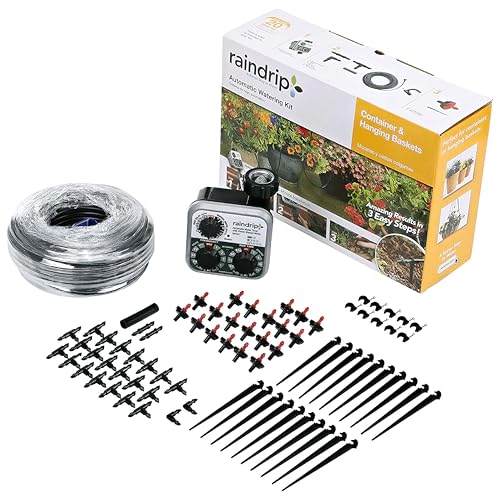
For a typical hobby house the pick is the Hiraliy 59 ft drip kit at around $29.99, paired with a four-zone timer so different parts of the house can run on different schedules.
Best for most hobby greenhouses
How much water a greenhouse actually uses
Sizing irrigation starts with demand, and greenhouse demand is higher than outdoor demand for the same crop because the plants are warmer, the growing season is longer and no rain ever falls on them.
The working figure for a crop in active growth at summer light levels is roughly 0.15 to 0.3 gallons per square foot of canopy per day. A 36 square foot house with two thirds of its floor in production is therefore using somewhere between 3.5 and 7 gallons a day in high summer. Individual containers are more demanding still: a 5 gallon grow bag of tomatoes at peak can exceed a gallon a day on its own.
| Season and condition | Per sq ft of canopy per day | A 36 sq ft house | Notes |
|---|---|---|---|
| High summer, fruiting crops | 0.25 to 0.30 gal | 6 to 7 gal/day | Peak demand, may need three cycles daily |
| High summer, leafy crops | 0.15 to 0.20 gal | 3.5 to 5 gal/day | Lower canopy, lower transpiration |
| Spring and fall, active growth | 0.10 to 0.15 gal | 2.5 to 3.5 gal/day | Moderate light, moderate demand |
| Winter, hardy crops holding | 0.03 to 0.06 gal | 0.7 to 1.4 gal/day | Growth is minimal, overwatering is the risk |
| Propagation trays, any season | By tray, not area | About 0.5 gal per 1020 tray | Bottom watering, little and often |
The fivefold seasonal swing is the practical point. A timer left on a summer schedule through winter will drown a house of overwintering plants, and winter root rot from overwatering is a more common loss than winter cold. The water use calculator works the figure for a specific footprint and season.
The three tiers
Greenhouse irrigation in three tiers
Beginner

Buy once

Expert
Why drip rather than overhead
Outdoors, overhead watering is fine and rain does it anyway. Under cover it is a practice worth abandoning entirely, for three reasons.
Wet foliage is how greenhouse disease starts. Botrytis and downy mildew need free water or near-saturated air at the leaf surface to germinate. In still, warm greenhouse air, leaves wetted in the evening stay wet for hours. Drip delivers to the medium and leaves the canopy dry, which removes the condition rather than treating the consequence.
Overhead watering raises house humidity. Water on foliage and on the medium surface evaporates into the same enclosed air volume, pushing relative humidity up at exactly the time of day when it is already rising. In winter this is a significant contributor to the sustained high humidity that causes most cold-season losses.
Hand watering a dry container mostly runs off. A container that has dried out develops channels and shrinks from the pot wall, so water poured on top runs down the sides and out of the base while the root ball stays dry. Drip applies water slowly enough for the medium to absorb it, which is why drip-watered containers stay evenly moist and hand-watered ones oscillate.
Timers and scheduling
The timer is what turns irrigation from equipment into a system, and there are three grades that matter.
A basic single-zone hose timer runs one circuit on one schedule. For a tunnel or a single-bed greenhouse this is sufficient and it is the cheapest route to unattended watering.
A four-zone timer runs four circuits on four independent schedules from one tap, which is what a mixed greenhouse needs. Beds on a long infrequent cycle, containers on short frequent ones, and propagation on its own schedule entirely.
A programmable timer with finer scheduling control suits a grower who wants to change the pattern seasonally without reprogramming from scratch, which given the fivefold demand swing between summer and winter is a real convenience.
On scheduling itself, the reliable principle in containers is short and frequent rather than long and infrequent. Three short cycles a day keep a container evenly moist, where one long cycle produces a saturated pot that then dries to the point of stress before the next. In beds the reverse applies: deeper, less frequent watering encourages roots downward, and frequent light watering keeps roots shallow.
Water source and quality
Where the water comes from matters more under cover than outdoors, and the reason is that nothing ever leaches.
Outdoors, rainfall passes through the soil profile continuously and carries dissolved salts down and away. Under cover, the only water entering the medium is what you apply, and everything dissolved in it stays behind when the water is taken up or evaporates. In a hard water area, carbonates and salts accumulate in beds and containers season after season, raising pH and eventually causing marginal leaf scorch and poor growth in a medium that tests as well fed.
Rainwater avoids this entirely, being soft and close to neutral. A greenhouse roof is also a substantial catchment that most owners never connect: a 10 by 18 house has 180 square feet of roof, and one inch of rain on that yields roughly 112 gallons. The gutter kit, diverter and barrel are a modest investment against that. Sizing is in the rain barrel capacity calculator.
Stored water has a second benefit inside the house: thermal mass. A 55 gallon barrel holds about 458 pounds of water, absorbing roughly 458 BTU per degree F of rise and releasing it overnight. Barrels that serve as both irrigation reserve and heat store are doing two jobs for one footprint, which is why they appear in the heat group of the expert build.
Maintenance, and the failure that catches everyone
Drip systems fail by blocking, and they do it gradually enough that the first sign is usually a dead plant rather than a visible fault.
Three causes, in order of frequency. Mineral scale from hard water builds inside emitters until flow drops. Biological growth in tubing left full of warm standing water forms a slime that carries into emitters. Particulate from the supply, particularly from a rain barrel, blocks emitters directly, which is why a filter at the head of the system is essential on any rainwater-fed installation.
The maintenance routine that prevents all three is short. Fit a filter and clean it monthly in season. Flush the lines by removing the end caps and running the system briefly at the start and end of each season. Drain everything before winter freezing, since water left in tubing splits it. And check individual emitters by observation rather than assumption: walk the system while it is running once a fortnight and look at each emitter.
The propagation bench is the exception to all of this, because it should not be on drip at all. Capillary matting under trays waters from below by wicking, which is the correct method for seedlings and removes the damping-off risk that any overhead method creates. A self-watering tray does the same in one unit.
How we chose
We did not run these systems through a season, and any site claiming hands-on testing of six irrigation kits is telling you a story. We compared component counts against realistic installation requirements, tubing and fitting compatibility, emitter type and flow rating, filter inclusion, and verified owner reviews weighted toward second-season reliability rather than unboxing impressions.
The property that separated kits was completeness. The dominant complaint across this whole category is discovering mid-installation that the kit contains ten emitters and four tees when the layout needs twenty and twelve, which turns an afternoon job into a week. Kits with generous fitting counts and standard tubing diameters scored higher, since standard sizing means additional parts can be bought anywhere.
We weighted filter inclusion heavily for the same reason it matters in service: a system fed from a rain barrel without a filter will block, and it will do so at the emitters, which are the most tedious component to clear.


