Misting serves two separate purposes: raising humidity around cuttings and seedlings so they lose less water than their roots can replace, and evaporative cooling in dry climates. The MistKing starter system at roughly $130 is the pick for propagation because it delivers a fine consistent mist on a timer. In an already humid house, misting is the wrong intervention and will cause disease.
Propagation target
80 to 95 percent RH
Cooling requires
Dry incoming air
Systems compared
4
Water quality
Soft, or nozzles block
Researched from published specifications and verified owner reviews · Updated 2026-08-16
Misting is the most situational equipment in a greenhouse. Used over a propagation bench it is close to essential for rooting cuttings. Used in a closed, humid house in an attempt to cool it, it creates exactly the conditions that cause botrytis. The same hardware, in two contexts, is either the right answer or a disease generator.
For propagation, the pick is the MistKing starter system at around $129.99, because consistency and droplet size are what separate a misting system from a spray bottle.
A pump-driven misting system with fine nozzles and integral timing, which is the specification that matters for propagation. Rooting cuttings need frequent brief mist cycles, on the order of several seconds every few minutes during daylight, and no manual routine sustains that. Droplet size is the other half: a fine mist evaporates into the air and raises humidity, where coarse droplets simply wet the foliage and the medium, which causes rot rather than reducing transpiration stress.
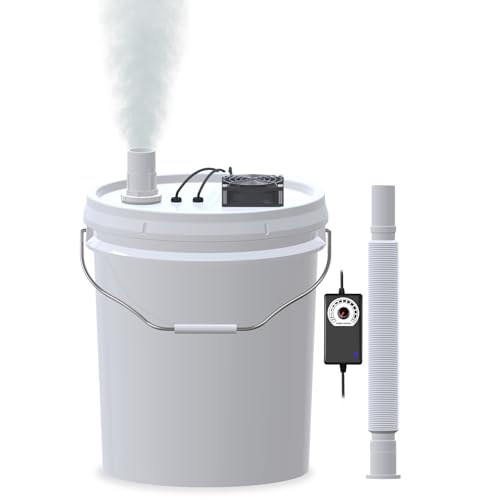
19 L DIY Fogger Humidifier Kit, Dual Mist ($39.99). An ultrasonic fogger kit at a fraction of the cost, which raises humidity in an enclosed propagation space effectively without any plumbing or pressure.
The two jobs, which are genuinely different
Propagation humidity. A cutting has no roots. It continues to transpire through its leaves while having no means to replace that water, so it wilts and dies unless the air around it is humid enough that transpiration nearly stops. Target relative humidity for rooting cuttings is 80 to 95 percent, which is far higher than any other greenhouse situation and would be actively harmful elsewhere in the house. This is why propagation misting belongs in an enclosed zone rather than applied to a whole greenhouse.
Evaporative cooling. Water evaporating in the air stream absorbs energy and lowers air temperature, which is the same principle as an evaporative cooler but distributed through the house rather than in one appliance. It works in dry air and does very little in humid air, for the reasons set out in evaporative coolers for greenhouses.
Conflating the two produces the most common misting error, which is misting a humid greenhouse in summer expecting cooling and getting mildew. If the outside air is above roughly 60 percent relative humidity during the hot hours, misting for cooling is the wrong tool and shade cloth plus extraction is the right one.
The three tiers
Misting in three tiers
3 tiers · priced at the time of writing
Beginner
A few trays or a small propagation area, misted by hand.
For a modest number of cuttings or a tray of seedlings that needs surface moisture, a hand mister is genuinely adequate and has one advantage no automatic system has: you look at the plants every time you use it. Problems get noticed. For a grower with twenty cuttings rather than two hundred, this is the correct scale of solution.
The trade-off:
It depends entirely on being present, and rooting cuttings need mist through the day rather than twice when convenient. Anything that requires sustained high humidity over weeks will not be served by hand misting.
An ultrasonic fogger produces very fine droplets with no pump or pressure plumbing, which makes it far simpler to install than a nozzle system, and it raises humidity in an enclosed space very effectively. Contained within a propagation zone rather than released into the whole house, it delivers the high humidity cuttings need without imposing it on crops that would suffer from it.
The trade-off:
It requires a genuinely enclosed space to be effective, since fog dissipates rapidly in an open greenhouse. Ultrasonic units also deposit any dissolved minerals as a fine white dust, so they want soft or distilled water rather than hard tap water.
Pump-driven high-pressure nozzles with integral timing produce a consistent fine mist on a schedule, which is what rooting cuttings actually require: brief frequent cycles through daylight hours rather than occasional soaking. The same system, aimed into the airflow of an exhaust fan, becomes distributed evaporative cooling in a dry climate, so it serves two purposes in the right conditions.
The trade-off:
Plumbing, a pump and nozzle maintenance, and nozzles block readily on hard water, which is a recurring chore rather than a one-time setup. It is also considerably more system than a grower rooting a few cuttings a year needs.
The distinction between misting, fogging and spraying is droplet diameter, and it determines the outcome completely.
Fog, roughly under 10 microns, remains suspended in air and evaporates before settling. This raises humidity without wetting anything, which is exactly what is wanted for both propagation humidity and evaporative cooling. Ultrasonic and very high pressure systems produce this.
Mist, roughly 10 to 100 microns, partly evaporates and partly settles as a light film. This is what most propagation systems produce and it is appropriate for cuttings, where a thin film on the leaf is beneficial as well as the humidity.
Spray, above roughly 100 microns, settles as droplets and wets foliage and medium. This is watering, not misting, and in a propagation context it causes rot rather than reducing stress. A cheap nozzle at low pressure produces spray regardless of what it is marketed as, which is why pressure matters as much as nozzle design.
Brass misting nozzles exist because the orifice in a misting nozzle is very small and its precision determines droplet size. Plastic nozzles wear at the orifice and the droplet size drifts upward over time, which is why a system that worked well in its first season can be wetting foliage by its third.
Watch out
Do not mist a house that is already humid
Misting a greenhouse to cool it works only when the incoming air is dry enough to absorb the water. Above roughly 60 percent ambient relative humidity, the cooling achieved is small and the humidity added is substantial, which pushes the house into the sustained high-humidity range where botrytis and mildew establish. In humid climates, shade cloth and extraction deliver far more cooling per dollar with no disease cost. Check your local humidity during the hot hours before buying a misting system for cooling.
Water quality and nozzle blockage
Misting nozzles have orifices measured in tenths of a millimetre, and everything dissolved or suspended in the water passes through them. Blockage is the defining maintenance issue of the category.
Hard water is the main cause. Calcium and magnesium carbonates precipitate as the water evaporates at the nozzle tip, building a deposit that narrows the orifice. The effect is gradual: flow drops, droplet size rises, and the system quietly stops misting and starts spraying. Soft water, and particularly captured rainwater, largely avoids this, which is another argument for the rainwater capture in the larger builds.
Particulate is the second cause and is straightforward to prevent with a filter at the head of the system, which is essential on any rainwater-fed installation. Biological growth is the third, and it is controlled by not leaving warm water standing in the lines between uses.
The maintenance routine is soaking nozzles in a descaling solution periodically, replacing them when soaking no longer restores the spray pattern, and filtering the supply. On an ultrasonic fogger, mineral content shows as a fine white dust deposited on nearby surfaces, which is a useful early indicator that the water is too hard for the equipment.
Misting for propagation, in practice
The classic propagation misting arrangement is brief and frequent: on the order of five to ten seconds of mist every few minutes during daylight hours, tapering as the cuttings root.
The reason for that pattern is that the goal is maintaining a film of moisture on the leaf and near-saturated air around it, not wetting the medium. A rooting cutting sitting in saturated medium rots at the base, which is the most common failure in propagation, and it is caused by misting for too long rather than too often.
As roots form, the plant regains its ability to replace transpired water and the misting should be reduced progressively over one to two weeks. Cuttings taken abruptly off mist wilt and are frequently lost at the last step, having successfully rooted. This weaning is the same principle as hardening off seedlings and is got wrong for the same reason.
Bottom heat under a misting bench is a genuine multiplier, because most cuttings root faster with a warm root zone and a cooler top, which is exactly the gradient misting creates by evaporative cooling at the leaf. A thermostatically controlled mat under the tray with mist above is the standard commercial arrangement in miniature.
Humidifiers, which are the enclosed-space alternative
Where the propagation area can be enclosed, a humidifier is frequently simpler than misting and achieves the same result.
A large humidifier in an enclosed propagation cabinet or a curtained-off bench holds high relative humidity continuously without wetting anything at all, which sidesteps both the rot risk and the nozzle maintenance. The constraint is that it needs a genuinely enclosed volume, because output that disperses into a whole greenhouse achieves very little.
The trade against misting is that a humidifier raises humidity without the light evaporative cooling that mist provides at the leaf surface, and that cooling is part of why misting works for cuttings under bright light. For shaded propagation the humidifier is generally the better tool; for cuttings under strong light, misting has the edge.
How we chose
We did not measure droplet size or flow rates, and any site claiming particle-size analysis of four misting systems is telling you a story. We compared published pressure and flow specifications, nozzle material and orifice size where stated, timing capability, filter inclusion, and verified owner reviews weighted toward multi-season use.
The category-defining variable is nozzle longevity, and it is why brass and stainless nozzles were weighted above plastic ones despite the cost. The failure is not dramatic: the orifice wears or scales, droplet size creeps upward, and a system that produced a fine mist begins producing spray. Because the change is gradual, growers frequently attribute the resulting rot to a disease problem rather than to the equipment.
We also weighted integral timing heavily, because propagation misting requires a cycle no manual routine sustains, and a system that requires a separate timer and solenoid to be assembled is a project rather than a product.
What goes with a misting system
The rest of the propagation environment
Humidity is one of four inputs for rooting cuttings and germinating seed. These are the others, plus the measurement that tells you whether the humidity is where you think it is.
Most cuttings root faster with a warm root zone and a cooler canopy, which is exactly the gradient mist creates. Warm below and misted above is the standard arrangement.
High humidity dissipates instantly in an open greenhouse. A dome or enclosed zone is what makes any humidity intervention effective and keeps it away from crops it would harm.
Controlling to a humidity setpoint rather than a timer means the system responds to conditions, which matters because ambient humidity varies enormously across a day.
Propagation targets 80 to 95 percent relative humidity, which is impossible to judge by feel. Logging also shows whether the level holds overnight or collapses.
Only when the incoming air is dry enough to absorb the water. In arid conditions distributed misting is genuinely effective cooling. Above roughly 60 percent ambient relative humidity the cooling achieved is small and the humidity added is substantial, which pushes the house into the range where botrytis and mildew establish. In humid climates, shade cloth and extraction deliver far more cooling with no disease cost.
+- How often should a propagation misting system run?
Brief and frequent: on the order of five to ten seconds every few minutes during daylight hours, tapering as cuttings root. The goal is a film of moisture on the leaf and near-saturated air around it, not wet medium. Cuttings sitting in saturated medium rot at the base, which is the most common propagation failure and is caused by misting for too long rather than too often.
+- What humidity do cuttings need to root?
80 to 95 percent relative humidity, which is far higher than any other greenhouse situation and would be actively harmful to established crops. A cutting has no roots, so it continues to transpire with no means of replacing that water, and only very high humidity slows transpiration enough for it to survive. This is why propagation humidity belongs in an enclosed zone rather than applied to a whole greenhouse.
+- Why do my misting nozzles keep blocking?
Almost always hard water. Calcium and magnesium carbonates precipitate as water evaporates at the nozzle tip, gradually narrowing an orifice measured in tenths of a millimetre. The effect is insidious because flow drops and droplet size rises slowly, so a system quietly stops misting and starts spraying. Soft or captured rainwater largely avoids it, and a filter at the head prevents the particulate cause.
+- Is a humidifier or a mister better for propagation?
A humidifier is simpler where the propagation area can be genuinely enclosed, because it raises humidity without wetting anything and has no nozzles to block. Misting has the edge for cuttings under strong light, since the evaporation at the leaf surface provides light cooling as well as humidity. Both require an enclosed volume; output dispersed into a whole greenhouse achieves very little.
+- Can I mist seedlings instead of watering them?
Misting is a supplement rather than a substitute. Seedlings need the medium moist to root depth, and mist wets only the surface, so a tray relying on misting alone develops a wet surface over a dry root zone, which encourages shallow rooting and damping off. Water from below by capillary action for the medium, and use mist only to keep the surface from crusting before emergence.
Working out the figures for your own house and season? The Greenhouse Build & Growing Planner is the
paid version of these pages: 8 printable worksheets you fill in with your own
numbers, plus the full PDF, $29.