Orchids are the crop that most inverts a greenhouse. Everything else on this site wants more light, and orchids want dramatically less: phalaenopsis is comfortable at 4 to 6 moles per square meter per day, which is roughly a quarter of what lettuce wants and a fifth of what tomatoes need. A greenhouse in summer delivers many times that.
They also invert the growing medium. Orchid roots are epiphytic, evolved to cling to bark in humid air with rain running past rather than sitting in soil. Potting one into ordinary compost is the single fastest way to kill it, because the roots suffocate and rot within weeks. Coarse bark that holds almost no water is what they actually want.
| Measure | Figure | Why it matters |
|---|---|---|
| Germination soil temperature | Not applicable at hobby scale | Orchid seed has no food reserve and requires sterile laboratory culture, so plants are bought rather than sown. |
| Days to emergence | Not applicable | At the optimum soil temperature, in a moist starting medium. |
| Optimum day temperature | 70 to 85 degF | Where growth is fastest. Above the range, specific processes start failing. |
| Optimum night temperature | 60 to 65 degF | The day to night difference controls stem elongation and plant habit. |
| Survives down to | 55 degF | Brief exposure on an acclimated plant, not a sustained figure. |
| Trouble above | 90 degF | Sustained heat combined with low humidity causes bud drop and stresses the root system. |
| Target daily light integral | 4 to 6 mol/m2/day for phalaenopsis, 8 to 12 for cattleya | Moles per square meter per day. Below this the crop holds rather than grows. |
| PPFD needed at 16 hours | 69 to 104 umol/m2/s | What a fixture must deliver at the canopy to reach that daily total. |
| Spacing under cover | Enough that leaves do not touch, typically 10 to 14 in | Wider than outdoor spacing, because still air makes disease the limit. |
| Floor area per plant | 0.7 to 1.2 sq ft | Includes each plant share of shoulder and path space. |
| Sowing depth | Roots at surface, never buried | Epiphytic roots need air. Burying them in dense medium is the most common way an orchid is killed. |
| Soil pH | 5.5 to 6.5 | Outside this band, nutrient availability rather than nutrient supply becomes the limit. |
| Days to first harvest | Flowering size in 2 to 4 years from a seedling, or bought in flower | From sowing, under cover, at good light. Winter timings run considerably longer. |
| Humidity preference | 0.4 to 0.8 kPa VPD | Expressed as vapor pressure deficit, which accounts for temperature as relative humidity does not. |
How do you start orchids under cover?
Orchids are not raised from seed at hobby scale. Orchid seed is microscopic and has no food reserve, relying in nature on a symbiotic fungus, and germinating it requires sterile flasked laboratory culture. Plants are bought as seedlings or in flower.
Repot into coarse orchid bark rather than compost, every one to two years, when the bark breaks down and starts holding water. This is the single most important maintenance task, and a plant left in decomposed bark will lose its roots even if nothing else is wrong. A standard potting soil is exactly what an orchid must not be planted in, which is worth stating plainly because the mistake is so common.
Repot into a container barely larger than the root mass. Orchids resent over-potting: a large pot holds a large volume of medium that stays damp, which is the condition their roots cannot survive. Clear pots are genuinely useful because they let you see root condition, which is otherwise invisible until the plant collapses.
Divide sympodial types such as cattleya and dendrobium when they outgrow their pot, leaving at least three or four growths per division. Phalaenopsis is monopodial and does not divide, though it occasionally produces an offset that can be separated once it has its own roots.
What temperature does orchids need in a greenhouse?
Phalaenopsis wants 70 to 85 degrees Fahrenheit by day and 60 to 65 at night. That day range makes them one of the few things comfortable in a summer greenhouse, but the night figure matters more than the day one.
A drop of 10 to 15 degrees Fahrenheit between day and night, sustained for several weeks in autumn, is what triggers phalaenopsis to initiate a flower spike. In a greenhouse this happens naturally as the season turns, which is one reason greenhouse-grown orchids flower more reliably than windowsill ones in a centrally heated room where the temperature barely changes.
The minimum is around 55 degrees Fahrenheit for phalaenopsis, below which the plant stops and chilling damage becomes a risk. That is warmer than most greenhouse crops need, so orchids in a cold climate mean a heated house through winter or bringing them indoors.
Above about 90 degrees, combined with the low humidity a hot greenhouse produces, orchids drop buds and the roots suffer. Shade and humidity together are the answer, and they are the same answer.
How much light does orchids need?
This is the number that defines orchid growing in a greenhouse. Phalaenopsis wants 4 to 6 moles per square meter per day, which over a 16 hour photoperiod is only 69 to 104 micromoles per square meter per second at the leaf. A greenhouse in summer delivers many times this.
That means 70 to 80 percent shade over the orchid area, which is far heavier than anything else in the house wants. Agfabric 70 Percent Sunblock Shade Cloth with Grommets, 10 x 12 ft over a dedicated bench, or a heavier cloth over a whole section, is the practical approach: shade the orchids specifically rather than shading the greenhouse to suit them.
Leaf colour is the field test. A phalaenopsis in correct light has mid-green leaves. Dark green means too little light and the plant will grow but not flower. Yellowish-green or reddish tinting means too much, and pale patches mean scorch, which is permanent. Adjust shade by leaf colour over weeks rather than chasing a meter reading.
Other genera differ substantially. Cattleya and oncidium want 8 to 12 mol/m2/day, roughly double phalaenopsis, so they belong on a less shaded part of the bench. Check any specific genus against the DLI targets chart before positioning it.
Spacing, support and training
Space so that leaves do not touch, typically 10 to 14 inches apart for phalaenopsis. Overlapping leaves trap moisture between them and hold it for hours, which is where bacterial and fungal rots start.
Height matters as much as spacing. Orchids benefit from being raised on staging or on an open mesh bench rather than sitting on a solid surface, because air needs to move around and under the pot as much as over the leaves.
Group orchids together rather than scattering them through the house. A dedicated section can be shaded heavily, humidified locally and watered on its own schedule, none of which suits the rest of a greenhouse. This is the single best organisational decision for growing orchids alongside vegetables.
Stake flower spikes as they extend, tying loosely and following the natural arch rather than pulling the spike upright. A spike snapped at the base is a year of growth lost.
Watering and feeding
Water thoroughly and then let the medium approach dryness before watering again. The epiphytic root has a spongy outer layer that absorbs water in minutes and then needs air, so a soaking followed by a dry period mimics the rain-then-dry cycle it evolved for.
Never leave an orchid standing in water. A pot sitting in a saucer of water is the most common route to root rot, and the roots will be dead long before the leaves show it.
Water quality matters more than for most crops. Orchids are sensitive to accumulated salts, and in a greenhouse where nothing is ever leached by rain, hard tap water builds up in the bark quickly. Rainwater is meaningfully better, and a rain barrel earns its place here more than almost anywhere else.
Feed weakly and frequently during active growth, at roughly a quarter of the strength a label suggests, and flush the pot with plain water monthly to clear accumulated salts. The standard advice of feeding weakly, weekly, then flushing, exists precisely because of the salt problem.
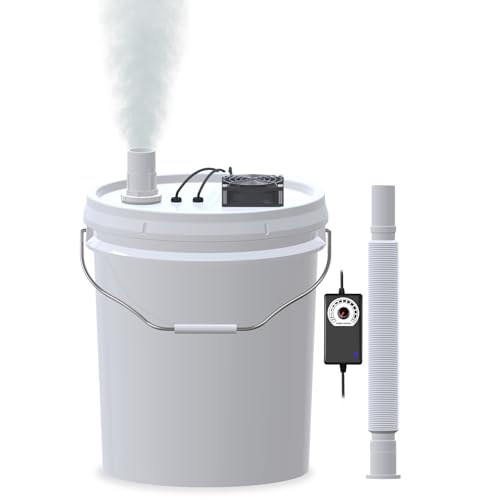
Humidity should sit high, with a vapour pressure deficit of 0.4 to 0.8 kPa, which is considerably more humid than vegetables want. Achieve it locally with a fogger or trays of wet gravel under the bench rather than by making the whole greenhouse damp.
What goes wrong with greenhouse orchids?
| What you see | Usual cause | What to do |
|---|---|---|
| Leaves are dark green and the plant never flowers | Too little light, which is the most common orchid complaint and the easiest to fix | Reduce shade over the orchid area until leaves are mid-green rather than dark. Light drives flowering. |
| Pale bleached patches on the leaf | Sun scorch, which is permanent tissue damage rather than a reversible stress | Increase shade immediately. The damaged tissue will not recover but new growth will be normal. |
| Plant looks fine then collapses suddenly | Root rot, from dense medium, over-potting or standing in water, and it is invisible until it is severe | Repot into coarse bark in a barely larger pot, remove all dead roots, and never leave the pot in standing water. |
| Roots are brown, soft and hollow when squeezed | Dead roots, from rot or from medium that has broken down and now holds water | Repot immediately into fresh coarse bark and cut away everything soft. Healthy roots are firm and white or green. |
| Buds yellow and drop before opening | Bud blast, from a sudden environmental change, low humidity, heat or draughts | Stabilise conditions during spike development, keep humidity up, and avoid moving a spiking plant. |
| Wrinkled, limp leaves despite a moist pot | The roots are dead and cannot take water up, so the plant is dehydrating in wet medium | Check the roots. This symptom looks like drought and is almost always the opposite. |
| Sticky residue and small brown bumps on leaves and stems | Scale insects, which are common on orchids and easily missed | Wipe off with a soft cloth, treat with a labelled horticultural product, and check new plants before introducing them. |
| Black soft patches spreading on a leaf | Bacterial rot, from water sitting in the crown or between overlapping leaves | Cut out the affected tissue with a sterile blade, keep water out of the crown, and increase airflow. |
Which types work best under cover?
| Type | Suits | Note |
|---|---|---|
| Phalaenopsis, moth orchid | Beginners and general greenhouse growing | Lowest light requirement, long-lasting flowers, and the most forgiving of imperfect conditions. |
| Cattleya | A brighter part of the bench | Wants 8 to 12 mol/m2/day, roughly double phalaenopsis, and a distinct dry rest after growth completes. |
| Dendrobium | Growers who can give a cool dry winter rest | Many types need a genuine dormant period with much less water to flower properly. |
| Oncidium | Bright shade and good airflow | Fine roots that dry quickly, so they want more frequent watering than phalaenopsis in the same conditions. |
| Paphiopedilum, slipper orchid | The shadiest part of the house | Terrestrial rather than epiphytic, so they take a slightly more moisture-retentive medium, and lowest light of all. |
| Cymbidium | A cool greenhouse with a cold autumn | Needs a substantial autumn night temperature drop to flower, and tolerates far cooler conditions than phalaenopsis. |
Start with phalaenopsis. It has the lowest light requirement, the widest tolerance of imperfect watering, the longest lasting flowers, and it flowers on a schedule a greenhouse naturally provides through the autumn temperature drop. Everything learned on phalaenopsis transfers to the more demanding genera.
The most common mistake when expanding a collection is treating every orchid the same. Cattleya on a phalaenopsis bench never flowers because it is too shaded, and phalaenopsis on a cattleya bench scorches. Group by light requirement rather than by appearance.
Harvesting and what comes next
Cut flower spikes for the vase only when the plant is strong, since the spike is also a food store. Phalaenopsis flowers last for months on the plant, which is far longer than in a vase, so leaving them is usually the better choice.
When a phalaenopsis spike finishes, cut it back to just above a node partway down and the plant will frequently produce a secondary spike from that node. Cutting the whole spike to the base directs energy into leaf and root growth instead, which is the better choice on a plant that looks tired.
Deadhead individual flowers as they fade rather than leaving them, since decaying petals in humid greenhouse air are where botrytis establishes and it spreads to sound flowers nearby.
Sterilise the blade between plants. Orchid viruses are transmitted on cutting tools and there is no cure, so a flamed or freshly disinfected blade for each plant is a genuine precaution rather than an excess of caution.
Equipment for growing orchids under cover



Orchids succeed in a greenhouse when they are treated as a separate zone rather than as one more plant on the bench. Shade them to a quarter of what the vegetables get, keep humidity high and air moving at the same time, pot them in bark that holds no water, and water with something soft. The autumn temperature drop a greenhouse gives you for free then does the flowering.