The best automatic vent opener for most greenhouses is the Bayliss XL Autovent at roughly $80, which lifts up to about 15 pounds of vent, begins opening around 68 degrees F and needs no electricity at all. For a cold frame lid, a smaller wax cylinder unit at around $25 does the same job, and dual-spring openers suit heavier vents that a single cylinder cannot lift.
Power required
None
Opens from about
60 to 75 F
Typical lift
7 to 15 lb
Openers compared
4
Researched from published specifications and verified owner reviews · Updated 2026-08-16
If one item in a greenhouse had to justify itself above all others, it is the automatic vent opener. It costs a fraction of a heater and prevents a failure that is both more common and more total: a closed house cooking its own crop on a sunny afternoon when nobody was home.
The pick for most greenhouses is the Bayliss XL Autovent at around $80, which lifts a heavier vent than the budget units and does it with no power, no sensor and no firmware.
A wax cylinder opener rated to lift roughly 15 pounds of vent, adjustable to begin opening somewhere around 68 degrees F and fully open about 15 to 20 degrees above that. The lifting capacity is what separates it from budget units: most hobby greenhouse roof vents with a polycarbonate panel and an aluminum frame are heavier than a cheap cylinder can manage, and an opener that cannot lift its vent is worse than none because it looks like it is working. It uses no electricity, so it functions during a power cut, which is exactly when the house is unattended.
Yziixi Heavy-Duty Dual-Spring Automatic Vent Opener ($29.99). A dual-spring design for heavier or stiffer vents, where a single cylinder struggles and where the extra return spring force helps close the vent reliably as the house cools.
How a wax cylinder opener works
There is no electronics involved, which is the reason to like them. A sealed cylinder contains a wax formulated to expand substantially over a specific temperature range. As the greenhouse warms, the wax expands and pushes a piston, which drives a linkage that lifts the vent. As the house cools, the wax contracts and a return spring closes it.
The consequences are worth spelling out. It needs no power, so it works during an outage. It has no sensor to fail or drift. It responds to the actual temperature at the vent rather than to a setpoint someone chose. It operates gradually rather than in steps, so the vent tracks conditions continuously. And the only consumable part is the cylinder itself, which is replaceable and typically lasts many years.
The limitations are equally simple. It lifts a limited weight. It cannot be overridden remotely. It has a fixed relationship between temperature and opening, adjustable only by a threaded collar that shifts the whole range up or down. And it opens slowly, which is correct behaviour but means it will not respond to a sudden change in the way a fan on a thermostat does.
The three tiers
Vent openers in three tiers
3 tiers · priced at the time of writing
Beginner
A cold frame lid or a light hinged vent, where the weight is modest.
A compact wax cylinder opener sized for frames and small vents, which is where the failure it prevents is most common. A cold frame is exactly the structure most likely to be out of sight from the house and most likely to cook a tray of seedlings on a pleasant spring morning. For the price this is the single best insurance in season extension.
The trade-off:
Limited lifting capacity. On a full greenhouse roof vent with a polycarbonate panel in an aluminum frame it will strain or fail to open fully, which is a worse outcome than no opener because it appears to be working.
The lifting capacity is the specification that matters and this has enough of it for a typical glazed roof vent, with an adjustable opening temperature and a build intended for years of outdoor cycling. Matching a heavier-rated opener to a standard vent means it operates well within its capacity rather than at the limit, which is the main determinant of service life.
The trade-off:
Several times the price of a budget cylinder for the same operating principle. What you are buying is lift and durability, so on a genuinely light vent the cheaper unit does the same job.
Two springs give a stronger and more positive return, which is the half of the cycle that fails first on tired units. A vent that opens reliably but closes lazily loses heat every night, and in a heated house that is a running cost rather than an inconvenience. On stiff hinges or larger vents, the extra force is what keeps the cycle complete.
The trade-off:
The stronger return spring raises the force the wax has to work against, which can slightly raise the effective opening temperature. On a light vent that is unnecessary complexity.
Two numbers matter and the first is the one people skip.
Vent weight. Weigh or estimate the actual vent, including the glazing panel and its frame. A typical hobby greenhouse roof vent with a 2 by 2 foot polycarbonate panel in an aluminum frame is commonly in the range of 5 to 12 pounds, and heavier if the glazing is thicker or the frame is steel. Then choose an opener rated comfortably above that, not at it. An opener working at its limit opens partially, opens late and wears rapidly.
Geometry. The linkage has a fixed stroke, typically a few inches, and where it attaches determines how far the vent actually opens. Attaching closer to the hinge gives more opening for the same stroke but requires more force; attaching further away gives less opening but easier lifting. Most units ship with a bracket position that assumes a standard vent, and it is worth checking that the vent reaches a genuinely useful opening rather than a token one.
On a cold frame, the same principles apply with the additional consideration that frame lids are frequently heavier than they look, particularly timber-framed ones. A kit such as the PatioHZ opener kit with the mounting hardware included saves fabricating brackets for a lid that was never designed for one.
Watch out
An opener is not a substitute for vent area
Horticultural practice puts total vent opening at roughly one fifth of floor area for passive ventilation to work properly. A 36 square foot house therefore wants around 7 square feet of opening, and a typical hobby kit ships with closer to 2. An automatic opener makes the vent you have work by itself; it does not create the vent area you do not have. On any house used through summer, budget for a second vent, a louvered low-level intake or a powered fan as well. The airflow figure is in the ventilation CFM calculator.
Setting the opening temperature
Most units adjust by turning a threaded collar, which shifts the whole opening range up or down rather than changing its width. The width, typically 15 to 20 degrees F between first movement and fully open, is fixed by the wax formulation.
Set the first-movement point at the top of the range you want the house to sit in rather than at the temperature you consider hot. For a mixed vegetable house, first movement somewhere around 68 to 72 degrees F is a sensible default: the house then begins shedding heat as it approaches the upper end of the comfortable range rather than after it has passed it.
In spring, err toward opening earlier. The cost of a vent opening at 65 F on a cool day is a slightly cooler house, which is trivial. The cost of it opening at 80 F on a sunny day is a house that reached 110 F before anything happened, which is not. In late fall the calculation inverts and it is worth winding the collar to open later, since heat retention becomes the priority.
The one adjustment worth making seasonally is exactly that, and it takes thirty seconds twice a year. Growers who never touch the collar generally have it set for one season and wrong for the other.
Where an opener is not the answer
Automatic openers handle the everyday problem of a house heating up while nobody is home. They do not handle three situations.
Genuine summer heat. On a hot afternoon a fully open roof vent cannot move enough air, because passive ventilation depends on a temperature difference driving a stack effect and there is not enough difference on a 95 degree day. That is a fan problem. See best greenhouse exhaust fans and vent opener versus exhaust fan.
Air distribution. An open vent does nothing about a still pocket in the middle of a bench where fungal spores germinate. That is a circulation fan problem and it applies when the house is closed, which is exactly when the vent opener is not doing anything.
Humidity in winter. Venting to control humidity in winter costs heat, and the trade needs managing deliberately rather than automatically. A brief vent on a mild afternoon is the standard practice, and a wax opener set for summer will not do it. This is covered in humidity and disease control.
How we chose
We did not cycle these openers through a season, and any site claiming hands-on testing of four vent openers across multiple summers is telling you a story. We compared published lifting capacity, stated opening temperature range and adjustability, cylinder replaceability, linkage and bracket design, and verified owner reviews weighted toward multi-season reliability.
Two failure patterns shaped the picks. The first is undersizing, which dominates negative reviews across the whole category: an opener rated to lift 7 pounds fitted to a 10 pound vent will open partially, open late, or stall, and the reviews read as product failures when they are specification failures. That is why lifting capacity is weighted above every other property here.
The second is the return stroke. Cylinders that open reliably for years frequently begin closing lazily first, which loses heat overnight and is easy to miss because you are rarely watching the vent at dusk. Units with stronger return springs, or with replaceable cylinders that can be swapped when the cycle softens, scored higher for that reason.
What to fit alongside
The rest of the ventilation system
A vent opener handles the mild days by itself. These four cover what it cannot: hot afternoons, still air, low-level intake and knowing whether any of it is working.
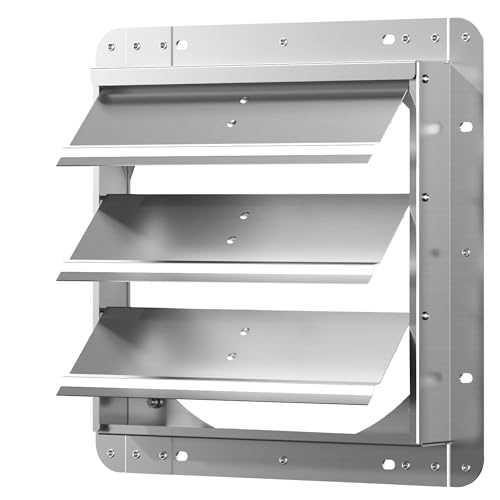
Passive venting cannot move enough air on a genuinely hot day, because the stack effect depends on a temperature difference that is not there. A shutter fan covers the top of the range.
Roof vents cannot exhaust without an intake at low level. Without one the openers are trying to breathe through a closed mouth, which is the most common ventilation error in hobby houses.
Air movement across leaf surfaces when the house is closed is the primary control on fungal disease. This is the job no vent does, because the vent is shut when it matters.
The afternoon maximum is the number that tells you whether the opener is set correctly. Without it you are adjusting the collar based on how the greenhouse felt when you happened to be in it.
+- How does an automatic greenhouse vent opener work?
A sealed cylinder contains a wax that expands over a specific temperature range. As the greenhouse warms the wax expands and pushes a piston that lifts the vent; as it cools the wax contracts and a return spring closes it. There is no electricity, no sensor and no firmware involved, so it continues to work during a power cut, which is exactly when the house is likely to be unattended.
+- At what temperature should a vent opener be set?
First movement somewhere around 68 to 72 degrees F suits a mixed vegetable house, with full opening 15 to 20 degrees above that. Set it to begin opening at the top of the range you want the house to sit in rather than at the temperature you consider hot. In spring, err toward opening earlier, because a slightly cool house costs nothing and a house that reached 110 degrees F costs a crop.
+- How much weight can an automatic vent opener lift?
Typically 7 to 15 pounds depending on the unit, and matching that to the actual vent weight is the single most important selection criterion. A hobby greenhouse roof vent with a polycarbonate panel in an aluminum frame is commonly 5 to 12 pounds. Choose an opener rated comfortably above the vent weight rather than at it, because one working at its limit opens partially, opens late and wears quickly.
+- Do automatic vent openers need electricity?
No. They operate purely on the thermal expansion of a wax cylinder, which is the main reason to prefer them over powered alternatives for the everyday venting job. No power means no wiring to the vent, no failure during an outage, and nothing to fail electronically. The only consumable is the cylinder itself, which is replaceable and typically lasts many years.
+- Is one automatic vent enough for a greenhouse?
Usually not for summer use. Horticultural practice puts total vent area at roughly one fifth of floor area, so a 36 square foot house wants around 7 square feet of opening while typical kits ship with closer to 2. An opener makes the vent you have work automatically; it does not create vent area. Add a second vent, a low-level louvered intake, or a powered fan for summer.
+- Why is my vent opener not closing properly?
Usually a weakening return spring or a tired cylinder, and it is easy to miss because you are rarely watching the vent at dusk. A vent that opens well but closes lazily loses heat every night, which in a heated house is a running cost. Check the linkage for stiffness and binding first, then replace the cylinder, which is a serviceable part on better units.
Working out the figures for your own house and season? The Greenhouse Build & Growing Planner is the
paid version of these pages: 8 printable worksheets you fill in with your own
numbers, plus the full PDF, $29.