These two are often presented as alternatives and they are not. A vent opener automates an opening you already have. A fan creates airflow you do not have. They solve different halves of the same problem, and the order matters because one of them prevents a total loss and the other improves a result.
The failure a vent opener prevents is specific and common: a clear morning in early spring, nobody home, a sealed greenhouse going from 45 degrees at dawn to over 100 by mid-morning, and a bench of seedlings that were fine yesterday. That happens on days that do not feel hot outside, which is exactly why it catches people.
The comparison
| Measure | Wax vent opener | Thermostatic exhaust fan |
|---|---|---|
| Power required | None | A circuit, typically 40 to 90 W |
| Cost | Low | Several times higher, plus wiring |
| What it does | Opens an existing vent on temperature | Moves a specified volume of air per minute |
| Airflow achieved | Whatever the stack effect and wind provide | Sized precisely, about 8 CFM per sq ft of floor |
| Works in still air | Partly, via the stack effect | Fully |
| Works in a power cut | Yes | No |
| Needs an intake | Yes, a low opening for the stack effect | Yes, at least as large as the fan outlet |
| Closes for weather | No, it responds only to temperature | No, and it may run in a gale |
| Maintenance | A wax cylinder, replaceable, occasional | Motor, shutters and a thermostat |
| Failure consequence | Vent stays shut, house overheats | No powered airflow, passive venting continues |
Why the opener comes first
Three reasons, and they are all practical rather than theoretical.
It needs no power. An enormous number of hobby greenhouses have no electricity at the site, and a wax opener is the only automation available to them. A GDHSWJ Solar Automatic Greenhouse Vent Opener ($26.99) contains a wax that expands as it warms, pushing a piston that lifts the vent, and contracts as it cools to close it again. Most begin opening somewhere around 60 to 75 degrees Fahrenheit and are fully open roughly 25 degrees above that, with the setpoint adjustable by turning the cylinder in its housing.
It costs very little relative to what it prevents. The comparison is not opener against fan, it is opener against a bench of seedlings, and the opener wins that comparison many times over in its first season.
It acts on the right schedule. A greenhouse needs venting by mid-morning on a clear day even in early spring and closing again before evening. That schedule is set by the sun and does not align with anybody working day. An opener follows it exactly.
Match the opener to the vent weight. Most lift 15 to 30 pounds. A heavier vent, or a house on an exposed site where the vent takes wind load, wants a dual-spring unit such as the Yziixi Heavy-Duty Dual-Spring Automatic Vent Opener ($29.99) or a heavier-duty Bayliss XL Autovent Automatic Window Opener ($80.69). Fitting an undersized opener produces a vent that opens partway and stalls, which is worse than a manual vent because it looks like it is working.
When the fan becomes necessary
Standard horticultural practice puts total passive vent opening at roughly one fifth of floor area, split between ridge and side vents. A typical 6 by 8 foot kit greenhouse at 48 square feet therefore wants about 9.6 square feet of vent, and ships with one roof vent of 2 to 3 square feet plus a door.
That shortfall is the fan case in one sentence. Where the structure cannot be given enough openable area, mechanical ventilation substitutes. So does a hot climate, a sheltered site with no wind to drive passive flow, and any house where the temperature rise between the intake end and the far end needs to be held tighter than passive flow can manage.
Size it properly rather than by eye: floor area multiplied by 8 CFM, corrected for house length, elevation, light level and the temperature rise you will accept. The ventilation CFM calculator applies all four corrections, and the fan CFM chart tabulates the common cases.
An iLIVING 12 in Wall-Mounted Shutter Exhaust Fan with Thermostat ($68.98) with a built-in thermostat is the standard hobby answer and covers a small to medium house. Larger houses want the iLIVING 14 in Wall-Mounted Shutter Exhaust Fan with Temperature and Humidity Controls ($115.99) or a pair of smaller units, which also gives redundancy.
The intake, which decides whether either works
Both devices depend on an opening for air to come in, and this is the part most often missed.
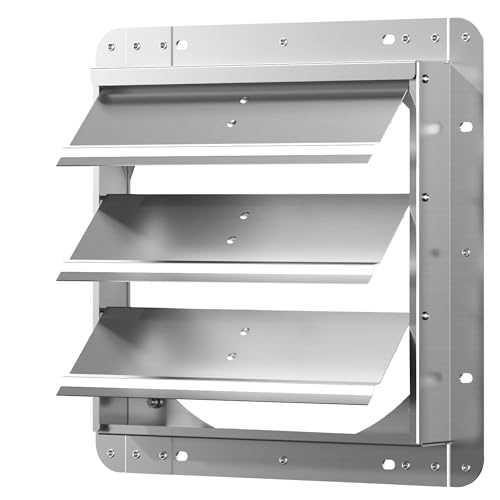
For a vent opener, the stack effect needs height between intake and exhaust: warm air leaves through the ridge vent and cool air enters through a low opening. Two vents at the same height do very little. A 12 in Galvanized Gravity Shutter Louver Vent ($38.99) low in a gable end is what makes a roof vent work properly, and it is a cheap addition that improves passive performance more than a second roof vent would.
For a fan, the intake must be at least as large as the fan outlet and preferably larger, or the fan works against a partial vacuum and moves substantially less air than its rating. And it belongs at the opposite end of the house, low down, so the air sweeps the length of the growing space instead of short-circuiting across a corner.
Circulation is a third thing entirely
Neither device addresses air movement inside the house. Exhaust ventilation exchanges air with outside; circulation moves it around within. Still air forms a saturated boundary layer over every leaf, and that film is where fungal spores germinate.
A Roodike 5 in Clip-On Circulation Fans, 2-Pack ($35.99) running continuously at a few watts breaks that layer, keeps leaf surfaces drying and produces measurably sturdier stems. It is the cheapest disease control on this site and it should run all the time, including overnight and through winter, for the reasons in humidity and disease control.
The buying order
- Automatic vent opener on every openable roof vent. Do this before anything else, including before a shade cloth.
- A low intake vent in a gable end, so the roof vent has somewhere to draw from.
- A circulation fan, running continuously. Cheap, low wattage, and it addresses disease rather than temperature.
- Shade cloth, which reduces the heat arriving and usually does more for peak temperature than a fan does. Covered in cooling a greenhouse in summer.
- An exhaust fan, sized properly, once the passive options are exhausted or the climate demands it.
Venting equipment in buying order



The full sizing method for both passive area and mechanical airflow is in greenhouse ventilation basics.