A closed greenhouse in full summer sun will pass 120 degrees Fahrenheit before mid-morning, and at that temperature tomato pollen becomes non-viable, lettuce bolts and seedlings cook. Ventilation is not a comfort feature, it is the thing that decides whether a summer crop exists.
Sizing follows the National Greenhouse Manufacturers Association method. Multiply floor area by 8, which is the figure that produces one complete air change per minute in a house of average height, then apply four correction factors. The one that catches hobby growers out is the house-length factor: it is a square root of 100 divided by length, which means a 12 foot long house needs 2.9 times the airflow per square foot that a 100 foot commercial house does. Short houses leak proportionally more through their end walls.
| Size | Floor area | CFM, full sun, sea level | CFM, 40 percent shaded | CFM at 5,000 ft | Passive vent area needed |
|---|---|---|---|---|---|
| 4 x 6 ft | 24 sq ft | 775 | 475 | 950 | 4.8 sq ft |
| 6 x 4 ft | 24 sq ft | 950 | 575 | 1,150 | 4.8 sq ft |
| 6 x 6 ft | 36 sq ft | 1,175 | 700 | 1,425 | 7.2 sq ft |
| 6 x 8 ft | 48 sq ft | 1,350 | 825 | 1,650 | 9.6 sq ft |
| 6 x 10 ft | 60 sq ft | 1,525 | 900 | 1,850 | 12 sq ft |
| 8 x 8 ft | 64 sq ft | 1,800 | 1,075 | 2,200 | 12.8 sq ft |
| 8 x 10 ft | 80 sq ft | 2,025 | 1,225 | 2,450 | 16 sq ft |
| 8 x 12 ft | 96 sq ft | 2,225 | 1,325 | 2,675 | 19.2 sq ft |
| 10 x 12 ft | 120 sq ft | 2,775 | 1,675 | 3,350 | 24 sq ft |
| 10 x 16 ft | 160 sq ft | 3,200 | 1,925 | 3,875 | 32 sq ft |
| 10 x 18 ft | 180 sq ft | 3,400 | 2,025 | 4,100 | 36 sq ft |
| 12 x 20 ft | 240 sq ft | 4,300 | 2,575 | 5,200 | 48 sq ft |
Why an exhaust fan with no intake barely works
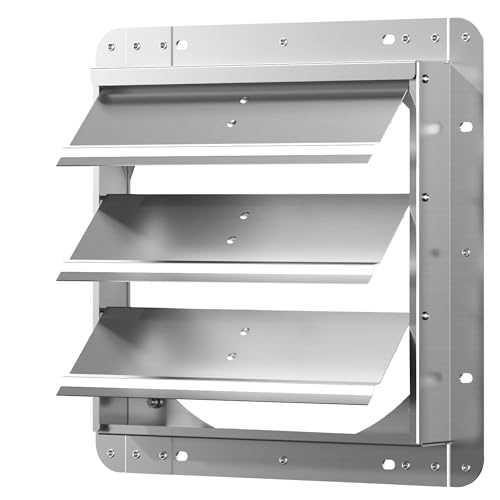
This is the single most common ventilation mistake in hobby greenhouses. A fan can only push out what it can pull in. Mount a 1,300 CFM shutter fan on a sealed house with no intake opening and it will move a fraction of its rating, run hot, and make far more noise than air. The intake needs to be at least 1.25 times the fan's own opening area, positioned at the opposite end and low down, so incoming cool air sweeps the length of the house before it leaves. A gravity louver shutter is the standard part, and it opens automatically under the fan's own suction with no power of its own.
Passive venting before powered venting
The last column of the chart is the passive alternative, and on houses under about 100 square feet it is often the whole answer. Standard horticultural practice is a total vent opening of roughly one fifth of floor area, split between ridge vents and side vents so warm air can leave at the top while cool air enters at the bottom. That stack effect needs no power, makes no noise and does not fail in a blackout.
Almost no hobby kit ships with anywhere near a fifth of floor area in vent opening. A typical 6 by 8 kit has one roof vent of about 3 square feet against a requirement near 9.6. The cheapest correction is a second vent, and the cheapest way to operate either is a wax-cylinder opener such as the Bayliss XL Autovent Automatic Window Opener, which lifts the vent as the house warms with no electricity involved and never forgets on a workday.
The three stages of greenhouse cooling, in order
- Shade first. Blocking light before it enters is always cheaper than removing the heat afterwards. 50 percent shade cloth over the roof cuts the solar load roughly in half for the price of one fan.
- Passive venting second. Ridge and side vents on automatic openers, sized toward the one fifth of floor area figure. No running cost, no failure in a power cut.
- Powered exhaust third. Sized from the chart above, with a matched intake, on a thermostat. This is what handles the worst two hours of the worst days.
- Evaporative cooling last. Only worth it in dry air, only above roughly 100 square feet, and it adds humidity you may not want.
Ventilation equipment by house size
-

-

-

100 to 200 sq ft
iLIVING 14 in Wall-Mounted Shutter Exhaust Fan with Temperature and Humidity Controls
$115.99
-
Matching a real fan to a CFM figure
Fan ratings are published at zero static pressure, which is a fan in free air with nothing in front of it. A shuttered wall fan pushing through its own louvers and pulling through an intake screen is working against static pressure, and the delivered airflow is typically 15 to 25 percent below the free-air rating. Add that margin when you select, or size from the manufacturer static-pressure curve if they publish one.
| Fan diameter | Free-air CFM | Realistic delivered CFM | Suits floor area up to |
|---|---|---|---|
| 6 in inline duct fan | 250 to 400 | 200 to 320 | 25 sq ft |
| 8 in inline duct fan | 400 to 800 | 320 to 640 | 50 sq ft |
| 10 in shutter fan | 800 to 1,100 | 650 to 900 | 60 sq ft |
| 12 in shutter fan | 1,100 to 1,500 | 900 to 1,200 | 85 sq ft |
| 14 in shutter fan | 1,600 to 2,100 | 1,300 to 1,700 | 120 sq ft |
| 16 in shutter fan | 2,200 to 2,900 | 1,800 to 2,300 | 160 sq ft |
| 18 in shutter fan | 3,000 to 3,900 | 2,400 to 3,100 | 215 sq ft |
| 20 in shutter fan | 4,000 to 5,200 | 3,200 to 4,200 | 290 sq ft |
Circulation is a different job from exhaust
Horizontal airflow, which is air moved around inside the house rather than out of it, is the ventilation job most hobby growers skip entirely and the one with the clearest disease consequence. Still air inside a leaf canopy becomes saturated because the leaf is transpiring into it, and a saturated boundary layer on a leaf surface at night is the precondition for botrytis. Air movement of even 50 to 100 feet per minute across the canopy breaks that layer up.
The commercial standard is horizontal airflow fans running continuously at low speed year round, including all winter when the exhaust fan is off. On a hobby scale a pair of small clip fans on a propagation shelf, or a quiet 6 inch clip fan above a seedling tray, does the same thing. The secondary benefit is mechanical: seedlings grown in moving air develop measurably thicker stems and transplant with less shock, which is why commercial propagators run fans over trays deliberately.
Work your own figure with the ventilation CFM calculator, which applies all four correction factors to your dimensions and elevation. The reasoning behind the numbers is in ventilation basics, the humidity side in humidity and disease control, the summer strategy in cooling a greenhouse in summer, and the passive-versus-powered decision in vent opener versus exhaust fan.