A greenhouse gathers far more heat during a sunny winter day than it can use, then loses it all within a couple of hours of sunset. That is the whole problem thermal mass addresses. It does not create heat. It moves heat from the middle of the day, when there is a surplus and the house is venting to get rid of it, to the middle of the night, when there is a deficit and the heater is running.
It is the only heating measure with no running cost and no failure mode. A barrel of water does not need a circuit, cannot trip a breaker, and works identically during a power cut. Against that, it is slow, its effect is measured in a few degrees rather than many, and it takes up floor space.
What actually stores heat, and how much
The property that matters is volumetric heat capacity: how much heat a given volume absorbs for each degree of temperature rise. Water is exceptional at this, which is why every serious passive solar greenhouse design uses it.
| Material | Heat stored per cu ft per degF | Practical form | Note |
|---|---|---|---|
| Water | About 62 BTU | Barrels, tanks, stacked jugs | Roughly four times concrete by volume, and it circulates internally so the whole mass charges evenly |
| Concrete or masonry | About 22 BTU | A north wall, paving slabs, a block bench base | Slower to charge and discharge, and useful as structure at the same time |
| Damp soil | About 25 BTU | The greenhouse floor itself | Free, already present, and the reason a soil floor beats a raised deck |
| Dry soil or sand | About 18 BTU | A sand bench base | Considerably less effective dry than damp, which is worth knowing |
| Air | About 0.02 BTU | The greenhouse volume | Effectively zero, which is why an empty greenhouse tracks outside temperature so closely |
The practical consequence of that last row is worth stating. A greenhouse full of air and empty benches has almost no capacity to hold heat overnight. The same greenhouse with a soil floor, full beds and a couple of water barrels behaves quite differently, and the difference is not marginal.
Sizing the mass to the house
The commonly published rule of thumb for a passive solar greenhouse is 2 to 5 gallons of water per square foot of floor area, with the lower end for a house that is also heated and the upper end for a house relying on mass alone.
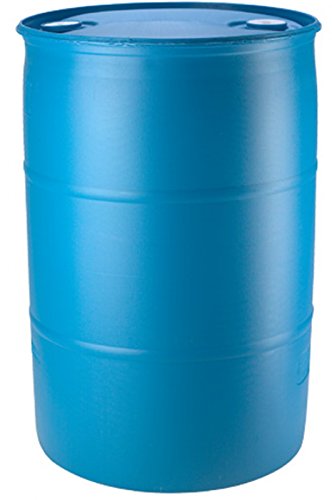
For a 6 by 8 foot house at 48 square feet, that is roughly 96 to 240 gallons, which is two to four 55 gallon barrels. Two barrels occupy about 5 square feet of floor, which on a 48 square foot house is a real sacrifice, and this is the honest limitation of thermal mass at small scale: the houses that most need help holding their minimum are the ones with the least room to store it.
The arithmetic of what that buys is straightforward. Two 55 gallon barrels hold 110 gallons, which is about 918 BTU for every degree Fahrenheit they cool. If they charge to 70 degrees during a sunny day and give up 15 degrees overnight, they release roughly 13,700 BTU into the house across the night. Set against a small house losing perhaps 4,000 BTU per hour at a 35 degree differential, that is several hours of the deficit covered, and in practice it shows up as a pre-dawn minimum a few degrees higher than it would otherwise have been.
Where to put it, which matters as much as how much
- In direct winter sun. Mass that never sees the sun never charges. The correct position is along the north side of the house where the low winter sun striking through the south glazing lands on it directly through the middle of the day.
- Painted a dark colour. A black or dark green barrel absorbs far more of the incident radiation than a white or translucent one. This is a large effect and it costs a can of paint.
- Not shading the crop. Barrels along the north wall are behind the growing area from the sun point of view, so they intercept light that would otherwise hit the north wall and be lost. Barrels in the middle of the house shade plants, which defeats the purpose.
- Where the floor can carry it. Water weighs 8.34 pounds per gallon, so a full 55 gallon barrel is about 460 pounds plus the drum. On a soil or gravel floor, spread the load with a paver. Do not put a full barrel on a bench.
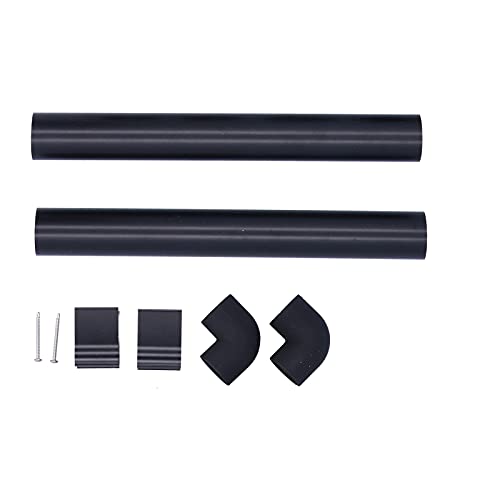
- Doing a second job. A barrel that is also the irrigation reservoir earns its floor space twice. Fed from a 32 mm Greenhouse Gutter and Water Butt Collection Kit ($23.39), it stores rainwater for irrigation and heat at the same time.
The floor and the beds are mass you already have
Before buying anything, notice that a greenhouse with a soil floor and full beds already contains a substantial thermal store. Damp soil holds about 25 BTU per cubic foot per degree, so a 4 by 8 foot bed 12 inches deep is 32 cubic feet holding around 800 BTU per degree, comparable to two barrels.
This is the strongest practical argument against a raised timber deck floor and for a soil or gravel one, and it is covered further in greenhouse flooring and paths. It is also an argument for deeper beds rather than shallower ones, which is separately good for root volume and for watering consistency. Size a bed fill with the bed and soil volume calculator.
What thermal mass will not do
Three honest limitations, because passive solar writing is prone to overclaiming.
It does not guarantee a minimum. Mass shifts heat in time; it does not create it. After three overcast days the mass is discharged and the house is running on whatever it can gather, which in midwinter is very little. Anything that must not freeze still needs a heater as backup.
It cannot be sized up indefinitely at hobby scale. The floor area is the constraint, and past two or three barrels a small greenhouse is mostly barrels.
And it works in both directions, which is occasionally an advantage. The same mass that raises the night minimum also lowers the day peak, because heat going into the barrels is heat not raising the air temperature. In summer that is genuinely useful. In a marginal spring it slightly slows the morning warm-up, which for seed germination is a small cost.
Thermal mass and rainwater storage


Thermal mass is the free half of winter temperature control. The bought half is in heating a greenhouse in winter, and the half that costs nothing at all is in insulating a greenhouse.