The best hoop house and tunnel kits, in three tiers
The short answer
For most gardeners the best tunnel is a set of fiberglass hoops over an existing bed: the OOTONAT 8 ft kit at roughly $17 puts a full raised bed under cover for less than a flat of seedlings costs. Step up to the Outsunny 13 x 10 ft hoop house at around $180 for standing headroom, and to a 25 x 10 ft tunnel if you are covering a whole plot.
Cost per sq ft covered
From about $0.50
Typical night gain
4 to 8 F
Kits compared
5
Power needed
None
Researched from published specifications and verified owner reviews · Updated 2026-08-16
A tunnel is the cheapest square footage under cover that money buys, and understanding what it is bad at is more useful than understanding what it is good at. It insulates poorly. It will not hold a frost-free minimum. It needs managing every time wind is forecast. What it does, better than any other structure per dollar, is put a large area of growing ground under protection, which is precisely what a vegetable garden needs at the shoulders of the season.
The pick for most gardeners is not a house at all but a set of hoops: the OOTONAT 8 ft fiberglass hoop kit converts an existing raised bed into a low tunnel in an afternoon for roughly $17.09, which is the best return on any single purchase in season extension.
Rust-free fiberglass hoops that turn a four by eight foot raised bed into a low tunnel in under an hour, for less than the cost of a flat of seedlings. Fiberglass matters here over the cheaper galvanized wire alternatives: it flexes without taking a permanent set, it does not rust at the soil line, and it holds its arc under the weight of a wet cover. The economics are the argument. This puts 32 square feet under protection at a cost per covered square foot no other structure approaches.
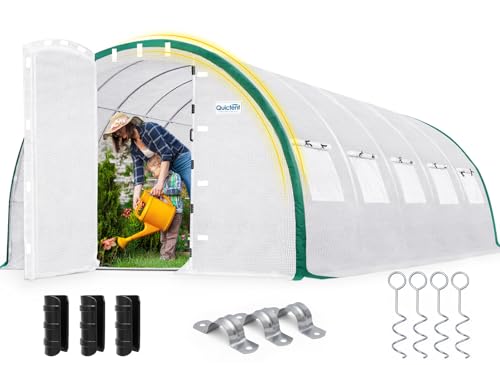
Outsunny 13 x 10 ft Hoop House Tunnel ($107.99). A 130 sq ft walk-in tunnel with a proper steel frame and zippered ends, which is the step to take when you want to work inside the structure rather than lift a cover off it.
Covered area per dollar, which is the whole argument
The case for a tunnel is arithmetic rather than performance. Set the cost of putting one square foot of ground under cover side by side across structure types and the gap is not close.
Figure 1. Cost per covered square foot by structure type·6 rows
Figure 1. Cost per covered square foot by structure type
Structure
Covered area
Approx cost at writing
Per sq ft
Holds a minimum?
Fiberglass hoops over one bed
32 sq ft
$17
About $0.53
No
Hoops plus heavy row cover
32 sq ft
$47
About $1.47
No
Walk-in hoop house, 13 x 10 ft
130 sq ft
$180
About $1.38
No
Large tunnel, 25 x 10 ft
250 sq ft
$260
About $1.04
No
Rigid cold frame
7 sq ft
$95
About $13.57
Marginally
Polycarbonate greenhouse, 6 x 6 ft
36 sq ft
$622
About $17.28
Only if heated
Prices recorded at the time of writing and move frequently, particularly on structures, which are seasonal. The final column is the point of the table: cost per square foot and the ability to hold a temperature floor are inversely related, and no structure gives you both.
That last column is the entire trade. A tunnel gives you area, and a greenhouse gives you control. They are not competing products so much as different tools, which is why the beginner build includes both a tunnel and a frame rather than choosing between them.
The three tiers
Tunnel kits in three tiers
3 tiers · priced at the time of writing
Beginner
Anyone with an existing raised bed who wants six more weeks at each end of the season.
Fiberglass hoops plus a cover is the entire product, and it converts ground you already have into protected ground in an afternoon. Fiberglass is the right material at this tier: it flexes without permanent deformation, does not corrode at the soil line where galvanized wire fails first, and holds its arc under a wet cover. Nothing else in season extension returns as much for as little.
The trade-off:
You must lift or roll the cover to work the bed, and clip it down before every wind event. It offers no standing headroom and no meaningful frost floor. This is a managed structure, not a set-and-forget one.
130 square feet with a steel tube frame and zippered ends. Walking in changes the relationship with the structure entirely: you can sow, weed, water and harvest without handling the cover, which in practice means the crops actually get tended. Zippered ends also give real ventilation control, which draped covers do not.
The trade-off:
A 130 sq ft cover is a large sail. This needs proper anchoring rather than the supplied pegs, and the cover is a consumable that will need replacing every three to five seasons depending on UV exposure. It also cannot be moved once sited without effectively rebuilding it.
250 square feet is enough to run several beds under one cover, which changes what the structure is for. At this scale a tunnel supports genuine winter production of hardy crops rather than only shoulder-season extension, and the cost per covered square foot is the lowest in the category. The larger air volume is also more thermally stable than a low tunnel, which swings hard.
The trade-off:
This is a serious wind structure and needs anchoring designed rather than improvised, plus a site that is genuinely level. In snow country the frame geometry matters: tunnels with shallow arcs accumulate rather than shed, and a collapsed tunnel takes the crop with it.
Tunnels do not fail at the glazing, the frame or the cover material. They fail by leaving the ground. A 130 square foot tunnel presents an enormous sail area against a structure that weighs very little, and the supplied pegs on essentially every kit in this category are inadequate for anything beyond a still, sheltered site.
Three anchoring approaches work, in rising order of seriousness. For low tunnels over beds, landscape staples through the cover edge into the bed soil every 18 inches, plus soil or timber laid along the cover skirt, is generally sufficient. The cover is the thing that lifts, and pinning the cover is most of the job.
For walk-in tunnels, screw-in earth anchors with ratchet straps over the frame are the standard answer. Straps over the hoops rather than ties at the base corners is the important detail: a strap over the arc resists lift directly, whereas a corner tie resists it through the whole frame and simply bends the frame instead.
For anything permanent, the frame legs should be set into the ground rather than resting on it, either driven into sleeves or set in concrete. The relevant load figures are set out in the snow and wind load chart, and the practical detail in anchoring a greenhouse against wind.
Watch out
Open both ends or neither
A tunnel with one end open and one closed is the worst possible configuration in wind. It becomes a parachute: air enters, cannot exit, and pressurizes the structure from inside, which is how tunnels are lost even when well pegged. Either open both ends to let air pass through, or close both and rely on anchoring. This single operational rule prevents most tunnel losses.
Cover material, and why the weight number matters
Tunnel covers come in two families and they do different jobs. Understanding which you need prevents buying the wrong one twice.
Polyethylene film, like the 6 mil sheeting used on walk-in tunnels, is a sealed barrier. It transmits high light, holds humidity in, sheds rain, and warms up substantially in sun. It is the right choice for a walk-in structure where you want a genuine microclimate and are prepared to ventilate it. It is the wrong choice draped directly on a crop, because condensation on the underside sits on foliage and invites disease.
Spun-bonded row cover, like the AlpineReach fabric, is permeable. Rain and air pass through, it can rest on foliage without scorching it, and it is graded by weight, which is the number that predicts performance. The relationship is direct and worth memorizing: 0.5 oz fabric transmits about 85 percent of light and gives 2 to 4 degrees F of protection; 1.2 oz transmits around 70 percent and gives 6 to 8 degrees F; heavier winter grades transmit under 50 percent and are for protection rather than growing.
That trade between light and warmth is the whole selection problem, and it inverts across the season. In spring, when light is the limiting factor and frosts are light, the lighter fabric usually produces better growth despite protecting less. In late fall, when the crop is holding rather than growing, the heavier fabric wins. Many growers own both. The full breakdown is in extending the season with row cover.
How we chose
We did not erect these tunnels ourselves, and any site claiming hands-on testing of five tunnel kits through multiple winters is telling you a story. We compared published frame material and tube diameter, hoop spacing, cover specification and thickness where stated, end configuration, stated wind and snow ratings where the maker publishes them, and verified owner reviews weighted toward the second and third season.
In this category the second-season filter is unusually revealing, because the failure that defines a tunnel kit is cover degradation, and it does not appear in first-season reviews at all. Polyethylene without a UV inhibitor package goes brittle and tears at the hoop contact points within roughly one to two seasons of full exposure. Film specified as UV-stabilized greenhouse film runs three to five. That distinction is frequently absent from listings and is the single most important thing to check.
We also disqualified kits where the frame is a thin galvanized wire rather than tube or fiberglass rod. Wire hoops take a permanent set under load, and once a hoop has bent it never recovers its arc, which progressively flattens the tunnel until it holds water and collapses.
Ventilation in a tunnel
Tunnels overheat faster than any other structure in this category, because the air volume is small relative to the glazed area and there is no thermal mass to speak of. A closed low tunnel in spring sun can pass 100 degrees F within an hour at an outside temperature in the forties.
The management is simple and unavoidable: open the ends in the morning, close them in the evening, through the entire spring. On a low tunnel, roll one side of the cover up onto the hoops and clip it rather than removing it entirely, which means the evening operation is a thirty second job rather than a five minute one. That difference decides whether it actually gets done.
In a walk-in tunnel, zippered ends are worth paying for specifically because they make partial venting possible. A tunnel that can only be fully open or fully closed is managed badly by definition. There is more on airflow and its relationship to disease in greenhouse ventilation basics and humidity and disease control.
What to buy with a tunnel
The four items a tunnel kit does not include
Every kit in this category ships incomplete in the same ways. Budgeting for these at purchase avoids the pattern where a $180 tunnel becomes a $300 project across three deliveries.
The cover is what lifts in wind, not the frame. Staples through the skirt every 18 inches is the cheapest and most effective anchoring on a low tunnel.
Cover clips are consumables and the first thing to go missing. Having spares is the difference between securing a cover before a storm and improvising.
A tunnel swings far harder than a greenhouse. Knowing the actual overnight minimum and afternoon maximum inside it is what tells you whether a crop is safe.
Where a tunnel beats a greenhouse, and where it does not
A tunnel wins decisively when the crop is grown in the ground, when you need area rather than control, and when the goal is shifting the shoulders of the season rather than growing through winter. Extending a productive vegetable plot by six weeks at each end is exactly the job it does best, and no greenhouse at the same price covers a comparable area.
A greenhouse wins when you need a temperature floor, when you are growing in containers or on benches, when propagation matters, and when you want to work in the structure comfortably through winter. Adding heat to a tunnel is possible and almost always a poor investment, because film has an R-value around 0.87 and the structure leaks at every seam.
Overnight, roughly 4 to 8 degrees F depending on cover weight and whether it is a sealed film tunnel or permeable fabric on hoops. Daytime is a different matter entirely: a closed tunnel in spring sun can exceed 100 degrees F within an hour at outside temperatures in the forties, so daily venting through spring is not optional.
+- How long does hoop house plastic last?
UV-stabilized greenhouse film typically runs three to five years in full exposure. Polyethylene sheeting without a UV inhibitor package goes brittle and tears at the hoop contact points within roughly one to two seasons. That specification is frequently absent from listings and is the single most important thing to check before buying a cover.
+- How do you stop a hoop house blowing away?
Pin the cover rather than only the frame, because the cover is what lifts. Landscape staples through the skirt every 18 inches on a low tunnel, and screw-in earth anchors with ratchet straps over the hoops on a walk-in. The critical operational rule is to open both ends or neither: one end open and one closed turns the tunnel into a parachute that pressurizes from inside.
+- Can you grow through winter in a hoop house?
Hardy crops, yes, in zone 6 and warmer, provided they were sown in late summer and grown to near-harvest size before the cold. Kale, spinach, chard, mache and winter lettuce all hold well. A tunnel holds crops through winter rather than growing them, because light rather than temperature becomes the limit once the days are short.
+- Is a hoop house cheaper than a greenhouse?
Substantially, per square foot covered. A fiberglass hoop kit over an existing bed puts 32 square feet under cover for about $0.53 per square foot, against roughly $17 per square foot for a small polycarbonate greenhouse. The greenhouse buys temperature control and standing headroom that the tunnel does not provide at any price, so they solve different problems rather than competing on cost.
+- What is the difference between a hoop house and a high tunnel?
Mostly scale and permanence. Low tunnels are knee to waist height over individual beds and are managed by lifting or rolling the cover. Walk-in hoop houses and high tunnels have standing headroom, are entered rather than uncovered, and are usually anchored permanently. The growing principles are identical; the difference is whether you work inside the structure or on top of it.
Working out the figures for your own house and season? The Greenhouse Build & Growing Planner is the
paid version of these pages: 8 printable worksheets you fill in with your own
numbers, plus the full PDF, $29.