This is the glazing version of the hoop house question, and it deserves separating because the answer is not always the same. Plenty of rigid greenhouses are usefully re-covered with film for a season, and plenty of tunnels benefit from a rigid gable end.
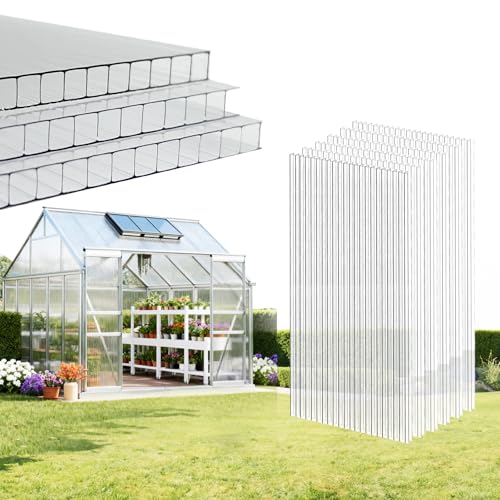
The core trade is straightforward. Film is cheap, light, passes more light than polycarbonate, insulates about half as well, seals poorly, and is a consumable. Polycarbonate costs several times as much per square foot, insulates twice as well, seals properly, and lasts a decade.
The numbers
| Measure | Single 6 mil film | Double film, inflated | Twin-wall 4 mm | Twin-wall 6 mm |
|---|---|---|---|---|
| R-value | 0.87 | 1.70 | 1.54 | 1.72 |
| U-factor | 1.15 | 0.59 | 0.65 | 0.58 |
| PAR transmission | 88 percent | 78 percent | 80 percent | 78 percent |
| Service life | 3 to 4 years | 4 to 5 years | 10 years | 10 to 12 years |
| Rigidity | None, needs a frame every few feet | None | Self-supporting over a panel span | Self-supporting |
| Fitting | Tensioned and buried or battened | Tensioned with a blower | Screwed into oversized holes | Screwed into oversized holes |
| Sealing at edges | Poor without a buried skirt | Poor | Good in a channel | Good in a channel |
That double film row is worth sitting with, because it is the cheapest route to real insulation available. Two layers of Tapix 6 mil UV-Resistant Poly Sheeting, 10 x 25 ft ($19.90) with an air gap between them reach about R-1.70, which is essentially 6 mm twin-wall performance for a small fraction of the material cost. Commercial houses hold the gap with a small blower; at hobby scale, a second layer clipped inside the hoops with a two inch gap achieves most of it for a winter and comes down in spring.
Where film is clearly right
- Covering a large area on a budget. Nothing else comes close per square foot, and this is why every commercial tunnel is film.
- Temporary and seasonal structures. A cover that comes off for summer or for winter is a cover that should be cheap.
- A second layer inside a rigid house. Adding film inside polycarbonate for the coldest months roughly doubles the effective R-value of that surface for a few dollars.
- Low tunnels over beds. At this scale rigid glazing makes no sense at all, and a set of hoops with a film or fleece cover does the whole job.
- Curved structures. Film follows a curve; rigid sheets do not without heavy cold-bending, which stresses the material.
Where polycarbonate is clearly right
- Anything heated. Halving the U-factor halves the conduction loss, and the saving accrues every hour the heater runs.
- Anything permanent. Not re-skinning every three to four years is worth a great deal in avoided work as well as money.
- Walls and doors that must seal. The infiltration penalty on a poorly sealed film house runs up to 25 percent on top of conduction, which is larger than the difference between adjacent glazing grades.
- Vertical surfaces near a path. Film punctures. Polycarbonate takes a wheelbarrow.
- Anywhere hail is routine. Film survives hail better than glass and worse than polycarbonate, and a punctured cover leaks and tears from the puncture.
The fitting differences that decide service life
Film fails from flapping. A loose cover works against every hoop and fastening until it tears at a stress point, usually in the first serious wind. Cover on a warm still day so the film goes on slightly loose and tightens as it warms, pull tension by hand, and secure the long edges by rolling them round a batten rather than punching grommets through the material.
Polycarbonate fails from being fitted tight or the wrong way round. The UV-protected face must be outward or the sheet yellows in two to three years instead of ten. The internal flutes must run vertically so condensation drains, or the channels fill with water and then algae, which cannot be cleaned. And fixing holes must be oversized because the sheet expands and contracts noticeably with temperature.
Both sets of rules are covered in full in the glazing guide, and getting them wrong is by far the most common cause of a glazing failing early.
Cost over a decade
Per square foot at purchase, film is dramatically cheaper. Over ten years the gap narrows because film is bought two or three times and fitted two or three times, and the fitting is a weekend each time.
The gap narrows further once heating enters the picture. On a heated house, the running cost difference between R-0.87 and R-1.54 over a decade can exceed the entire material cost difference. Model your own case with the glazing heat loss calculator, which gives a seasonal cost for each option on the same footprint.
On an unheated structure the arithmetic barely moves, and film remains the correct answer for covering ground.
Film and panels



Glazing choice is the second half of the structure decision. The first half, whether the structure is a tunnel at all, is in hoop house versus greenhouse.