This is the first structural decision anyone makes and the one most often made on price alone. The price difference is real and large, but it is not the interesting part. The two structures do genuinely different jobs, and buying the wrong one produces a covered space that cannot do what you bought it for.
The short version: a hoop house buys area, a rigid greenhouse buys control. If the constraint is that you want to grow more square feet under cover in spring and autumn, the tunnel wins by a wide margin. If the constraint is that something must not go below a particular temperature on a particular night, the greenhouse wins and the tunnel cannot substitute at any size.
The numbers side by side
| Measure | Hoop house or tunnel | Polycarbonate greenhouse |
|---|---|---|
| Glazing R-value | About 0.87 for 6 mil film | About 1.54 for 4 mm twin-wall |
| Light transmission | About 88 percent when new | About 80 percent |
| Covered area per dollar | Roughly five times as much | The baseline |
| Glazing service life | 3 to 4 years, a consumable | 10 to 15 years |
| Door sealing | Poor, usually a zip or a loose flap | Good, a framed door that latches |
| Air infiltration allowance | Up to 1.25 | Around 1.1 for a well-fitted kit |
| Wind resistance | Depends entirely on anchoring and cover tension | Better, but panels can leave the frame |
| Snow behaviour | Accumulates a wedge along both shallow sides | Sheds above about 30 degrees of pitch |
| Ease of heating | Poor, because of the R-value and the leakage | Reasonable in a small footprint |
| Assembly | A weekend, and re-skinning every few years | A weekend, then largely permanent |
Run those two glazing figures through the glazing heat loss calculator on the same house and the practical consequence is stark: the film loses heat at nearly twice the rate through the same envelope area. Combine that with a tunnel typically being much larger, and heating a tunnel to a useful winter minimum is not a hobby-scale proposition.
When the hoop house is the right answer
A tunnel is the correct choice when area matters more than minimum temperature, which covers a great deal of practical growing.
- Season extension rather than winter growing. Three weeks earlier in spring and three weeks later in autumn across a large area, which is what most growers actually want.
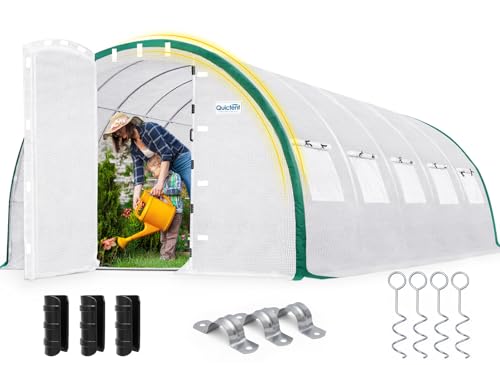
- Growing in ground rather than on benches. A Quictent 25 x 10 ft Walk-In Tunnel Greenhouse ($284.98) covers 250 square feet, which is enough for a proper bed rotation rather than a bench and a path.
- Rain exclusion. Keeping rain off a tomato or a strawberry crop prevents a substantial share of foliar disease, and that alone justifies a tunnel in a wet climate.
- A temporary or moveable structure. A tunnel can be re-sited, and in some jurisdictions a structure with no permanent foundation is treated differently for planning purposes, which is worth checking locally.
- Covering existing beds. At the small end, an OOTONAT 8 ft Fiberglass Garden Hoop Tunnel Kit ($17.09) turns a raised bed into a low tunnel for less than the cost of a flat of seedlings.
When the rigid greenhouse is the right answer
- Anything that must not freeze. A sealed insulated envelope with a door that latches is the only version of this that works, and it is not a matter of degree.
- Propagation. Raising transplants needs stable temperature and a place to put benches, lights and heat mats, which means power and a structure that supports fittings.
- Overwintering tender plants. Citrus, pelargoniums and tender perennials need a reliable minimum through months, not a shelter that tracks outside temperature.
- Small gardens. A Palram Canopia Mythos 6 x 6 Greenhouse ($622.42) occupies 36 square feet, which fits where a 250 square foot tunnel does not.
- Longevity. Re-skinning a tunnel every three to four years is a recurring cost in money and a weekend of work each time.
The failure modes are different
A tunnel fails by losing its cover. Wind gets under the skirt, inflates the structure from below and takes it, or the film flaps until it tears at a fixing. Both are prevented by burying or continuously weighting the skirt and by keeping the cover tensioned, which is covered in anchoring a greenhouse against wind.
A rigid greenhouse fails by losing panels. Most budget kits retain glazing in an aluminium channel with small spring clips, which are adequate in still air and are the first thing to go in a gust. Adding a washered screw at the top and bottom of every panel, through an oversized hole, is an hour of work that prevents the most common total loss these structures suffer.
Snow behaves differently too. A tunnel accumulates a wedge along both shallow sides that can push hoops permanently out of shape. A gable greenhouse above about 30 degrees of pitch sheds most of what falls on it, and holds a dangerous load below about 20. The detail is in greenhouse snow and wind load.
Cost over ten years, not at purchase
The purchase price comparison flatters the tunnel and the ten-year comparison narrows it considerably.
A film cover is a consumable at three to four years, so a decade of tunnel ownership includes two or three re-skins plus the labour. A polycarbonate house at ten to fifteen years of panel life may need a few panels replaced and little else. Against that, the tunnel is covering several times the area throughout, so per square foot per year the tunnel still wins comfortably. The comparison only inverts when the requirement includes heat.
A middle option exists and is worth knowing: a walk-in tunnel with a rigid door frame and heavier hoops, such as an Outsunny 11.5 x 10 ft Walk-In Tunnel Greenhouse ($117.31), seals meaningfully better than a light hoop kit and costs a fraction of a rigid house of the same footprint. It is still a film structure with film insulation, but the infiltration penalty is much closer to a rigid house.
Structures at both ends of the decision


Whichever structure you choose, the systems inside it matter more than the shell. Size the heat, air and water first using the calculators, then buy the structure that can carry them.