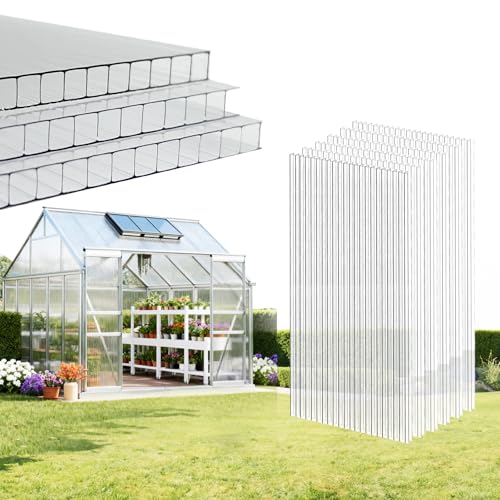
Glazing heat loss and light transmission calculator
The short answer
Glazing R-values run from about 0.83 for single-wall polycarbonate and 0.87 for 6 mil film up to 2.5 for 16 mm five-wall, a factor of three. Light transmission over the same range falls only from about 88 percent to 62 percent. Insulation varies far more than light does, which is why moving up the glazing scale is usually worthwhile in cold climates and stops being worthwhile well before the top of the range.
6 mil film
R-0.87, 88% PAR
4 mm twin-wall
R-1.54, 80% PAR
Single glass
R-0.95, 90% PAR
16 mm five-wall
R-2.50, 62% PAR
Researched from published specifications and verified owner reviews · Updated 2026-08-16
Calculator
Compare two glazings on the same house
Set the house once, then put two glazing materials side by side. The readout gives heat loss, running cost and the light each one lets through, which is the trade nobody quotes together.
Heat saved by B3,800
A, BTU per hour
0
B, BTU per hour
0
Season cost, A
$0
Season cost, B
$0
PAR transmission
88 vs 78
Researched estimate, not professional engineering or horticultural advice. Results depend on
your climate, your structure and your crop. Treat the output as a starting figure to check
against local conditions and against the manufacturer's own sizing guidance.
The trade this calculator makes visible
Insulation and light transmission move against each other in glazing, because the mechanisms that stop heat leaving also stop light entering. Adding a wall to a multiwall sheet adds an air gap that resists conduction and adds two more surfaces that reflect and absorb light. No glazing does both jobs well.
What the numbers show, though, is that the trade is not symmetrical. R-value across the practical range runs from about 0.83 to 2.5, a factor of three. Light transmission over the same range falls from roughly 88 percent to 62 percent, a factor of about 1.4. Insulation varies far more than light does.
The practical conclusion is that in a cold climate with a long heating season, moving up the glazing scale is usually worth the light penalty, and in a light-limited northern winter growing light-hungry crops it stops being worth it well before the top of the range. Somewhere around 6 to 8 mm twin-wall is where most hobby growers in temperate climates should stop.
What R-values do and do not include
Published glazing R-values describe the glazing material in isolation, under standardized test conditions. A real greenhouse loses heat by three routes and only one of them is in that figure.
Conduction through the glazing is what the R-value describes, and in a well-sealed structure it is the largest single term.
Conduction through the frame is a thermal bridge that the glazing figure ignores. Aluminum conducts heat readily, and the frame is typically a few percent of the envelope area but a disproportionate share of the loss. It is real but modest, and not worth much anxiety in a hobby house.
Air infiltration through door gaps, vent seals and panel joints is the one that surprises people. In a hobby structure it commonly adds 10 to 25 percent to the total, and in an older film house with loose doors it can be more. This calculator applies an infiltration allowance for exactly that reason.
The consequence worth acting on: sealing gaps frequently produces a larger real improvement than upgrading the glazing, and it costs a fraction as much. Door seals, vent seals and taped panel joints are the highest-return work on most existing greenhouses. See insulating a greenhouse.
Reading the comparison sensibly
Three cautions when comparing the outputs.
Transmission figures are for new material. Everything degrades. Polyethylene film loses transmission fastest and is typically replaced every three to five years anyway. Polycarbonate with a proper UV layer holds well for a decade; without one it yellows in three. Glass barely changes, which is part of why it lasts twenty-five years and remains the reference for maximum light.
Diffusion is not captured by a transmission number. Twin-wall polycarbonate scatters light rather than passing a direct beam, and diffuse light penetrates a plant canopy better, illuminating lower leaves that direct light never reaches. A diffusing glazing at 80 percent transmission can produce more total canopy photosynthesis than a clear one at 90. This is a genuine effect and it partly offsets the transmission penalty of multiwall sheet.
The envelope does not have to be uniform. Splitting the specification between roof and walls is frequently a better answer than picking one glazing for everything. The roof is where winter light comes from and where transmission matters most; the walls are where heat is lost to wind. The Palram Hybrid does exactly this with clear roof panels over twin-wall sides, and lining only the north wall with bubble insulation applies the same logic to an existing house.
Field tip
The cheapest R-value upgrade is not new glazing
Horticultural bubble insulation adds roughly R-0.5 to R-1.0 to whatever it lines, and it seals air leakage at the same time. Lining the north wall and gable ends of a 4 mm twin-wall house takes that portion of the envelope from about R-1.54 toward R-2.2 for a small fraction of what re-glazing would cost, and the north wall contributes almost no useful winter light so there is very little to lose. Run the comparison in this calculator with the improved figure and the reduction in required heater output is usually striking.
Which glazing for which situation
Reduced to the decisions people actually face.
Covering a tunnel or any curved frame: 6 mil UV-stabilized polyethylene film. Rigid panels do not follow a curve and attempting it cracks them. At R-0.87 the insulation is poor, but on an unheated structure that costs very little.
Replacing a broken panel: match the existing thickness exactly, because the frame channel is sized for it. Mixing thicknesses creates gaps that leak more than the original damage did.
Glazing a house you intend to heat:twin-wall polycarbonate at 4 or 6 mm, with proper flute tape and channel fitting. This is the durable answer and where most hobby growers should be.
A cold climate with a long heating season:thicker multiwall is defensible, because the cumulative winter energy saving is real money. Weigh it against the transmission loss using the winter light figures for your latitude.
Maximum winter light for a light-hungry crop: keep the roof transmissive and insulate the walls instead. Never shade a north-facing winter greenhouse by over-specifying the roof glazing.
Fitting details that change the real figure
Three installation details affect the delivered performance enough to matter, and all three are easy to get wrong once and impossible to correct later.
Flute sealing. Twin-wall has open channels at every cut edge. Left open they fill with water, dust and algae and the panel goes green from the inside within two seasons, which cannot be cleaned out and reduces transmission permanently. Breathable anti-dust tape on the lower edge and solid aluminum tape on the upper is correct. Solid tape on both traps water inside, which is worse than leaving both open.
Flute orientation. Flutes must run vertically or down the slope of a roof so condensation inside can drain out. Horizontal flutes hold water for the life of the panel and both the insulation and the transmission suffer.
Expansion clearance. Polycarbonate has a high coefficient of thermal expansion and a 6 ft panel moves several millimetres between a winter night and a summer afternoon. Fitted tight with no clearance it bows, and a bowed panel eventually pops out or cracks at a fixing. Where panels are screwed rather than channelled, oversize the holes and use washered fixings rather than driving them tight.
Acting on the comparison
Whichever glazing the comparison points to, these four are what determine whether the installed performance matches the published figure.
About R-0.83 for single-wall corrugated polycarbonate, R-0.87 for 6 mil polyethylene film, R-0.95 for single-pane horticultural glass, R-1.54 for 4 mm twin-wall polycarbonate, R-1.72 for 6 mm, R-2.10 for 8 mm triple-wall and around R-2.50 for 16 mm five-wall. These describe the glazing alone and exclude frame conduction and air infiltration, which in a hobby structure commonly add 10 to 25 percent to real losses.
+- Is glass or polycarbonate warmer for a greenhouse?
Polycarbonate, substantially. Single-pane glass is roughly R-0.95 against R-1.54 for 4 mm twin-wall, so the polycarbonate house loses around 40 percent less heat through the same area. Glass wins on light, transmitting about 90 percent of photosynthetically active radiation against roughly 80 percent for twin-wall, and it holds that transmission for decades where plastic degrades.
+- Is thicker polycarbonate always better?
No, and there is a sensible stopping point. R-value rises from 1.54 at 4 mm to about 2.5 at 16 mm, but transmission falls from around 80 percent to 62. In a northern midwinter where the daily light integral inside a greenhouse can already be below what lettuce needs, that light loss is expensive. For most temperate hobby growers, 6 to 8 mm is where the trade stops favouring more thickness.
+- Does air leakage matter more than glazing R-value?
Frequently, yes, in a hobby structure. Infiltration through door gaps, vent seals and panel joints commonly adds 10 to 25 percent to total heat loss and can exceed that in an older film house. Sealing those gaps often produces a larger real improvement than upgrading the glazing and costs a fraction as much, which is why door seals and taped joints are the highest-return work on most existing greenhouses.
+- Should the roof and walls use the same glazing?
Not necessarily, and splitting the specification is frequently better. The roof is where winter light comes from and where transmission matters most; the walls are where heat is lost to wind and where insulation matters more. Clear roof panels over twin-wall sides is a deliberate and sensible design, and lining only the north wall of an existing house applies the same logic cheaply.
+- Does diffuse light from twin-wall reduce growth?
Less than the transmission figure suggests, and sometimes not at all. Diffuse light penetrates a plant canopy better than a direct beam, illuminating lower leaves that direct light never reaches, so a diffusing glazing at 80 percent transmission can produce more total canopy photosynthesis than a clear one at 90. This effect partly offsets the transmission penalty of multiwall sheet and is rarely accounted for.
Working out the figures for your own house and season? The Greenhouse Build & Growing Planner is the
paid version of these pages: 8 printable worksheets you fill in with your own
numbers, plus the full PDF, $29.