Glazing choice is the one decision on a greenhouse that cannot be changed later without rebuilding the structure, and it is a straight trade between two numbers that pull in opposite directions. R-value is thermal resistance, measured in hours multiplied by square feet multiplied by degrees Fahrenheit, divided by BTU. Higher is better insulation. PAR transmission is the percentage of photosynthetically active radiation, the 400 to 700 nanometer band plants actually use for photosynthesis, that reaches the crop. Higher is better growing. No glazing is best at both.
The table below is the whole decision in one place. Every figure is the manufacturer-published value for new material. All of them degrade: film yellows, polycarbonate loses a few percent of transmission per decade even with a UV layer, and glass loses transmission to surface deposits that never fully wash off.
| Glazing | R-value | U-factor | PAR transmission | Typical service life |
|---|---|---|---|---|
| Single polyethylene film, 6 mil | 0.87 | 1.15 | 88% | 3 to 4 years |
| Double polyethylene film, inflated | 1.70 | 0.59 | 78% | 4 to 5 years |
| Single horticultural glass, 3 mm | 0.95 | 1.05 | 90% | 25 years and up |
| Double insulated glass unit | 2.00 | 0.50 | 78% | 20 years and up |
| Corrugated single-wall polycarbonate, 0.8 mm | 0.83 | 1.20 | 88% | 10 years |
| Twin-wall polycarbonate, 4 mm | 1.54 | 0.65 | 80% | 10 years |
| Twin-wall polycarbonate, 6 mm | 1.72 | 0.58 | 78% | 10 to 12 years |
| Twin-wall polycarbonate, 8 mm | 1.89 | 0.53 | 76% | 10 to 15 years |
| Triple-wall polycarbonate, 8 mm | 2.10 | 0.48 | 74% | 10 to 15 years |
| Five-wall polycarbonate, 16 mm | 2.50 | 0.40 | 62% | 15 years |
| Double-wall acrylic, 16 mm | 2.00 | 0.50 | 83% | 20 years and up |
| Fiberglass reinforced panel | 0.83 | 1.20 | 85% | 7 to 15 years |
What does R-value actually cost you in heating?
The practical consequence of these numbers is easiest to see on one house. A 6 by 8 ft even-span greenhouse with a 5.5 ft eave and an 8 ft ridge has roughly 300 square feet of glazed envelope. Heat loss follows Q = A x U x deltaT, so at a 40 degree Fahrenheit differential, which is a 20 degree night outside against a 60 degree target inside, the glazing choice alone changes the heater you need by a factor of nearly three.
| Glazing | U-factor | BTU per hour | Equivalent electric heat |
|---|---|---|---|
| Single polyethylene film, 6 mil | 1.15 | 11,700 | 3,450 W |
| Double polyethylene film, inflated | 0.59 | 6,000 | 1,750 W |
| Single horticultural glass, 3 mm | 1.05 | 10,700 | 3,150 W |
| Double insulated glass unit | 0.50 | 5,100 | 1,500 W |
| Corrugated single-wall polycarbonate, 0.8 mm | 1.20 | 12,200 | 3,600 W |
| Twin-wall polycarbonate, 4 mm | 0.65 | 6,600 | 1,950 W |
| Twin-wall polycarbonate, 6 mm | 0.58 | 5,900 | 1,750 W |
| Twin-wall polycarbonate, 8 mm | 0.53 | 5,400 | 1,600 W |
| Triple-wall polycarbonate, 8 mm | 0.48 | 4,900 | 1,450 W |
| Five-wall polycarbonate, 16 mm | 0.40 | 4,100 | 1,200 W |
| Double-wall acrylic, 16 mm | 0.50 | 5,100 | 1,500 W |
| Fiberglass reinforced panel | 1.20 | 12,200 | 3,600 W |
Why diffuse glazing can out-produce clear glazing
The transmission column is not the whole story, and this is where a straight reading of the table misleads. Twin-wall polycarbonate diffuses light heavily. Diffuse light scatters as it enters, which means it penetrates a plant canopy and illuminates leaves in the second and third layer that direct beam light never reaches. Published greenhouse research consistently finds that a diffusing cover can produce equal or greater total photosynthesis than a clearer cover transmitting several percent more light, particularly on tall crops like tomatoes and cucumbers where canopy depth is significant.
The effect is smaller on short crops. A tray of seedlings or a bed of lettuce has almost no canopy depth, so diffusion buys nothing and the raw transmission number governs. That is the practical rule: if you are growing tall fruiting crops, do not penalize twin-wall for its transmission figure. If you are propagating and growing salad, the transmission figure is real and you should weight it.
How long does each glazing last?
Service life in the table means the point at which light transmission has dropped enough to affect growing, not the point at which the material falls off the frame. Six mil single polyethylene film reaches that point in three to four years, and it is genuinely a consumable: budget for recovering the house on a fixed cycle rather than waiting for failure.
Polycarbonate lives or dies by its ultraviolet layer. Quality sheets carry a co-extruded UV-blocking layer on one face only, and that face must go outward. The layer is invisible, and the only marking is usually printed on the removable protective film, so a panel installed upside down looks perfect and fails in three years instead of twelve. Check every sheet before the film comes off. Spare panels such as EVERECO Twin-Wall Polycarbonate Panels, 4 x 2 ft, 6-Pack are worth buying with the house rather than after a hail storm, when the exact size is invariably out of stock.
Twin-wall has one failure mode that has nothing to do with UV: the open flutes at the cut edges fill with water, dust and algae, and the panel greens from the inside. The correct treatment is breathable anti-dust tape on the lower edge and solid aluminum tape on the upper edge. Almost no kit includes it, and retro-fitting means taking the panels back out. If you are covering a home-built frame, 6 mil UV-resistant polyethylene avoids the problem entirely at the cost of insulation and lifespan.
Glazing and glazing accessories
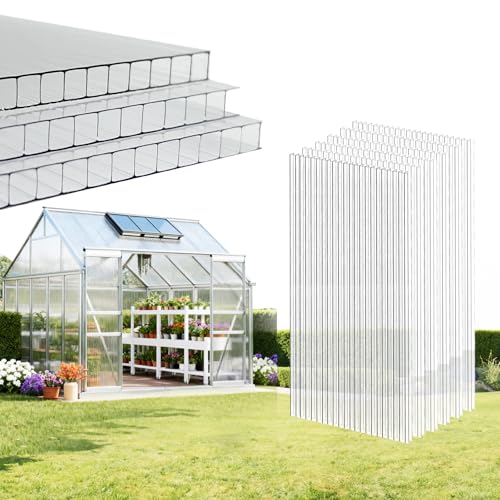


Which glazing should you choose?
- Growing through winter with heat: 6 mm or 8 mm twin-wall polycarbonate. The extra R over 4 mm pays for itself in heater runtime, and the transmission loss is a few percent.
- Spring and autumn season extension only: 4 mm twin-wall, or 6 mil film if the structure is a tunnel. You are not paying to heat it through the dark months, so insulation matters far less.
- Maximum winter light, heat is not the constraint: single horticultural glass at 90 percent PAR, or a hybrid with clear roof panels over twin-wall sides.
- Hail country or a house near a play area: polycarbonate, in any thickness. It does not shatter, and that is not a small consideration over a food crop.
- Propagation only, light quality secondary: five-wall or triple-wall for the insulation. At 62 to 74 percent PAR you will be supplementing with fixtures anyway.
What the glazing costs per square foot
Material cost is the figure buyers compare, and it is the least important of the three costs a glazing carries. The other two are the frame the material demands and the heating bill it commits you to for the life of the structure. Glass needs a heavy frame with precise glazing bar spacing and a foundation that will not move, because glass does not tolerate racking. Film needs almost no frame at all but needs replacing on a cycle. Polycarbonate sits between the two and is the reason it dominates hobby kits.
| Glazing | Material cost | Frame demand | Ten-year replacement | Relative heating cost |
|---|---|---|---|---|
| Single polyethylene film, 6 mil | Lowest | Minimal, hoops are enough | Two to three recovers | Highest, 1.77x baseline |
| Double polyethylene film | Low | Hoops plus an inflation blower | Two recovers | 0.91x baseline |
| Corrugated single-wall polycarbonate | Low | Light purlins | One replacement likely | 1.85x baseline |
| Twin-wall polycarbonate, 4 mm | Moderate | Standard aluminum kit frame | None expected | Baseline |
| Twin-wall polycarbonate, 6 mm | Moderate to high | Standard aluminum kit frame | None expected | 0.89x baseline |
| Triple-wall polycarbonate, 8 mm | High | Standard frame, heavier clips | None expected | 0.74x baseline |
| Single horticultural glass | Moderate | Heavy frame, rigid foundation | Breakages only | 1.62x baseline |
| Double insulated glass | Highest | Heaviest frame and foundation | None expected | 0.77x baseline |
Read the last column carefully, because it compounds. A film-covered tunnel costs 1.77 times as much to heat as the same structure in 4 mm twin-wall, every night, for as long as you own it. On a house that costs $400 a winter to heat, that is $308 a year, which pays the difference in glazing cost within two or three seasons and then keeps paying. Film is the right choice for a structure you do not heat. It is rarely the right choice for one you do.
How glazing choice changes what you can grow
The chart is a set of physical properties, but the decision it drives is horticultural. Three thresholds matter more than any of the individual numbers.
- The winter light floor. Lettuce and other salad crops need a daily light integral of roughly 12 to 17 moles per square meter per day for good growth, and they will survive but barely grow below about 6. In a temperate midwinter the outdoor DLI can be 5 to 10, so a glazing transmitting 62 percent puts an unlit house below the survival line for weeks. That is the argument against the thickest multiwall panels for winter greens.
- The frost-protection floor. Holding 35 degrees Fahrenheit inside when it is 5 outside needs about 1,900 BTU per hour on a 6 by 8 in 6 mm twin-wall, and about 3,400 in single film. The first is comfortably within a 1500 W heater and the second is not, on identical structures.
- The summer ceiling. Higher transmission is not free in summer either. A glass house in high summer takes on solar load faster than a twin-wall one and needs proportionally more shade and more ventilation to hold the same temperature, so the glazing that gives you the best winter also gives you the hardest summer.
Run the numbers for your own house rather than accepting a rule of thumb. The glazing heat loss calculator compares any two glazings on your dimensions and your climate, and the heater BTU calculator turns the result into the heater you need. The full argument between the two most common choices is in polycarbonate versus glass, the thickness question in twin-wall versus triple-wall, and the film question in poly film versus polycarbonate.