Glazing is the single component that decides both how much heat a greenhouse loses and how much light it lets in, and those two properties move in opposite directions. Every glazing decision is a trade along that axis, and the right answer depends entirely on whether your limiting factor in winter is temperature or light.
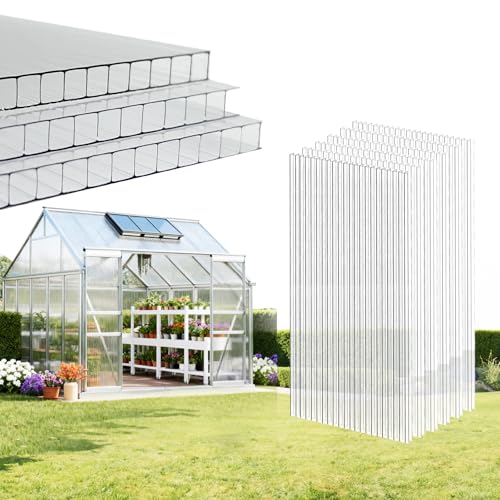
For most repairs and additions the answer is twin-wall polycarbonate panels, which sit at a genuinely good point on that trade: roughly R-1.54 against about 80 percent transmission of photosynthetically active radiation.
The standard for rigid glazing
The trade that governs every glazing decision
Insulation and light transmission are inversely related in glazing, because the mechanisms that stop heat leaving also stop light entering. Adding a wall to a multiwall sheet adds an air gap that resists conduction, and adds two more surfaces that reflect and absorb light. There is no glazing that is both highly insulating and highly transmissive, and product marketing that implies otherwise is describing one property and omitting the other.
| Material | Approx R-value | PAR transmission | Typical service life | Best suited to |
|---|---|---|---|---|
| Single-pane horticultural glass | R-0.95 | About 90% | 20 years plus | Maximum winter light |
| 4 mil polyethylene film | R-0.83 | About 87% | 1 to 2 years | Temporary and low tunnels |
| 6 mil UV-stabilized film | R-0.87 | About 85% | 3 to 5 years | Tunnels and film houses |
| Double-layer inflated film | R-1.7 | About 78% | 3 to 5 years | Commercial film houses |
| 0.7 mm corrugated single-wall | R-0.83 | About 88% | 5 to 10 years | Roof lights and lean-tos |
| 4 mm twin-wall polycarbonate | R-1.54 | About 80% | 10 to 15 years | The hobby standard |
| 6 mm twin-wall polycarbonate | R-1.72 | About 78% | 10 to 15 years | Heated winter houses |
| 8 mm twin-wall polycarbonate | R-2.10 | About 75% | 10 to 15 years | Cold climates, heat priority |
| 16 mm five-wall polycarbonate | R-2.50 | Under 70% | 10 to 15 years | Extreme cold, light-tolerant crops |
Reading that table the useful way: the entire practical range of R-value runs from about 0.83 to about 2.50, a factor of three, while transmission runs from 90 percent down to 70, a factor of about 1.3. Insulation varies far more than light does. That asymmetry is why, in most cold climates, moving up the glazing scale is worth it and why, in northern winters with genuinely marginal light, it stops being worth it well before the top of the range.
The three tiers
Glazing in three tiers
Beginner

Buy once
Expert

Polyethylene film: the specification that matters
Film selection comes down to one property that listings frequently omit: whether the polyethylene carries a UV inhibitor package. This is not a minor grade difference, it is the difference between one season and five.
Generic polyethylene sheeting sold as construction plastic has no UV package. In full sun it goes chalky, then brittle, and tears at every stress point, typically at the hoop contacts, inside one to two seasons. Greenhouse film is a different product with UV stabilizers compounded into the resin, and it is usually sold with a stated year rating. Pay for the rating.
Thickness in mils is the second specification and it is more about handling and tear resistance than insulation. 4 mil is thin enough to be genuinely fragile and suits low tunnels that come off seasonally. 6 mil is the working standard for walk-in film houses, resists tearing at fixings, and survives being handled. Going heavier buys strength rather than R-value, because the air film either side of the sheet does the insulating rather than the plastic.
Two further properties appear on better films and are worth understanding. Anti-drip or anti-condensate treatment changes the surface tension so condensation forms a running sheet rather than droplets. This matters horticulturally: droplets fall on foliage and spread disease, and they also scatter light. IR-blocking films reduce longwave radiative loss at night, which is worth a genuine degree or two in a clear-sky climate.
Polycarbonate panels: the details that decide service life
Twin-wall polycarbonate is durable in a way film is not, but only if three details are handled at fitting. All three are routinely missed and all three are effectively irreversible afterwards.
The UV layer is directional. The co-extruded UV-blocking layer is on one face only, and that face must go outward. There is generally no way to identify it once the protective film is off, because the only marking is printed on that removable film. A panel fitted upside down looks identical and fails in roughly a third of the time. Check every sheet before peeling.
The flutes must be sealed. Twin-wall has open channels at every cut edge. Left open they fill with water, dust and airborne algae, and the panel goes green from the inside within two seasons, which cannot be cleaned out. Correct practice is breathable anti-dust tape on the lower edge, which lets condensation drain but blocks debris, and solid aluminum tape on the upper edge. Using solid tape on both edges traps water inside, which is worse than leaving both open.
Panels must be able to move. Polycarbonate has a high coefficient of thermal expansion, and a 6 ft panel moves several millimetres between a winter night and a summer afternoon. Fitted tight into a channel with no clearance, it bows, and a bowed panel eventually pops out or cracks at a fixing. Where panels are screwed rather than channelled, the holes must be oversized and fitted with a washered fixing rather than driven tight.
The orientation of the flutes matters too, and it is simple: they must run vertically, or down the slope of a roof, so condensation inside a flute can drain out of the bottom. Horizontal flutes hold water for the life of the panel.
Bubble insulation: the cheapest winter upgrade
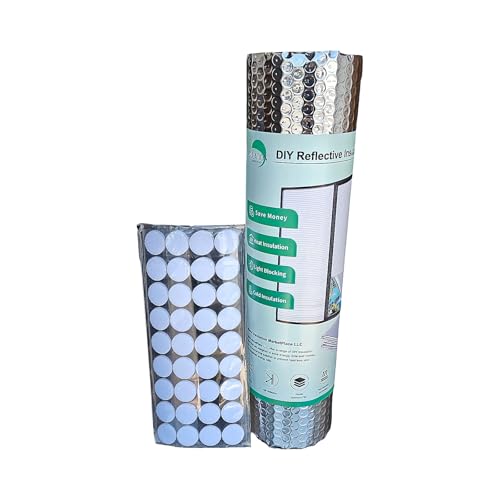
Lining existing glazing with horticultural bubble insulation is the highest-return winter modification available on a hobby greenhouse, and it is the one most often skipped because it looks temporary.
Bubble insulation adds roughly R-0.5 to R-1.0 depending on the product, which on a 4 mm twin-wall house takes the envelope from around R-1.54 to somewhere near R-2.2. That is a reduction in conductive loss of roughly 30 percent, for a small fraction of what upgrading the glazing itself would cost. It also seals air leakage, which in a real structure is frequently a larger loss path than conduction.
The cost is light, and the way to manage it is selective application. The north wall of a greenhouse contributes very little direct solar gain in winter and can be insulated with almost no penalty, which is why the expert build insulates the north wall specifically. Insulating the south-facing roof is a different proposition and generally the wrong trade in a light-limited winter.
Use horticultural grade with larger bubbles rather than packing material, because the larger air cells insulate better and the material is UV-treated for the environment. Fix it to the inside of the frame with clips rather than taping it to the glazing, leaving a small air gap, since the gap is doing much of the work. There is more in insulating a greenhouse.
How we chose
We did not conduct our own transmission or thermal testing, and any site claiming laboratory measurement of nine glazing materials is telling you a story. R-values and PAR transmission figures here are researched from published manufacturer data and published horticultural engineering references, and where sources disagree we have given the more conservative figure.
Product selection was based on stated specification completeness, since in this category a listing that omits thickness, UV treatment or year rating is almost always omitting it because the answer is unfavourable. We weighted verified owner reviews from the second season onward, because glazing failures are almost entirely time-dependent and nothing useful about a glazing material is knowable in its first month.
One caution on published R-values generally. They describe the glazing material in isolation. A real greenhouse loses heat through frame conduction and through air infiltration at doors, vents and panel joints as well, and in a hobby structure those paths are frequently comparable to the glazing loss. Sealing gaps often produces a larger real improvement than upgrading the glazing. The glazing heat loss calculator works from envelope area, and the glazing chart tabulates the material figures.
Supporting materials
What glazing work needs alongside the panels



Which glazing for which situation
Reduced to the practical decisions people actually face.
Replacing one broken panel: match the existing thickness exactly, because the frame channel is sized for it. Mixing thicknesses in one structure creates gaps that leak more than the original damage did.
Covering a tunnel or curved frame: 6 mil UV-stabilized film. Rigid panels do not follow a curve, and attempting it cracks them.
Glazing a home-built frame you intend to keep: twin-wall polycarbonate at 4 or 6 mm, with proper flute tape and channel fitting. This is the durable answer and the difference in labour between doing it properly and doing it quickly is a few hours once.
Reducing heating cost on an existing house: bubble insulation on the north wall and gables plus door sealing, before considering a glazing upgrade. It costs a fraction and frequently delivers more, because it addresses infiltration as well as conduction.
Maximizing winter light: keep the roof as transmissive as possible and insulate the walls instead. Splitting the specification between roof and walls, which is what the Palram Hybrid does with clear roof panels over twin-wall sides, is a better answer than choosing one glazing for the whole envelope. This is covered in twin-wall versus triple-wall.