Polycarbonate is sold in a ladder of thicknesses and wall counts, and manufacturers understandably present each step up as an improvement. It is an improvement in one direction and a regression in another, and the point at which the trade stops being worth making arrives sooner than the product range suggests.
The pattern across the whole range is asymmetric. R-value roughly triples from single-wall corrugated at 0.83 to five-wall 16 mm at 2.50. Light transmission over the same range falls only from about 88 percent to 62 percent. Insulation varies far more than light does, which is why moving up the ladder is worthwhile at all, and it is also why the top of the ladder is a poor buy for most hobby growers.
The ladder
| Material | R-value | U-factor | PAR transmission | Conduction loss vs 4 mm |
|---|---|---|---|---|
| Corrugated single-wall, 0.8 mm | 0.83 | 1.20 | 88 percent | 85 percent higher |
| Twin-wall, 4 mm | 1.54 | 0.65 | 80 percent | Baseline |
| Twin-wall, 6 mm | 1.72 | 0.58 | 78 percent | 11 percent lower |
| Twin-wall, 8 mm | 1.89 | 0.53 | 76 percent | 18 percent lower |
| Triple-wall, 8 mm | 2.10 | 0.48 | 74 percent | 26 percent lower |
| Five-wall, 16 mm | 2.50 | 0.40 | 62 percent | 38 percent lower |
Two things jump out. The step from single-wall to twin-wall is enormous and costs almost no light in relative terms, which is why nobody should buy a single-wall corrugated house for a cold climate. And the step from 8 mm triple-wall to 16 mm five-wall buys 12 percentage points of conduction improvement for 12 percentage points of light, which for a growing house is a bad trade almost everywhere.
Why light matters more in winter than the percentages suggest
A 6 percentage point light loss sounds trivial, and in summer it is: a greenhouse in the growing season has more light than the crop can use, which is why shade cloth exists at all. In the shortest weeks of the year the situation reverses completely.
At mid latitudes, a greenhouse in midwinter frequently delivers a daily light integral below what the crop wants. Vegetable seedlings want 12 to 17 mol per square meter per day and a winter house can be well under that. When the starting figure is already below target, taking another 6 or 12 percent off it makes the difference between a crop that grows slowly and one that holds.
Check what your own house delivers with the DLI and PPFD calculator before choosing a heavy glazing, because the answer is climate-specific and the general advice is not.
What the extra R-value is actually worth in money
The saving is proportional to the size of the house and the temperature difference held, which means a general figure is meaningless. The shape is consistent though: moving from 4 mm to triple-wall 8 mm cuts conduction loss by about 26 percent, and that saving accrues every hour the heater runs.
There is a second saving that is often larger and rarely counted. Reducing the heat load can bring a house back inside the 1,440 watt continuous limit of a single 15 amp circuit, which avoids a 240 volt supply entirely. That is a four-figure saving in electrical work, and it dwarfs any difference in glazing price. Check where your house sits with the heater BTU calculator.
Run both glazings against your own dimensions in the glazing heat loss calculator before deciding. On a small house in a mild climate the seasonal difference is often smaller than the price gap, and on a larger house in a cold one it is often much larger.
The cheaper alternatives to moving up the ladder
Before paying for heavier glazing, three measures usually beat it per dollar.
- Seal the door and vents. The infiltration penalty runs up to 25 percent on top of conduction, which is larger than the entire gap between twin-wall and triple-wall. A Shed and Greenhouse Door Hardware Kit with T-Handle Lock ($39.99) that gives a positive latch against a stop addresses it for a fraction of a re-glazing.
- Insulate the north panels only. FONUNO Reflective Bubble Insulation Roll, 23.6 in x 10 ft ($11.69) adds about R-1 to roughly a quarter of the envelope at almost no useful light cost, because the north side receives no direct winter sun anyway.
- Add a removable inner layer. A second film layer for the coldest weeks, taken down in spring, gives insulation when it is needed and full light when it is not, which is a trade heavier glazing cannot make.
All three are covered in insulating a greenhouse, and all three are reversible in a way that a glazing choice is not.
Practical differences in handling
Thicker sheets are heavier, stiffer and less forgiving to cut, though all of them remain a utility knife job rather than a saw job. The more consequential difference is that thicker sheets need wider glazing bar channels, so a house designed for 4 mm cannot simply be re-glazed with 8 mm triple-wall. Check the channel width before buying panels, because the difference between 4 mm and 8 mm is not something a clip absorbs.
Expansion allowance grows with thickness and with panel size, so fixing holes on a large thick panel need to be more generously oversized than on a small thin one. And all of them need the UV face outward, the flutes vertical, the top edge sealed with solid tape and the bottom edge vented, exactly as described in the glazing guide.
Panels and the cheaper alternatives
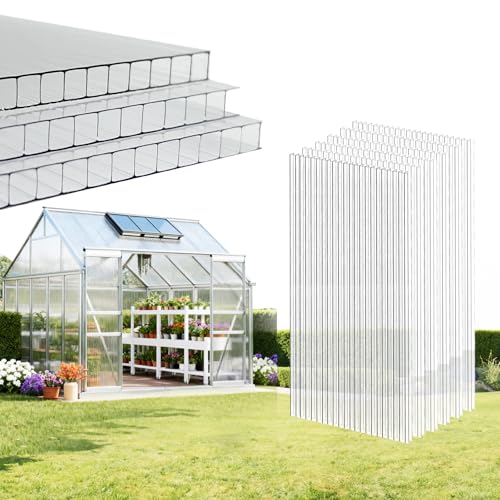


The wider material question, including glass and film, is in polycarbonate versus glass and poly film versus polycarbonate.