The cheapest covered ground on this site, and the shortest-lived roof.
 Most Covered Ground Per Dollar
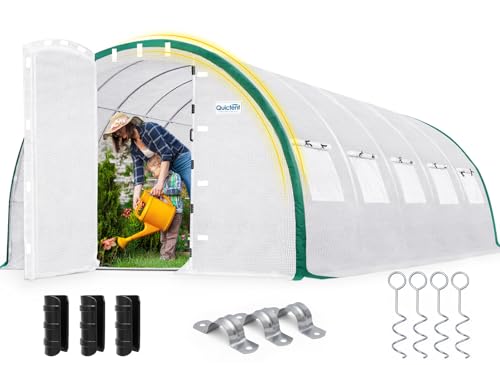
 Quictent 25 x 10 x 6.6 ft Premium Tunnel Greenhouse with 2 Door Frames
~$285
A 250 sq ft walk-in tunnel with patented dual swing-door frames, a reinforced anti-sagging top, a 150 GSM tear-resistant PE cover and eight mesh screen windows.
Check price on AmazonSpecifications
| Footprint | 25 x 10 x 6.6 ft, roughly 250 sq ft of covered ground |
|---|---|
| Cover | 150 GSM reinforced PE mesh with UV inhibitor, Oxford seam reinforcement |
| Light transmission | 85 percent |
| Doors | Dual swing-door frames, each opening 180 degrees |
| Ventilation | 8 mesh screen windows |
| Top structure | Reinforced with 4 to 5 extra crossbars to shed water and snow |
| Support | Lifetime parts replacement for connectors and stakes, 365-day components cover |
Specifications above come from Quictent's published feature list for this model. Treat pricing as approximate, since Amazon pricing moves.
What it does well
- 250 sq ft at roughly $1.14 per square foot is the cheapest covered growing ground in this catalogue by a wide margin, and it is not close.
- Swing door frames instead of zips is the single most important improvement a tunnel maker can make. Zips are the commonest failure point on film tunnels, and once a zip goes the door is gone.
- Eight mesh windows matter more than they sound. A tunnel with venting only at the ends is a bad shape for airflow and will run far hotter than one with side windows.
- 85 percent light transmission through the cover is high, and film tunnels genuinely beat twin-wall polycarbonate on light while losing badly on insulation.
- Lifetime replacement on connectors and stakes is a real commitment on a product whose small parts are usually irreplaceable.
Where it falls short
- The cover is a consumable. A PE film cover under UV degrades and will need replacing on a cycle measured in a few seasons, not decades, and that recurring cost is the true price of a tunnel.
- It insulates barely at all. A single layer of film gains useful heat in daylight and is within a few degrees of outside air before dawn, so this is season extension rather than winter production.
- 250 sq ft under film cooks fast. Eight windows help and they are not a substitute for real ventilation on a hot day, so plan on both doors open and consider a fan.
- Everything about a tunnel depends on the anchoring. A 250 sq ft sail on a lightweight frame is the classic total loss in a gale, and stakes into soft ground are not enough on an exposed site.
- You cannot hang much from it and you cannot lock it. A film tunnel does not take shelving, hooks or a security fixing the way a rigid kit does.
What owners report
Owner reports on walk-in tunnels are dominated by two subjects: wind and the cover. Tunnels that survive were anchored properly, and tunnels that failed were staked into soft soil or left with a door open in a gale so the structure inflated. Neither is subtle, and both are avoidable. Read the anchoring guide before assembly and over-specify the ground fixings for your soil, because the frame is only as good as what it is tied to.
On the cover, expectations rather than quality are usually the problem. A 150 GSM UV-inhibited PE cover is a good cover, and it is still film. Growers who budget for replacement on a cycle are satisfied with tunnels; growers who expected a permanent building are not. Our poly film versus polycarbonate comparison sets out the lifespan and cost arithmetic, and our hoop house versus greenhouse comparison covers which crops actually need hard glazing.
Third, heat. The recurring practical complaint is temperature in summer, and the eight mesh windows are the reason this model draws fewer of those complaints than tunnels with end venting only. It is still 250 sq ft under film. Size the requirement on the ventilation CFM calculator, and if you are growing through a hot summer, our shade cloth review covers the cheaper half of the answer, because shading a tunnel before the heat arrives beats trying to extract it afterwards.
Who it suits
- Growers who want a lot of ground under cover for season extension rather than a permanent building.
- Anyone raising field transplants, overwintering hardy crops or running an early and late salad succession at scale.
- Gardeners on a sheltered site who will anchor it properly and budget for a replacement cover.
Who should skip it
- Anyone on an exposed windy site without a way to anchor into something solid.
- Growers who want a lockable structure to keep tools and a heater in.
- Anyone wanting winter production, because a single film layer does not insulate enough for that.
Alternatives worth considering
 Smaller Tunnel
 Outsunny 11.5 x 10 ft Walk-In Tunnel Greenhouse with 7 Mesh Windows
~$117
Roughly 115 sq ft for well under half the money, with seven mesh windows and roll-up sidewalls. Take it if 250 sq ft is more tunnel than the plot or the crop plan justifies.
Check price on Amazon Hard-Glazed Alternative
 Broivira 8 x 12 ft Heavy-Duty Polycarbonate Greenhouse
~$600
96 sq ft rather than 250, for twice the money, and panels that do not need replacing on a cycle plus a door that locks. The right choice when permanence matters more than area.
Check price on Amazon Budget Hard Kit
 Glanzend 6 x 8 ft Polycarbonate Walk-In Greenhouse
~$144
Half the covered area of the tunnel at half the price, in 8 mm rigid panels with sliding doors. The cheapest route to hard glazing if you would rather have 48 permanent square feet than 250 temporary ones.
Check price on AmazonKeep reading
- Hoop house vs greenhouse
- Poly film vs polycarbonate
- Greenhouse size calculator
- Ventilation CFM calculator
- Broivira 8 x 12 greenhouse review
- 90 percent shade cloth review
- Best hoop house kits
This review draws on published specifications, manufacturer figures and the consensus of verified owner reviews. We have not tested this product ourselves, and we say so rather than implying otherwise. As an Amazon Associate we earn from qualifying purchases.