Glass is what a greenhouse looks like in the imagination, and there are real reasons it has been the default for a century and a half. It passes more light than anything else, it does not degrade, and it stays clear for decades. Twin-wall polycarbonate is a modern replacement that trades some of that light for insulation and toughness.
The decision is less about which is better and more about which failure you would rather have. Glass fails suddenly and dangerously. Polycarbonate fails slowly and safely, by yellowing and losing transmission over ten to fifteen years.
The numbers
| Measure | Single horticultural glass | Twin-wall polycarbonate, 4 mm | Twin-wall, 8 mm |
|---|---|---|---|
| R-value | 0.95 | 1.54 | 1.89 |
| U-factor | 1.05 | 0.65 | 0.53 |
| PAR transmission | About 90 percent | About 80 percent | About 76 percent |
| Light quality | Direct, sharp shadows | Diffused | Diffused |
| Service life | 25 years and up | 10 years | 10 to 15 years |
| Weight | Heavy, needs a frame built for it | Very light | Light |
| Hail and impact | Breaks | Survives almost anything domestic | Survives almost anything domestic |
| Failure mode | Shatters, and it is above your head | Yellows and loses transmission gradually | Yellows gradually |
| Cutting on site | Specialist, and risky | A utility knife | A utility knife |
Read the first two rows against the heat loss equation and the practical difference emerges. Heat loss is area times U-factor times temperature difference, so swapping single glass at U-1.05 for 4 mm twin-wall at U-0.65 cuts conduction loss by about 38 percent on the same house. Run it on your own dimensions with the glazing heat loss calculator.
Diffused light is a genuine advantage, not a consolation
Polycarbonate scatters light rather than passing it straight through, and this is usually presented as the price paid for insulation. It is at least partly a benefit.
Direct light lights the top of a canopy and leaves the lower leaves in shadow. Diffused light arrives from many directions and penetrates further into the canopy, so more of the leaf area is doing useful work. Commercial glasshouses now often specify diffusing glass deliberately for exactly this reason.
The practical effect is that the 10 percentage point transmission gap between glass and twin-wall understates polycarbonate slightly for a dense crop and overstates it for a single layer of seed trays. It also means polycarbonate produces less scorch on tender foliage in strong sun.
What each one demands of the frame
Glass is heavy, and a frame designed for polycarbonate will not carry it. Glass houses need a substantially heavier frame section, a properly levelled and rigid base, and glazing bars with the right profile and clips. This is why converting a polycarbonate house to glass is not a realistic project, while the reverse is straightforward.
Glass also demands a square, unmoving structure. A glass pane cannot flex, so any racking of the frame from settlement or wind cracks panes. That means a solid level base is not optional, whereas a polycarbonate house tolerates a certain amount of movement.
Polycarbonate, in exchange, demands room to move. It expands and contracts noticeably with temperature, roughly an eighth of an inch over a 6 foot length across a seasonal swing, so fixing holes must be oversized and the panel must be clamped rather than pinched. The full fitting detail is in the glazing guide.
Which climate favours which
Cold climates favour polycarbonate. The insulation difference is worth real money every night the heater runs, and it frequently makes the difference between a house that fits inside one 15 amp circuit and one that does not, which is a much bigger saving than the glazing itself.
Marginal-light climates favour glass, particularly at high latitude where winter light is already the binding constraint. Ten percentage points of transmission matters far more in a six hour winter day than in a sixteen hour summer one.
Hail-prone and storm-prone areas favour polycarbonate without much argument. So do gardens with trees overhead, football, or children.
Permanence favours glass. A well-built glass house is a 40 year structure. A polycarbonate house is a 10 to 15 year structure that will need re-glazing at least once in the same period. If the greenhouse is going in as a permanent garden feature, that changes the arithmetic considerably.
The middle options
Two hybrids are worth knowing about, because they address the specific weakness of each material.
Clear roof over twin-wall walls. A house such as the Palram Canopia Hybrid 6 x 10 Greenhouse ($713.99) uses clear single-wall panels on the roof where light transmission matters most and twin-wall on the sides where insulation matters most and light arrives at a glancing angle anyway. It is a sensible compromise rather than a marketing one.
Double-wall acrylic holds about R-2.0 at roughly 83 percent transmission, which is better on both counts than twin-wall polycarbonate. It is also considerably more expensive and more brittle, and it is uncommon at hobby scale, but where it is available it is genuinely the best of both.
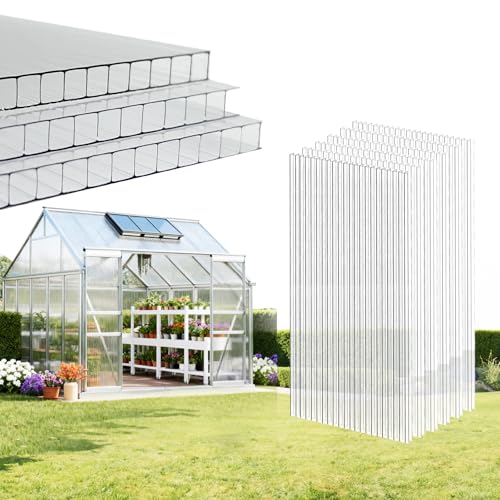
And for anyone re-glazing an existing glass house rather than buying new, EVERECO Twin-Wall Polycarbonate Panels, 4 x 2 ft, 6-Pack cut to size with a utility knife will fit most glazing bar profiles, which turns a broken-pane problem into an afternoon rather than a glazier visit.
Glazing and structures


Whichever you choose, the glazing is only one term in the heat loss equation and usually not the largest one you can change cheaply. Sealing and north-wall insulation, covered in insulating a greenhouse, frequently beat a glazing upgrade for a fraction of the cost.